
A 2-inch Schedule 40 pipe is one of the most commonly used pipe sizes in plumbing, construction, industrial processing, irrigation systems, and mechanical engineering projects. Its balance of strength, flow capacity, and affordability makes it suitable for a wide range of applications.
Whether you are working with steel, stainless steel, PVC, or other piping materials, understanding the dimensions of a 2-inch Schedule 40 pipe is essential for proper system design and installation.
This guide covers the dimensions, size chart, wall thickness, weight, pressure considerations, applications, and selection tips for 2-inch Schedule 40 pipes.
What Is a 2-Inch Schedule 40 Pipe?
A 2-inch Schedule 40 pipe refers to a pipe with a nominal pipe size (NPS) of 2 inches and a Schedule 40 wall thickness.
Many beginners assume that a 2-inch pipe has an actual outside diameter of exactly 2 inches. However, pipe sizing follows standardized dimensions.
For a 2-inch Schedule 40 pipe:
- Nominal Pipe Size (NPS): 2 inches
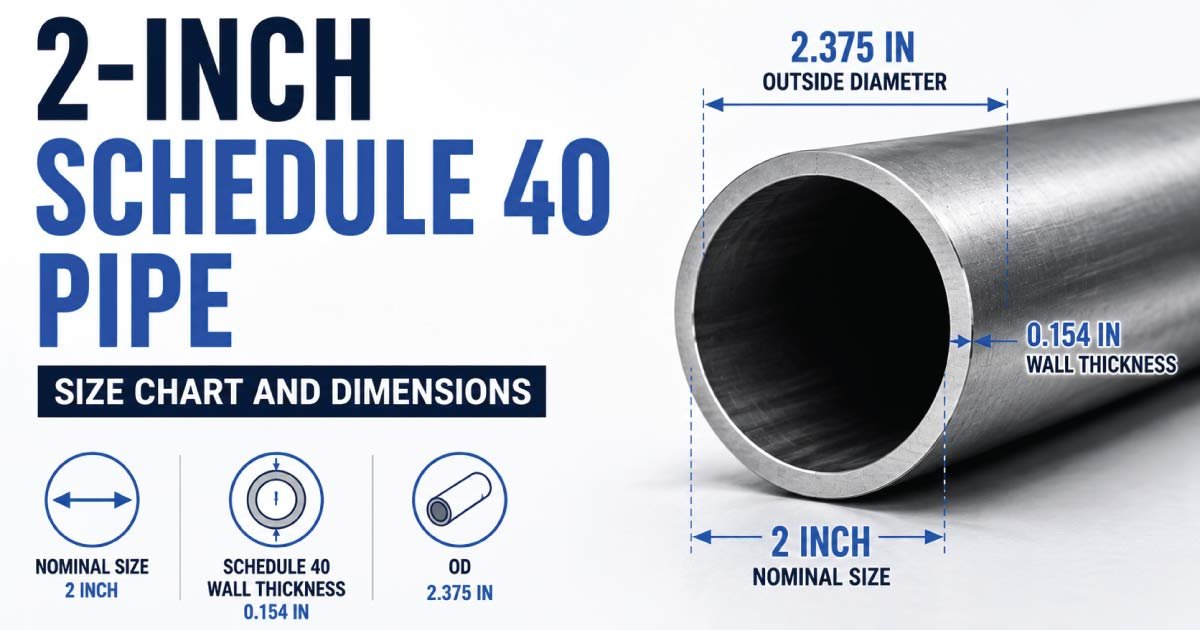
- Actual Outside Diameter (OD): 2.375 inches (60.3 mm)
- Schedule: 40
The schedule number indicates wall thickness rather than pipe diameter.
Understanding Pipe Dimensions
Several dimensions are used to classify pipes.
Nominal Pipe Size (NPS)
NPS is the standardized naming system used for pipe sizes.
A 2-inch NPS pipe does not have an actual outside diameter of 2 inches.
Outside Diameter (OD)
The outside diameter remains constant regardless of schedule.
For all 2-inch pipes:
- OD = 2.375 inches (60.3 mm)
Wall Thickness
Wall thickness changes according to schedule.
A Schedule 40 pipe has a thicker wall than Schedule 10 but a thinner wall than Schedule 80.
Inside Diameter (ID)
Inside diameter varies depending on wall thickness.
Thicker walls reduce the inside diameter.
2-Inch Schedule 40 Pipe Size Chart
The following chart shows the standard dimensions for a 2-inch Schedule 40 pipe.
| Property | Inches | Millimeters |
|---|---|---|
| Nominal Pipe Size (NPS) | 2″ | DN50 |
| Outside Diameter (OD) | 2.375″ | 60.3 mm |
| Wall Thickness | 0.154″ | 3.91 mm |
| Inside Diameter (ID) | 2.067″ | 52.5 mm |
| Pipe Radius (OD) | 1.1875″ | 30.15 mm |
These dimensions apply to carbon steel, stainless steel, and PVC Schedule 40 pipes manufactured according to industry standards.
2-Inch Schedule 40 Pipe Cross-Section Dimensions
The inside diameter can be calculated using:
ID = OD − (2 × Wall Thickness)
For a 2-inch Schedule 40 pipe:
ID = 2.375 − (2 × 0.154)
ID = 2.067 inches
This measurement is important because it determines the pipe’s flow capacity.
2-Inch Schedule 40 Pipe Weight Chart
Pipe weight varies depending on material.
For carbon steel:
| Length | Approximate Weight |
|---|---|
| 1 Foot | 3.65 lbs |
| 10 Feet | 36.5 lbs |
| 20 Feet | 73 lbs |
| 40 Feet | 146 lbs |
Stainless steel and PVC pipes may have different weights due to material density.
2-Inch Schedule 40 Pipe Dimensions in Metric Units
Many countries use metric measurements.
| Property | Metric Dimension |
|---|---|
| Outside Diameter | 60.3 mm |
| Wall Thickness | 3.91 mm |
| Inside Diameter | 52.5 mm |
| Nominal Size | DN50 |
These dimensions are commonly used in international projects.
Schedule 40 vs Schedule 80 for 2-Inch Pipe
Many buyers compare Schedule 40 and Schedule 80 pipes.
| Property | Schedule 40 | Schedule 80 |
|---|---|---|
| Outside Diameter | 2.375″ | 2.375″ |
| Wall Thickness | 0.154″ | 0.218″ |
| Inside Diameter | 2.067″ | 1.939″ |
| Weight | Lower | Higher |
| Pressure Capacity | Lower | Higher |
Both schedules share the same outside diameter, but Schedule 80 has thicker walls and greater pressure resistance.
Materials Available in 2-Inch Schedule 40 Pipe
Schedule 40 dimensions remain consistent across different materials.
Carbon Steel Pipe
Used for:
- Industrial systems
- Structural applications
- Oil and gas pipelines
Benefits:
- High strength
- Cost-effective
- Durable
Stainless Steel Pipe
Used for:
- Food processing
- Pharmaceutical facilities
- Chemical plants
Benefits:
- Corrosion resistance
- Long service life
- Hygienic properties
PVC Pipe
Used for:
- Water supply systems
- Irrigation
- Drainage
Benefits:
- Lightweight
- Corrosion resistant
- Easy installation
Galvanized Steel Pipe
Used for:
- Outdoor plumbing
- Water distribution
- Construction projects
Benefits:
- Improved corrosion protection
- Strong structure
Common Applications of 2-Inch Schedule 40 Pipe
The 2-inch Schedule 40 pipe is widely used because it offers a strong balance between flow capacity and structural durability. Its medium size makes it suitable for both fluid transport and light structural purposes. This versatility allows it to be used in residential, commercial, agricultural, and industrial systems with reliable performance.
1. Water Distribution Systems
This pipe size is commonly used in water supply networks for homes, buildings, and municipal systems. It efficiently carries clean water under standard pressure conditions. Its strength and durability help maintain steady water flow, making it a dependable choice for both underground and above-ground water distribution installations.
2. Industrial Process Piping
In industrial environments, 2-inch Schedule 40 pipes are used to transport liquids, gases, and mild chemicals. Their thickness and pressure rating make them suitable for handling continuous flow in manufacturing and processing plants. They are valued for their reliability and ability to perform under demanding operational conditions.
3. Irrigation Systems
Agricultural irrigation systems frequently use this pipe size to distribute water across fields and farms. It supports efficient water flow over medium distances and can withstand outdoor environmental conditions. Its durability and ease of installation make it a practical solution for modern irrigation setups.
4. Fire Protection Systems
This pipe is also used in fire sprinkler and firefighting systems where reliable water delivery is critical. It helps maintain consistent pressure and flow during emergency situations. Its strength and pressure-handling ability ensure safety and performance in fire protection infrastructure.
5. HVAC Systems
In heating, ventilation, and air conditioning systems, 2-inch Schedule 40 pipes are used to transport chilled or heated water. They help maintain temperature control in large buildings and industrial facilities. Their corrosion resistance and durability make them suitable for long-term HVAC applications.
6. Structural Applications
Beyond fluid transport, these pipes are also used in structural frameworks such as railings, support columns, and light construction projects. Their strength allows them to handle moderate loads while maintaining stability. This makes them a versatile material in both engineering and architectural designs.
Pressure Ratings of 2-Inch Schedule 40 Pipe
Pressure ratings depend on:
- Pipe material
- Operating temperature
- Manufacturing standards
Generally, steel Schedule 40 pipes can withstand significantly higher pressures than PVC Schedule 40 pipes.
Always consult manufacturer specifications before selecting a pipe for high-pressure applications.
Industry Standards for Schedule 40 Pipes
Schedule 40 pipes are manufactured according to internationally recognized standards to ensure uniformity, safety, and compatibility across different systems. These standards define dimensions, material properties, and performance requirements, making it easier to use pipes with fittings, valves, and other components from different manufacturers without mismatch issues.
1. ASME B36.10M
ASME B36.10M covers the dimensions and specifications of welded and seamless carbon steel pipes. It defines standard outside diameters, wall thicknesses, and nominal pipe sizes. This standard is widely used in industrial piping systems and ensures consistent sizing for carbon steel pipes used in construction, oil, gas, and water applications.
2. ASME B36.19M
ASME B36.19M applies specifically to stainless steel pipes. It provides standardized dimensions for corrosion-resistant piping used in industries such as food processing, pharmaceuticals, and chemical plants. This standard ensures that stainless steel Schedule 40 pipes maintain uniform sizing and can be easily integrated into different piping systems.
3. ASTM Standards
ASTM standards govern the material quality, chemical composition, and mechanical properties of pipes. Different ASTM specifications apply depending on the pipe type and application, ensuring strength, durability, and safety. These standards help maintain consistent manufacturing quality and ensure pipes perform reliably under different pressure and environmental conditions.
These industry standards work together to ensure that Schedule 40 pipes are safe, interchangeable, and compatible across various industrial and structural applications.
How to Measure a 2-Inch Schedule 40 Pipe
Follow these steps:
Step 1: Measure Outside Diameter
Use calipers or a measuring tape.
A true 2-inch Schedule 40 pipe should measure:
- 2.375 inches OD
Step 2: Measure Wall Thickness
Use a pipe thickness gauge or caliper.
Expected thickness:
- 0.154 inches
Step 3: Verify Schedule
Compare measurements with standard dimension charts.
This helps confirm the pipe specification.
Advantages of Using 2-Inch Schedule 40 Pipe
The 2-inch Schedule 40 pipe is one of the most commonly used pipe sizes across residential, commercial, and industrial systems. It is popular because it balances strength, flow efficiency, and cost. Its standard sizing and wide availability make it a practical choice for many plumbing, irrigation, and structural applications.
1. Widely Available
This pipe size is one of the most commonly produced and stocked in the market. Because of its popularity, it is easily available in different materials such as PVC, steel, and stainless steel. This wide availability makes it convenient for contractors and reduces project delays due to material shortages.
2. Cost Effective
The 2-inch Schedule 40 pipe offers strong performance at a reasonable price. It provides a good balance between material cost and durability, making it suitable for both small and large-scale projects. Its affordability makes it a preferred option in plumbing, irrigation, and general construction work.
3. Good Flow Capacity
This pipe size allows efficient movement of liquids and gases without excessive pressure loss. It is suitable for medium to high flow requirements in water distribution, irrigation systems, and industrial processes. Its internal diameter is well-optimized to maintain steady and reliable flow performance.
4. Strong and Durable
2-inch Schedule 40 pipes are designed to withstand pressure, impact, and environmental stress. Their wall thickness provides reliable strength for long-term use in demanding conditions. Whether used in underground systems or exposed installations, they deliver consistent durability and dependable performance over time.
5. Compatible With Standard Fittings
One of the major advantages is its compatibility with a wide range of standard fittings such as valves, elbows, couplings, and flanges. This makes installation easier and more flexible, allowing it to be integrated into different piping systems without the need for special or custom components.
Common Mistakes When Selecting Pipe Sizes
Avoid these common errors:
- Confusing nominal size with actual diameter.
- Ignoring wall thickness requirements.
- Selecting pipe based only on outside diameter.
- Using the wrong schedule for pressure conditions.
- Overlooking temperature effects on pressure ratings.
Proper sizing helps prevent costly installation and performance issues.
Conclusion
A 2-inch Schedule 40 pipe is a versatile and widely used piping option for residential, commercial, agricultural, and industrial applications. With an outside diameter of 2.375 inches, a wall thickness of 0.154 inches, and an inside diameter of approximately 2.067 inches, it provides an excellent balance between strength and flow capacity.
By understanding the dimensions, wall thickness, weight, pressure capabilities, and industry standards associated with 2-inch Schedule 40 pipes, engineers, contractors, fabricators, and homeowners can confidently select the right pipe for their projects.
Also Read: 👉 Choosing the right PEX pipe size is crucial for efficient water flow and reliable plumbing performance. This PEX Pipe Size Chart guide covers standard PEX pipe dimensions, sizing recommendations, and common residential applications. Learn how different PEX sizes affect water pressure and system efficiency. Read the full post to explore detailed size charts, specifications, and expert tips for selecting the correct PEX pipe.