
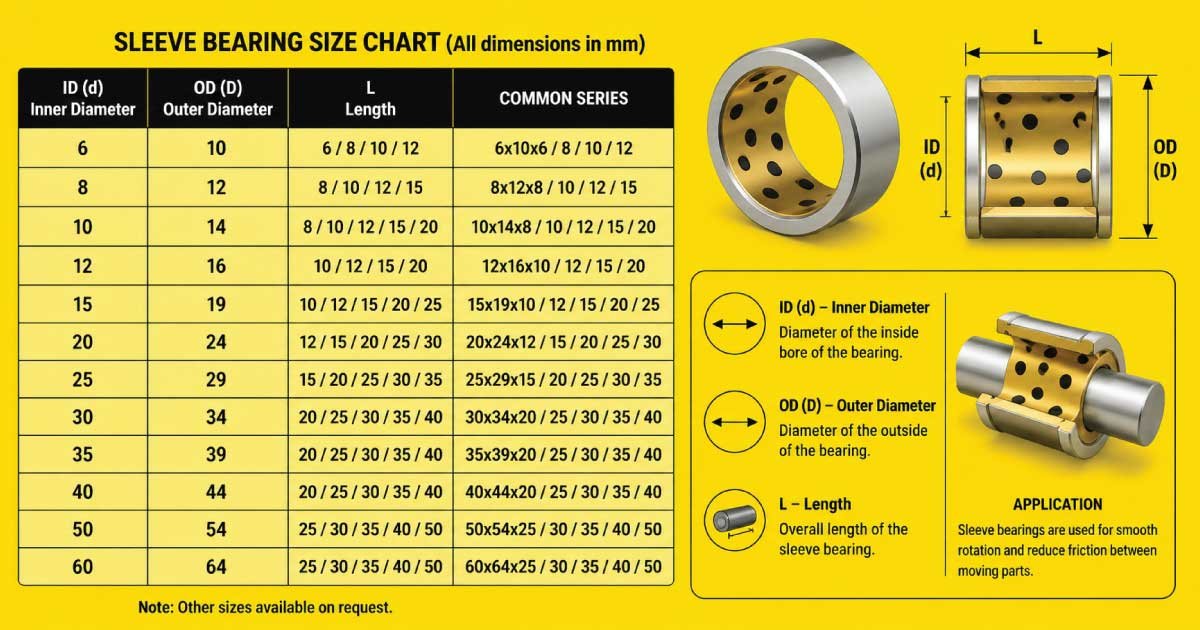
Sleeve bearings are among the most widely used bearing types in mechanical systems. From electric motors and pumps to conveyors, industrial machinery, and automotive components, sleeve bearings provide smooth rotational motion while reducing friction between moving parts.
Selecting the correct sleeve bearing size is critical for ensuring proper equipment performance, reducing wear, and extending machinery lifespan. A bearing that is too small may fail prematurely, while an oversized bearing can cause alignment issues and excessive vibration.
This complete sleeve bearing size chart guide explains standard sizes, dimensions, applications, materials, selection methods, and maintenance tips to help you choose the right sleeve bearing for your project.
What Is a Sleeve Bearing?
A sleeve bearing, also known as a plain bearing or bushing, is a cylindrical component designed to support a rotating shaft. Unlike ball bearings or roller bearings, sleeve bearings do not contain rolling elements.
Instead, the shaft rotates directly against the bearing surface, which is often made from low-friction materials such as:
- Bronze
- Oil-impregnated bronze
- Brass
- PTFE composites
- Polymer materials
- Cast iron
- Steel-backed bushings
Because of their simple design, sleeve bearings are often more economical and easier to maintain than rolling-element bearings.
How Sleeve Bearings Work
Sleeve bearings operate by creating a smooth, low-friction surface between a rotating shaft and its housing. Their simple design allows them to support loads efficiently while reducing wear and vibration. Understanding how they function helps technicians select the right bearing for industrial, automotive, and mechanical applications.
1. Bearing Supports the Load
One of the primary functions of a sleeve bearing is to support the load generated by a rotating shaft. The bearing distributes forces evenly across its surface, helping maintain shaft alignment, reduce stress concentrations, and ensure stable operation under varying load conditions.
2. Friction Is Minimized
Sleeve bearings are designed to reduce friction between moving components. By providing a smooth contact surface and utilizing lubrication when necessary, they allow shafts to rotate more freely, improving efficiency, reducing energy consumption, and minimizing heat generation during operation.
3. Wear Is Reduced
A properly functioning sleeve bearing reduces direct metal-to-metal contact between the shaft and surrounding components. This protective action minimizes wear on critical parts, lowers maintenance requirements, and helps extend the operational lifespan of both the bearing and the equipment.
4. Smooth Rotation Is Maintained
Smooth shaft rotation is essential for efficient machine performance. Sleeve bearings help maintain consistent movement by providing stable support and reducing resistance, allowing equipment to operate quietly, reliably, and with minimal interruptions even during continuous use.
5. Vibration Is Controlled
Sleeve bearings naturally absorb and dampen vibration generated by rotating equipment. This characteristic improves machine stability, reduces noise levels, protects surrounding components from excessive stress, and contributes to smoother overall operation in industrial and mechanical systems.
In lubricated systems, a thin film of oil separates the shaft from the bearing surface, significantly extending service life and improving overall performance.
Why Bearing Size Matters
Bearing size plays a critical role in the performance, reliability, and lifespan of mechanical systems. Selecting the correct bearing size ensures proper load support, smooth rotation, and efficient power transmission. An incorrectly sized bearing can lead to excessive wear, overheating, vibration, and premature equipment failure. Understanding the importance of bearing sizing helps improve machine performance while reducing maintenance costs and downtime.
1. Improves Equipment Life
Correctly sized bearings distribute loads evenly across the rolling elements and raceways, minimizing stress concentrations that can cause premature wear. Proper load distribution also protects shafts, housings, and related components from excessive strain. As a result, machinery operates longer with fewer repairs, extending the overall service life of both the bearing and the equipment.
2. Reduces Friction
A properly fitted bearing maintains the correct internal clearance needed for smooth and efficient rotation. When bearing dimensions match the application requirements, rolling elements move freely with minimal resistance. Reduced friction lowers energy losses, improves operating performance, and helps machinery run more smoothly while minimizing wear on critical moving components.
3. Prevents Overheating
Improper bearing sizing can create excessive friction, misalignment, or inadequate load support, all of which generate unwanted heat. Elevated operating temperatures can degrade lubricants, damage bearing surfaces, and shorten component life. Choosing the correct bearing size helps maintain normal operating temperatures, protects internal parts, and ensures consistent performance under varying load conditions.
4. Increases Reliability
Proper bearing dimensions contribute significantly to equipment reliability by ensuring stable operation under expected loads and speeds. Bearings that fit correctly are less likely to experience premature failure, excessive vibration, or alignment issues. Improved reliability reduces unexpected breakdowns, lowers maintenance requirements, and helps keep production systems running without costly interruptions.
5. Enhances Efficiency
Well-sized bearings allow machinery to operate with less resistance and better load management, resulting in improved efficiency. Reduced friction and smoother motion mean less energy is required to drive rotating components. This not only lowers operating costs but also contributes to better overall equipment performance, especially in applications where continuous operation and energy savings are important.
Standard Sleeve Bearing Size Chart (Inch Sizes)
The following chart lists common sleeve bearing dimensions used in industrial and mechanical applications.
| Shaft ID | Outside Diameter (OD) | Length |
|---|---|---|
| 1/4″ | 3/8″ | 1/2″ |
| 5/16″ | 1/2″ | 1/2″ |
| 3/8″ | 1/2″ | 3/4″ |
| 1/2″ | 5/8″ | 3/4″ |
| 5/8″ | 3/4″ | 1″ |
| 3/4″ | 7/8″ | 1″ |
| 7/8″ | 1″ | 1-1/4″ |
| 1″ | 1-1/4″ | 1-1/2″ |
| 1-1/4″ | 1-1/2″ | 2″ |
| 1-1/2″ | 1-3/4″ | 2″ |
These dimensions are common in agricultural equipment, conveyors, and industrial machinery.
Metric Sleeve Bearing Size Chart
Many modern machines use metric-sized bearings.
| Bearing ID | Outside Diameter | Length |
|---|---|---|
| 10 mm | 12 mm | 10 mm |
| 12 mm | 14 mm | 12 mm |
| 15 mm | 17 mm | 15 mm |
| 20 mm | 23 mm | 20 mm |
| 25 mm | 28 mm | 25 mm |
| 30 mm | 34 mm | 30 mm |
| 35 mm | 40 mm | 35 mm |
| 40 mm | 45 mm | 40 mm |
| 50 mm | 55 mm | 50 mm |
| 60 mm | 65 mm | 60 mm |
Metric bearings are commonly found in imported machinery and manufacturing equipment.
Understanding Sleeve Bearing Dimensions
Selecting the correct sleeve bearing requires a clear understanding of its key dimensions. These measurements ensure proper fit, smooth operation, and long service life. Incorrect sizing can lead to excessive wear, misalignment, or premature failure, so technicians must carefully match bearing dimensions with shaft and housing requirements.
1. Inside Diameter (ID)
The inside diameter (ID) of a sleeve bearing refers to the inner opening that fits directly onto the rotating shaft. It must match the shaft size precisely to ensure smooth rotation and proper alignment during operation.
For example:
- A 1-inch shaft requires a 1-inch ID bearing.
- A 25 mm shaft requires a 25 mm ID bearing.
The shaft should fit smoothly without excessive clearance to avoid vibration, slippage, or uneven wear.
2. Outside Diameter (OD)
The outside diameter (OD) is the external measurement of the bearing that fits into the housing or mounting bore. A correct OD ensures the bearing remains securely positioned during operation.
A precise fit helps maintain alignment and prevents movement during operation, reducing the risk of mechanical failure or uneven load distribution.
3. Bearing Length
Bearing length determines the total surface area available to support the rotating shaft. It plays an important role in load distribution and operational stability.
Longer bearings generally provide:
- Better load distribution
- Increased stability
- Longer service life
However, they also require more installation space, which must be considered during design and equipment assembly.
Common Sleeve Bearing Materials
Material selection plays a crucial role in determining the performance, durability, and efficiency of sleeve bearings. Different materials offer varying levels of strength, friction resistance, and maintenance requirements. Choosing the right material depends on load conditions, operating environment, and application type.
1. Bronze Sleeve Bearings
Bronze is one of the most widely used materials for sleeve bearings due to its excellent mechanical strength and durability. It performs well under heavy loads and continuous operation, making it suitable for industrial machinery.
Benefits include:
- Excellent wear resistance
- High load capacity
- Long service life
- Good corrosion resistance
Common applications:
- Pumps
- Electric motors
- Industrial machinery
2. Oil-Impregnated Bronze Bearings
Oil-impregnated bronze bearings are self-lubricating and designed to release oil during operation, reducing friction without the need for frequent maintenance. This makes them ideal for applications requiring long-term reliability.
Advantages include:
- Reduced maintenance
- Continuous lubrication
- Long operating life
Widely used in:
- Small motors
- Fans
- Appliances
3. Brass Bearings
Brass bearings offer a good balance between strength and machinability. While not as strong as bronze, they provide adequate performance for moderate-load applications and resist corrosion effectively.
Suitable for lighter-duty applications with:
- Good machinability
- Corrosion resistance
- Moderate load capacity
4. Polymer Bearings
Polymer bearings are modern, lightweight alternatives that operate without traditional lubrication. They are ideal for clean or sensitive environments where contamination must be avoided.
Often used in:
- Food-processing equipment
- Medical equipment
- Light machinery applications
Benefits include:
- Lightweight construction
- Corrosion resistance
- Quiet operation
- No lubrication requirements
Types of Sleeve Bearings
Sleeve bearings are available in several designs, each suited for specific mechanical and industrial applications. The choice of bearing type depends on load direction, installation requirements, maintenance needs, and operating conditions. Understanding these types helps ensure better performance, reliability, and longer equipment life.
1. Straight Sleeve Bearings
Straight sleeve bearings are the most commonly used type due to their simple and efficient design. They provide smooth rotation and are widely used in general machinery where standard radial loads are present.
Features:
- Simple cylindrical design
- Easy installation
- Cost-effective
Used in a wide variety of industrial machines where basic support and low friction are required.
2. Flanged Sleeve Bearings
Flanged sleeve bearings include an integrated flange at one end, which helps control axial movement and improves alignment within the housing. This makes them suitable for applications requiring additional stability.
Benefits:
- Improved positioning
- Better axial load support
- Easier installation
Common in electric motors and pumps where shaft alignment is critical.
3. Split Sleeve Bearings
Split sleeve bearings are designed in two separate halves, allowing easier installation and replacement without fully disassembling machinery. They are ideal for heavy-duty equipment where downtime must be minimized.
Advantages:
- Easy replacement
- Reduced downtime
- Simplified maintenance
Frequently used in large industrial machinery and high-load systems.
4. Self-Lubricating Bearings
Self-lubricating sleeve bearings are designed with built-in lubrication materials that reduce the need for external oiling or maintenance. They provide consistent performance in hard-to-reach or continuous-operation environments.
Benefits include:
- Reduced maintenance
- Longer operating life
- Cleaner operation
Popular in applications where regular maintenance is difficult or not practical.
Read Our Complete Guide:
Common Applications of Sleeve Bearings
Sleeve bearings are widely used in many mechanical and industrial systems due to their simple design, reliability, and cost-effectiveness. They perform well in both light and heavy-duty environments, making them suitable for continuous operation where smooth rotation, low noise, and minimal maintenance are required.
1. Electric Motors
Electric motors commonly use sleeve bearings because they provide quiet and stable operation. Their simple structure helps reduce vibration and improves overall motor efficiency, especially in small to medium-sized motors.
Benefits include:
- Low noise
- Reduced maintenance
- Cost efficiency
2. Pumps
Sleeve bearings are widely used in pumps to support rotating shafts while minimizing friction and vibration. They help maintain smooth fluid movement and improve the overall reliability of pumping systems.
3. Conveyor Systems
In conveyor systems, sleeve bearings support rollers and rotating shafts, ensuring continuous and stable material movement. Their durability makes them suitable for long-running industrial operations.
4. Agricultural Equipment
Agricultural machinery relies on sleeve bearings due to their strength, simplicity, and ability to handle dirty and demanding environments. They perform well under heavy loads and continuous use in field conditions.
Examples include:
- Tractors
- Balers
- Harvesters
- Irrigation equipment
5. Industrial Machinery
Sleeve bearings are widely used in manufacturing and industrial equipment where consistent performance and load handling are required. They help ensure smooth operation in production environments.
Industrial applications include:
- Gearboxes
- Drive systems
- Material handling equipment
- Production machinery
Sleeve Bearing vs Ball Bearing
Engineers often compare sleeve bearings and ball bearings when selecting components for mechanical systems. Both bearing types serve the same basic purpose of reducing friction between moving parts, but they differ significantly in design, performance, cost, and application suitability. Choosing the right type depends on load conditions, speed requirements, and operating environment.
1. Sleeve Bearings
Sleeve bearings operate through sliding contact between the shaft and bearing surface. Their simple structure makes them reliable, cost-effective, and suitable for many general-purpose applications where quiet operation and load handling are important.
Advantages:
- Lower cost
- Simple design
- Quiet operation
- High load capacity
Disadvantages:
- Higher friction
- Lubrication requirements
- Limited high-speed capability
2. Ball Bearings
Ball bearings use rolling elements (balls) to reduce friction between moving parts. This design allows smoother rotation at higher speeds and improved efficiency, making them ideal for precision and high-speed applications.
Advantages:
- Lower friction
- Higher speed capability
- Greater efficiency
Disadvantages:
- Higher cost
- More complex design
- Greater sensitivity to contamination
Each bearing type serves different applications, and the choice depends on whether the priority is load capacity, speed, cost, or maintenance requirements.
Signs of Sleeve Bearing Wear
Sleeve bearing wear is a common issue in rotating machinery, and identifying early warning signs is essential to prevent serious equipment damage. When sleeve bearings begin to deteriorate, performance drops gradually and symptoms become noticeable in noise, vibration, temperature, and overall efficiency. Regular inspection and early detection help avoid costly downtime and extend the life of both the bearing and the machine.
1. Excessive Noise
One of the earliest signs of sleeve bearing wear is unusual or increased noise during operation. As the bearing clearance increases due to wear, the shaft may move unevenly inside the bearing surface, creating knocking, squealing, or rattling sounds. These noises indicate that lubrication or alignment is no longer optimal and that the bearing requires immediate inspection.
2. Increased Vibration
Worn sleeve bearings often allow excessive shaft movement, which leads to noticeable vibration in the machine. This instability can affect connected components and reduce overall performance. Increased vibration is a clear warning that the bearing is no longer maintaining proper alignment, and continued operation in this condition may cause further mechanical damage or system imbalance.
3. Overheating
Excessive friction caused by worn or poorly lubricated sleeve bearings can lead to abnormal heat buildup. Overheating damages lubricants, accelerates wear, and can eventually cause bearing seizure. If a machine feels unusually hot near the bearing area, it is a strong indication that internal friction has increased and corrective maintenance is urgently needed.
4. Reduced Performance
As sleeve bearings wear, machines may begin to operate less efficiently. This can show up as slower rotation, reduced power output, or inconsistent operation. Increased internal resistance forces the system to work harder, which lowers efficiency and increases energy consumption. Reduced performance is often a sign that bearing wear is already affecting overall machine function.
5. Visible Damage
Physical inspection can reveal clear signs of sleeve bearing wear. Look for scoring on the bearing surface, cracks, uneven wear patterns, or visible deformation. These issues indicate that the bearing material is breaking down and can no longer support proper operation. Regular inspection helps detect such damage early, preventing sudden failures and costly equipment breakdowns.
Read Our Complete Guide:
Maintenance Tips for Sleeve Bearings
Proper maintenance of sleeve bearings is essential for ensuring smooth operation, reducing friction, and extending equipment life. Since sleeve bearings operate with direct surface contact, they rely heavily on lubrication and correct alignment. Regular care helps prevent overheating, excessive wear, and unexpected breakdowns, making machinery more reliable and efficient over time.
1. Maintain Proper Lubrication
Adequate lubrication is the most important factor in sleeve bearing performance. It reduces direct metal-to-metal contact, minimizes friction, and prevents excessive wear on both the bearing surface and shaft. Always use the recommended lubricant type and ensure proper application intervals. Poor lubrication can quickly lead to overheating, increased resistance, and premature bearing failure.
2. Keep Equipment Clean
Dirt, dust, and debris can severely damage sleeve bearings by contaminating the contact surfaces. Even small particles can increase friction and cause scoring or uneven wear. Keeping the equipment clean and properly sealed helps prevent contaminants from entering the bearing area. Clean operating conditions significantly improve bearing lifespan and ensure smoother, more efficient performance.
3. Monitor Operating Temperatures
Regularly monitoring bearing temperature is important for early fault detection. A sudden rise in temperature often indicates insufficient lubrication, excessive load, or misalignment. Overheating can degrade lubricant quality and accelerate wear, eventually leading to bearing failure. Keeping track of temperature trends helps identify issues early and allows timely maintenance before serious damage occurs.
4. Check Alignment
Proper alignment of the shaft and bearing is critical for even load distribution. Misalignment causes uneven wear, increased friction, and higher operating stress on the bearing surface. Over time, this reduces efficiency and shortens service life. Regular alignment checks ensure smooth rotation, lower vibration levels, and improved overall mechanical stability in the system.
5. Replace Worn Bearings Promptly
When sleeve bearings show signs of wear, timely replacement is essential to prevent further damage. Continuing to operate with worn bearings can lead to shaft scoring, increased vibration, and costly repairs. Early replacement not only protects surrounding components but also restores proper machine performance, ensuring long-term reliability and reducing unexpected downtime.
Read Our Complete Guide:
Advantages of Sleeve Bearings
Sleeve bearings are widely used in industrial and mechanical systems because they offer a simple yet highly effective design. Their ability to perform reliably under various load conditions makes them a preferred choice in many applications where cost, durability, and smooth operation are important factors.
Key advantages include:
- Low cost
- Simple installation
- High load capacity
- Quiet operation
- Compact design
- Long service life
- Easy maintenance
Why These Advantages Matter
These benefits make sleeve bearings highly practical for both light-duty and heavy-duty applications. Their low cost and simple design reduce manufacturing and maintenance expenses, while their ability to handle significant loads ensures reliable performance. Quiet operation and compact size also make them suitable for electric motors, pumps, and precision machinery where space and noise control are important.
Conclusion
A sleeve bearing size chart is an essential reference for engineers, mechanics, maintenance technicians, and equipment operators. Understanding bearing dimensions, materials, load requirements, and application needs helps ensure proper selection and reliable machine performance.
Whether you’re working with electric motors, agricultural equipment, pumps, conveyors, or industrial machinery, choosing the correct sleeve bearing size improves efficiency, reduces wear, and extends equipment life. By using the charts and guidelines in this guide, you can confidently select the right sleeve bearing for virtually any application.
Read Our Complete Guide:
FAQs:
1. What is a sleeve bearing and how does it work?
A sleeve bearing is a simple cylindrical bearing that supports a rotating shaft without using rolling elements. Instead, the shaft slides directly on a smooth inner surface, often lubricated to reduce friction. It works by distributing load evenly, minimizing wear, and allowing smooth rotation. This makes it ideal for motors, pumps, and industrial machinery applications.
2. Why is sleeve bearing size important?
Sleeve bearing size is important because it directly affects alignment, load handling, and performance. If the bearing is too small, it may wear quickly or fail. If too large, it can cause vibration and poor fit. Correct sizing ensures smooth rotation, reduced friction, better stability, and longer service life of both shaft and bearing components.
3. What happens if a sleeve bearing is too loose or too tight?
If a sleeve bearing is too loose, it causes vibration, noise, and misalignment, leading to uneven wear and reduced efficiency. If too tight, it increases friction, overheating, and energy loss, which can damage both shaft and bearing. Proper clearance is essential for smooth operation, efficient load distribution, and long-lasting mechanical performance in any system.
4. What materials are commonly used in sleeve bearings?
Sleeve bearings are made from materials like bronze, oil-impregnated bronze, brass, cast iron, steel-backed bushings, and polymer composites. Bronze is widely used for heavy loads, while polymers are used for low-maintenance applications. Each material offers different benefits such as wear resistance, corrosion protection, lubrication efficiency, and suitability for specific industrial or mechanical environments.
5. Where are sleeve bearings commonly used?
Sleeve bearings are widely used in electric motors, pumps, conveyors, agricultural machines, and industrial equipment. They are also found in automotive components and HVAC systems. Their simple design, quiet operation, and ability to handle continuous loads make them ideal for applications where reliability, low maintenance, and smooth rotational movement are required.
6. How do I choose the correct sleeve bearing size?
To choose the correct sleeve bearing size, first measure the shaft diameter accurately. Then check load requirements, operating speed, and environmental conditions like dust or moisture. Finally, ensure the outer diameter matches the housing. Proper sizing ensures smooth rotation, reduced wear, and long service life while preventing vibration, overheating, and mechanical failure.
7. What are signs of a worn sleeve bearing?
Common signs of worn sleeve bearings include excessive noise, increased vibration, overheating, reduced machine performance, and visible surface damage. These symptoms occur due to friction, poor lubrication, or misalignment. If ignored, they can lead to shaft damage or system failure. Early detection and timely replacement help maintain efficiency and prevent costly breakdowns.