
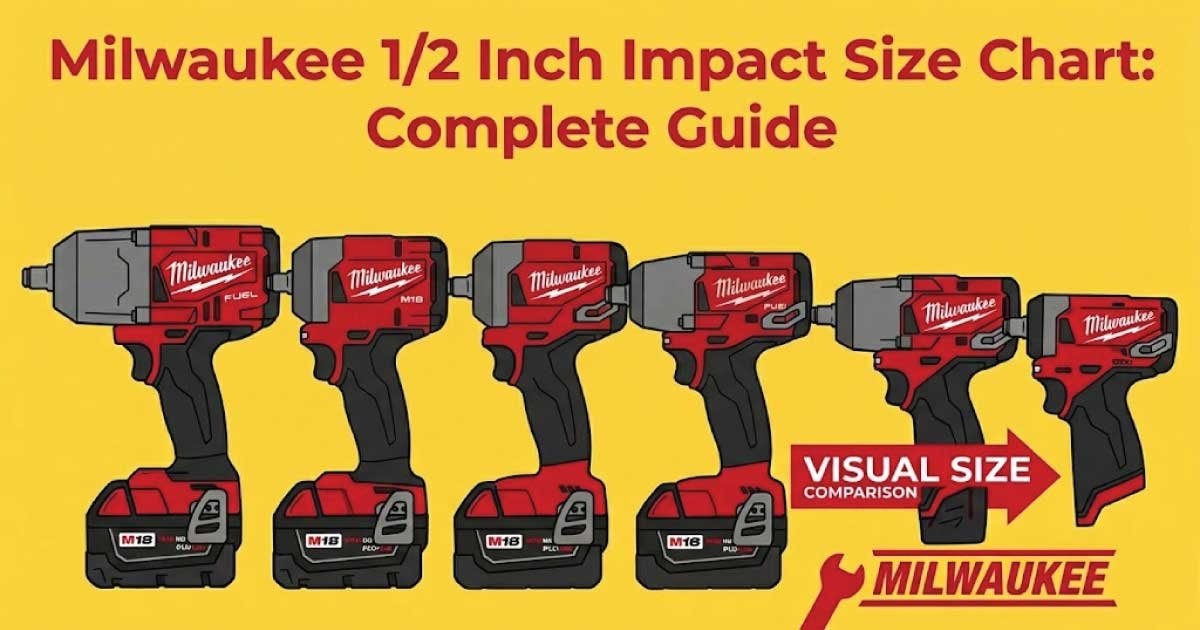
A Milwaukee 1/2-inch impact wrench is one of the most popular power tools used by mechanics, DIY enthusiasts, construction workers, and industrial technicians. Known for their exceptional torque, cordless convenience, and durability, Milwaukee impact wrenches make it easy to loosen stubborn bolts and tighten fasteners quickly.
However, choosing the correct socket size for your Milwaukee 1/2-inch impact wrench is essential for safety, performance, and efficiency. Using the wrong socket can damage fasteners, reduce torque transfer, and even cause injuries.
This complete guide covers Milwaukee 1/2-inch impact socket sizes, common applications, torque specifications, popular models, and expert tips for selecting the right sockets for every job.
What Is a Milwaukee 1/2 Inch Impact Wrench?
A Milwaukee 1/2-inch impact wrench is a power tool equipped with a 1/2-inch square drive that accepts 1/2-inch drive impact sockets. These tools use a hammer-and-anvil mechanism to deliver high torque output while reducing user effort.
Milwaukee’s M18 FUEL impact wrench lineup has become especially popular among professionals because of its cordless performance and powerful brushless motors.
Common uses include:
- Automotive repair
- Tire and wheel service
- Heavy equipment maintenance
- Construction work
- Industrial assembly
- Agricultural machinery repair
- Mechanical maintenance
Why Socket Size Matters
Choosing the correct socket size is extremely important in mechanical and industrial work because it directly affects tool performance, safety, and the condition of fasteners. Using the right size ensures that torque is applied efficiently without slipping or damaging the bolt head. It also improves overall productivity and reduces the risk of costly repair work caused by stripped or rounded fasteners.
1. Maximum Torque Transfer
Proper socket size allows full contact with the fastener, ensuring that the applied torque is transferred effectively without energy loss. This improves tightening and loosening performance.
2. Reduced Fastener Damage
Using the correct size prevents rounding or stripping of bolts and nuts. This helps maintain the integrity of fasteners and reduces replacement costs.
3. Improved Safety
A correctly fitted socket reduces the chance of slipping during operation, which lowers the risk of injury to the operator and damage to surrounding components.
4. Better Grip on Nuts and Bolts
Proper sizing ensures a tight and secure grip on fasteners, allowing more controlled and stable operation even under high torque conditions.
5. Faster Work Completion
When the socket fits correctly, tasks are completed more quickly because there is no need for repeated adjustments or corrections.
A socket that is too large may round off fasteners, while one that is too small simply will not fit.
Milwaukee 1/2 Inch Impact Socket Size Chart (SAE)
The following chart shows common SAE socket sizes used with Milwaukee 1/2-inch impact wrenches.
| Socket Size | Common Bolt Size | Typical Application |
|---|---|---|
| 7/16″ | 1/4″ Bolt | Light equipment |
| 1/2″ | 5/16″ Bolt | General repairs |
| 9/16″ | 3/8″ Bolt | Automotive work |
| 5/8″ | 7/16″ Bolt | Suspension systems |
| 11/16″ | 1/2″ Bolt | Heavy automotive |
| 3/4″ | 1/2″–9/16″ Bolt | Wheel fasteners |
| 13/16″ | Lug nuts | Passenger vehicles |
| 7/8″ | Larger lug nuts | Trucks and SUVs |
| 15/16″ | Heavy-duty applications | Equipment repair |
| 1″ | Industrial fasteners | Machinery maintenance |
Milwaukee 1/2 Inch Metric Socket Size Chart
Metric sockets are commonly used on modern vehicles and equipment.
| Socket Size (mm) | Common Fastener |
|---|---|
| 10 mm | Small automotive bolts |
| 12 mm | Engine components |
| 13 mm | Brackets and mounts |
| 14 mm | Suspension parts |
| 15 mm | Vehicle repairs |
| 17 mm | Wheel components |
| 19 mm | Lug nuts |
| 21 mm | Vehicle wheel nuts |
| 22 mm | Trucks and SUVs |
| 24 mm | Heavy-duty equipment |
| 27 mm | Industrial machinery |
| 30 mm | Large equipment |
These are among the most frequently used sizes by professional mechanics.
Most Common Socket Sizes for Automotive Work
In automotive repair and maintenance, having the right socket sizes is essential for fast, safe, and efficient work. Most vehicles use a standard range of metric socket sizes, and knowing these helps mechanics avoid delays and prevent damage to fasteners. These sockets are commonly used in engine work, suspension systems, and wheel-related repairs.
1. 10 mm Socket
The 10 mm socket is one of the most frequently used sizes in automotive work. It is small but extremely important, as it appears in many engine and electrical components.
Used for:
- Battery terminals
- Interior components
- Engine covers
- Electrical brackets
2. 13 mm Socket
The 13 mm socket is commonly found in structural and engine-related applications. It is slightly larger and used in areas that require more strength and stability.
Commonly found on:
- Engine mounts
- Chassis brackets
- Suspension components
3. 17 mm Socket
The 17 mm socket is widely used in suspension and brake systems where moderate to high torque is required.
Frequently used for:
- Brake calipers
- Suspension bolts
- Wheel-related repairs
4. 19 mm Socket
The 19 mm socket is one of the most common sizes for wheel lug nuts in many passenger vehicles. It is essential for tire removal and installation.
Ideal for:
- Passenger vehicles
- Crossovers
- Small trucks
5. 21 mm Socket
The 21 mm socket is typically used in larger vehicles where stronger fastening systems are required, especially for wheel and suspension work.
Common on:
- SUVs
- Pickup trucks
- Larger vehicles
Popular Milwaukee 1/2 Inch Impact Models
Milwaukee is well known for producing high-performance cordless impact wrenches designed for automotive, construction, and industrial use. The 1/2 inch drive models are especially popular because they combine portability, strong torque output, and advanced brushless motor technology. These tools are widely used by professional mechanics who need reliable power without air hoses.
1. Milwaukee M18 FUEL Mid-Torque Impact Wrench
The mid-torque model is designed to provide a perfect balance between power and control. It is compact, easy to handle, and ideal for everyday automotive repair tasks where excessive torque is not required but consistent performance is important.
Features include:
- Compact design
- Brushless motor
- Cordless operation
- Suitable for automotive repairs
Ideal for mechanics who need power without excessive weight.
2. Milwaukee M18 FUEL High-Torque Impact Wrench
The high-torque model is one of the most powerful tools in Milwaukee’s 1/2 inch lineup. It is built for heavy-duty applications where stubborn and rusted fasteners require maximum breaking force.
Benefits include:
- Extremely high torque output
- Fast bolt removal
- Heavy-duty construction
- Professional-grade performance
Perfect for stubborn lug nuts and large fasteners.
3. Milwaukee M18 FUEL Extended Anvil Impact Wrench
This model is designed for improved reach and accessibility, making it easier to work on deep or recessed fasteners that are difficult to access with standard tools.
Advantages include:
- Extended access
- Better clearance
- Easier work in tight spaces
Widely used in fleet maintenance and truck repair.
Milwaukee Impact Torque Comparison
| Model | Approximate Fastening Torque |
|---|---|
| Mid-Torque | Up to 650 ft-lbs |
| High-Torque | Up to 1,000+ ft-lbs |
| Extended Anvil | Similar to High-Torque |
| Compact Impact | 250–400 ft-lbs |
Actual torque may vary depending on battery condition, fastener type, and application.
Deep vs Standard Impact Sockets
Choosing the correct socket length is just as important as selecting the correct socket size. The right type of socket improves accessibility, torque transfer, and overall efficiency during mechanical and industrial work. Standard and deep impact sockets are designed for different working conditions, and using the right one helps prevent damage and improves safety.
1. Standard Impact Sockets
Standard impact sockets are designed for general-purpose use where fasteners are easily accessible. They provide strong torque transfer and are commonly used in routine mechanical maintenance and repair work.
Advantages:
- Stronger construction
- Less flex
- Better torque transfer
- Ideal for accessible bolts
Best for routine maintenance and repair work.
2. Deep Impact Sockets
Deep impact sockets are designed for situations where fasteners are located deeper or are difficult to reach. They provide extra length, making them ideal for wheel service and complex mechanical assemblies.
Advantages:
- Reach long studs
- Access recessed nuts
- Increased versatility
- Common in wheel service
Many mechanics keep both types in their toolbox.
Read Our Complete Guide:
Impact Socket Material
The material used in impact sockets plays a major role in their strength, durability, and safety. High-quality sockets are built to withstand extreme torque and repeated impact forces without cracking or deforming.
1. Chrome Molybdenum (Cr-Mo)
Chrome Molybdenum steel is the industry standard for professional-grade impact sockets due to its excellent strength and shock resistance.
Benefits include:
- High durability
- Shock resistance
- Long service life
- Ideal for impact tools
Most professional-grade impact sockets use Cr-Mo steel.
2. Black Oxide Coating
Many impact sockets feature a black oxide finish that enhances durability and protects against harsh working conditions.
Benefits include:
- Corrosion resistance
- Reduced wear
- Professional appearance
This coating also helps extend socket lifespan.
Common Applications for Milwaukee 1/2 Inch Impacts
Milwaukee 1/2 inch impact wrenches are widely used across multiple industries because they deliver strong torque, portability, and cordless convenience. These tools are especially popular in automotive, construction, agriculture, and industrial environments where fast and efficient fastening is required.
1. Automotive Repair
Milwaukee 1/2 inch impacts are highly effective in automotive workshops where speed and reliability are essential for daily repair tasks.
Perfect for:
- Brake repairs
- Suspension work
- Engine maintenance
- Wheel removal
2. Tire Shops
Tire shops rely heavily on impact wrenches for fast and efficient wheel service operations. These tools help improve productivity during high-volume tire work.
Widely used for:
- Lug nut installation
- Tire rotation
- Wheel balancing services
3. Construction
In construction environments, these tools are used for assembling and securing structural components and machinery with high torque requirements.
Helpful for:
- Structural fastening
- Equipment assembly
- Machinery maintenance
4. Agriculture
Milwaukee impacts are commonly used on farms where equipment maintenance and repair are necessary for daily operations.
Commonly used on:
- Tractors
- Harvesters
- Utility vehicles
- Farm equipment
5. Industrial Maintenance
In industrial settings, these tools support maintenance and repair tasks in factories and production environments where heavy machinery is frequently serviced.
Useful for:
- Equipment repairs
- Manufacturing plants
- Mechanical assemblies
- Production facilities
Read Our Complete Guide:
Recommended Socket Set Sizes
A complete Milwaukee 1/2-inch impact socket set is designed to handle a wide range of automotive, mechanical, and industrial applications. These sets typically include both SAE and metric sizes to ensure compatibility with different vehicles and equipment. Having a full range of sockets improves efficiency and reduces downtime during repair or maintenance work.
1. SAE Set
SAE (inch-based) sockets are commonly used in older vehicles, heavy-duty trucks, and some industrial equipment. These sizes are essential for American-made machinery and fasteners.
Common SAE sizes:
- 3/8″
- 7/16″
- 1/2″
- 9/16″
- 5/8″
- 11/16″
- 3/4″
- 13/16″
- 7/8″
- 15/16″
- 1″
2. Metric Set
Metric sockets are widely used in modern vehicles, machinery, and global equipment standards. These sizes are essential for automotive repair and industrial maintenance work.
Common metric sizes:
- 10 mm
- 11 mm
- 12 mm
- 13 mm
- 14 mm
- 15 mm
- 17 mm
- 18 mm
- 19 mm
- 21 mm
- 22 mm
- 24 mm
These sizes cover most automotive and mechanical tasks, making them essential for both professional mechanics and workshop use.
Read Our Complete Guide:
How to Choose the Right Socket Size
Selecting the correct socket size is essential for safe, efficient, and accurate mechanical work. The right fit ensures proper torque transfer, prevents damage to fasteners, and improves overall productivity in automotive and industrial applications. A small mistake in sizing can lead to stripped bolts or tool slippage.
1. Identify Fastener Size
The first step is to correctly identify the size of the bolt head or nut before choosing a socket. This ensures you start with the right reference point and avoid unnecessary trial and error during work.
- Measure the bolt head or nut before selecting a socket
2. Match the Socket Exactly
A properly matched socket should fit the fastener tightly without any looseness or movement. A snug fit helps maintain grip and prevents rounding of bolt edges during high-torque applications.
- The socket should fit snugly without excessive movement
3. Consider Access Requirements
Different working conditions require different socket types depending on how accessible the fastener is. Choosing the correct design improves reach and efficiency during repair tasks.
- Standard sockets for open access
- Deep sockets for long studs
- Extensions for hard-to-reach fasteners
4. Invest in Quality Sockets
High-quality impact sockets are more durable and reliable under heavy loads. They are designed to withstand repeated impact force and last significantly longer than cheaper alternatives.
- Premium impact sockets last longer and provide better performance than low-cost alternatives
Read Our Complete Guide:
Maintenance Tips for Milwaukee Impact Tools
Proper maintenance of Milwaukee impact tools is essential for keeping them performing at their best over time. These tools work under heavy torque and continuous stress, so regular care prevents wear, reduces breakdowns, and improves efficiency. Simple habits like cleaning, proper storage, battery care, and part inspection significantly extend tool life and ensure safe, reliable operation in demanding working conditions.
1. Keep Batteries Charged
Always maintain Milwaukee impact tool batteries at a healthy charge level to ensure consistent power output and maximum torque performance. Avoid completely draining the battery, as it reduces long-term battery life. Use only recommended chargers and store batteries properly when not in use. Well-maintained batteries improve efficiency, reduce downtime, and ensure smooth operation during heavy-duty fastening tasks.
2. Clean the Anvil
Regularly clean the anvil area to remove accumulated dirt, grease, metal shavings, and debris. A dirty anvil can affect socket fit and reduce tool efficiency over time. Use a clean cloth or compressed air for safe cleaning. Keeping this area clean ensures smooth socket engagement, reduces wear, and helps maintain accurate and powerful torque transfer during operation.
3. Store Properly
Always store Milwaukee impact tools in a dry, clean, and moisture-free environment to prevent rust, corrosion, and internal damage. Avoid leaving tools exposed to extreme temperatures or damp conditions. Use protective cases when possible for added safety. Proper storage not only extends tool lifespan but also ensures it remains ready for reliable performance whenever needed.
4. Inspect Retaining Rings
Frequently inspect retaining rings to ensure they are not worn, loose, or damaged. These rings play a critical role in holding sockets securely in place during high-torque operation. A damaged ring can lead to socket slippage and safety hazards. Replacing worn retaining rings promptly helps maintain tool stability, improves safety, and ensures consistent working performance under load.
Conclusion
A Milwaukee 1/2-inch impact wrench is one of the most versatile power tools available for automotive, construction, industrial, and agricultural work. Whether you’re removing lug nuts, servicing suspension components, or maintaining machinery, selecting the correct socket size is essential for safety and efficiency.
By using this Milwaukee 1/2 Inch Impact Size Chart, you can quickly identify the right socket for any fastener, improve productivity, and get the most from your Milwaukee impact wrench. Keeping both standard and deep impact sockets in common SAE and metric sizes ensures you’re prepared for virtually any job that comes your way.
Read Our Complete Guide:
FAQs:
What socket size is most commonly used with a Milwaukee 1/2-inch impact wrench?
The most commonly used socket size with a Milwaukee 1/2-inch impact wrench is the 19 mm or 21 mm metric socket for wheel lug nuts. In SAE sizes, 3/4 inch and 13/16 inch are very common. These sizes cover most automotive and light truck applications, making them essential for everyday mechanical and workshop use.
Why is a 1/2-inch drive used in Milwaukee impact wrenches?
A 1/2-inch drive is used because it offers a perfect balance between strength and versatility. It can handle high torque applications like lug nuts and suspension bolts while still being manageable in size. This drive size is widely accepted in automotive and industrial work, making it compatible with most impact sockets and accessories.
Can I use regular sockets with a Milwaukee impact wrench?
No, regular chrome sockets should not be used with a Milwaukee impact wrench. Standard sockets are not designed for high torque and may crack or shatter under pressure. Always use impact-rated sockets made from stronger materials like chrome molybdenum steel to ensure safety, durability, and proper torque transfer during operation.
What happens if I use the wrong socket size?
Using the wrong socket size can damage both the fastener and the tool. A loose socket may slip and round off bolt heads, while a smaller socket will not fit properly. This reduces torque efficiency and increases the risk of injury. Always match socket size exactly for safe and efficient operation.
What are deep sockets used for in Milwaukee impact wrenches?
Deep sockets are used when fasteners are located on long studs or in recessed areas. They provide extra depth, allowing better access where standard sockets cannot reach. Mechanics commonly use them for wheel assemblies and suspension work. Deep sockets improve flexibility and make it easier to handle complex repair and maintenance tasks.
Which Milwaukee impact wrench is best for automotive work?
The Milwaukee M18 FUEL mid-torque impact wrench is best for most automotive work because it offers a balance of power and control. It handles everyday tasks like brake jobs, suspension work, and general repairs efficiently. For heavy-duty jobs like stubborn lug nuts, the high-torque version is more suitable.
How do I choose the right socket size quickly?
To choose the right socket size quickly, first identify the fastener size by checking or measuring the bolt head. Then match it exactly with a socket that fits snugly without play. Always keep common sizes like 17 mm, 19 mm, and 21 mm ready, as they cover most automotive tasks.
How can I maintain Milwaukee impact sockets and tools?
Maintain Milwaukee tools by regularly cleaning sockets, checking for cracks, and storing them in a dry place. Keep batteries charged and inspect retaining rings for wear. Avoid overloading the tool beyond its torque limit. Proper maintenance improves performance, increases tool life, and ensures safe and efficient operation in all conditions.