
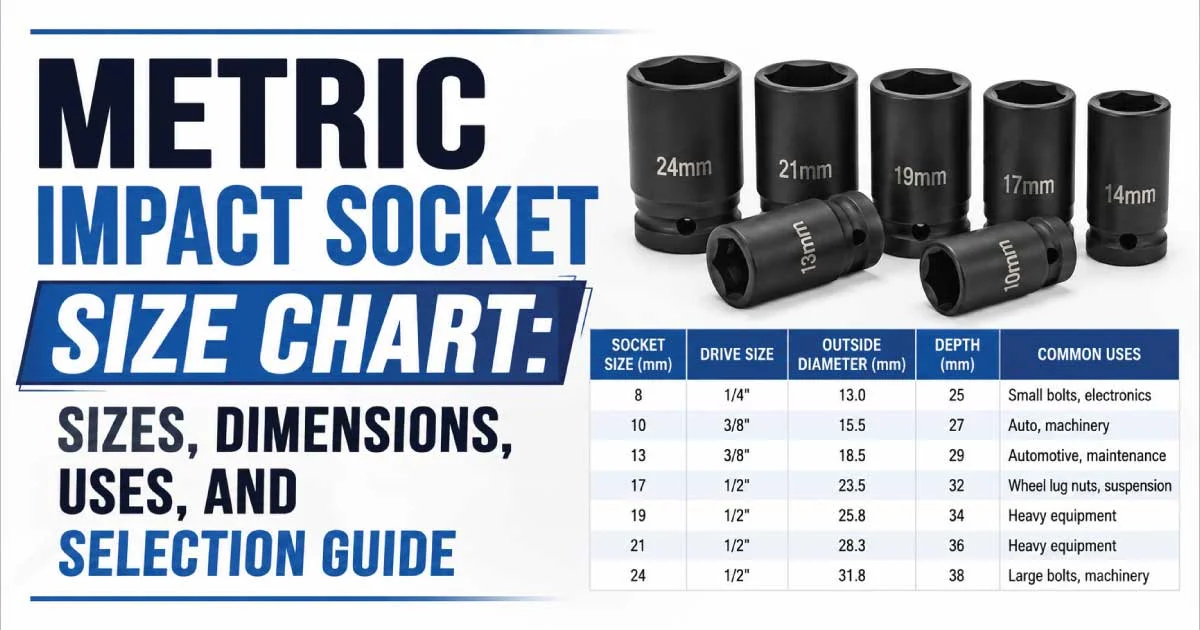
This article covers metric impact socket sizes, common dimensions, drive sizes, markings, socket types, and practical tips for choosing the correct socket for automotive repairs, machinery maintenance, and other heavy-duty fastening work.
What Is a Metric Impact Socket?
A metric impact socket is a heavy-duty tool designed to loosen or tighten fasteners using an impact wrench or impact driver with a compatible socket attachment. Unlike ordinary hand sockets, impact sockets are manufactured to withstand repeated hammering forces and sudden torque changes.
Metric impact sockets are sized in millimeters (mm), based on the width across the flats of the fastener head or nut. For example, a 17 mm impact socket fits a compatible hex fastener measuring approximately 17 mm across its flat sides.
These sockets are commonly used in automotive workshops, truck maintenance, industrial machinery, construction equipment, and mechanical repair.
Important: Socket size and bolt thread size are not the same. A metric M10 bolt, for example, may require a 16 mm or 17 mm socket depending on the fastener standard and design.
Metric Impact Socket Size Chart
The following chart lists common metric impact socket sizes and their typical applications. Actual fit depends on the fastener dimensions, while the recommended drive size depends on the socket design and the tool being used.
| Socket Size (mm) | Approx. Equivalent (inches) | Common Applications |
|---|---|---|
| 6 mm | 0.24 in | Small machine fasteners |
| 7 mm | 0.28 in | Small automotive and equipment fasteners |
| 8 mm | 0.31 in | Small bolts and nuts |
| 9 mm | 0.35 in | Compact mechanical assemblies |
| 10 mm | 0.39 in | Automotive and general mechanical work |
| 11 mm | 0.43 in | Specialized metric fasteners |
| 12 mm | 0.47 in | Machinery and automotive components |
| 13 mm | 0.51 in | General mechanical fasteners |
| 14 mm | 0.55 in | Automotive and equipment maintenance |
| 15 mm | 0.59 in | Automotive suspension and machinery |
| 16 mm | 0.63 in | Larger mechanical fasteners |
| 17 mm | 0.67 in | Automotive and wheel-related fasteners |
| 18 mm | 0.71 in | Suspension and machinery components |
| 19 mm | 0.75 in | Common automotive wheel nuts and bolts |
| 21 mm | 0.83 in | Wheel and chassis fasteners |
| 22 mm | 0.87 in | Larger automotive and industrial fasteners |
| 24 mm | 0.94 in | Heavy-duty mechanical assemblies |
| 27 mm | 1.06 in | Truck and industrial applications |
| 30 mm | 1.18 in | Heavy machinery and large fasteners |
| 32 mm | 1.26 in | Heavy-duty automotive and industrial work |
| 36 mm | 1.42 in | Large nuts and machinery components |
| 41 mm | 1.61 in | Heavy equipment and specialized fasteners |
| 46 mm | 1.81 in | Industrial and heavy machinery |
| 50 mm | 1.97 in | Large industrial fasteners |
This is a general reference chart, not a universal vehicle or fastener specification. Not every size is included, and the applications are illustrative rather than guaranteed fits.
Metric Impact Socket Drive Size Chart
Impact sockets are also classified by their drive size. The drive size refers to the square connection that attaches the socket to the impact wrench, not the hexagonal opening that fits the fastener.
Choosing the correct drive size is essential because the socket must fit the tool securely and withstand the intended load.
| Drive Size | Equivalent in Inches | Typical Use |
|---|---|---|
| 1/4-inch | 6.35 mm | Small fasteners and compact tools |
| 3/8-inch | 9.53 mm | Light to medium automotive repairs |
| 1/2-inch | 12.70 mm | General automotive and workshop work |
| 3/4-inch | 19.05 mm | Heavy automotive and industrial maintenance |
| 1-inch | 25.40 mm | Large machinery and heavy-duty fastening |
| 1-1/2-inch | 38.10 mm | Specialized industrial applications |
| 2-inch | 50.80 mm | Very large industrial fastening systems |
The drive sizes listed are nominal imperial dimensions, even when the socket’s opening is measured in millimeters.
How to Choose the Correct Drive Size
- 1/4-inch drive: Suitable for compact tools and smaller fasteners when the manufacturer’s torque rating permits.
- 3/8-inch drive: Useful for lighter automotive work and accessible mechanical assemblies.
- 1/2-inch drive: A versatile choice for many passenger-vehicle repairs.
- 3/4-inch drive: Designed for larger sockets and higher-load applications.
- 1-inch and larger drives: Used with suitable heavy-duty impact wrenches for demanding industrial work.
Do not choose a drive size based on socket opening alone. Check the impact wrench’s compatibility, rated torque, socket rating, and intended application.
Metric Socket Size vs. Metric Bolt Size
One of the most common sources of confusion is the difference between a socket’s size and a bolt’s nominal thread diameter.
Metric bolts are identified by an M designation followed by a nominal thread diameter. For example, M8 indicates a nominal thread diameter of 8 mm. The socket size refers to the distance between the opposite flat faces of the bolt head or nut.
The two measurements are related through fastener standards, but they are not interchangeable.
| Metric Fastener | Nominal Thread Diameter | Illustrative Hex Size |
|---|---|---|
| M6 | 6 mm | 10 mm |
| M8 | 8 mm | 13 mm |
| M10 | 10 mm | 16 or 17 mm |
| M12 | 12 mm | 18 or 19 mm |
| M14 | 14 mm | 21 or 22 mm |
| M16 | 16 mm | 24 mm |
| M18 | 18 mm | 27 mm |
| M20 | 20 mm | 30 mm |
| M22 | 22 mm | 32 or 34 mm |
| M24 | 24 mm | 36 mm |
These are illustrative combinations, not a substitute for the applicable fastener standard. Head dimensions can vary with the standard, bolt type, flange design, manufacturer, and application.
For an accurate fit, measure the fastener’s hexagonal head or nut across its flats, or consult the vehicle service manual, equipment documentation, or fastener specification.
Types of Metric Impact Sockets
Metric impact sockets come in several designs. The best type depends on the fastener’s shape, accessibility, and the task being performed.
Standard Impact Sockets
Standard impact sockets have a relatively short body and are useful when the fastener is easy to access.
Common applications include:
- General automotive repairs
- Engine and machinery maintenance
- Workshop assembly tasks
- Accessible bolts and nuts
Their compact length can make them easier to use in restricted spaces where a longer socket is unnecessary.
Deep Impact Sockets
Deep impact sockets have an extended body that reaches fasteners positioned on long studs or inside recessed areas.
They are particularly useful for:
- Wheel nuts on protruding studs
- Deeply recessed fasteners
- Certain suspension and chassis components
- Nuts positioned beyond the reach of standard sockets
A deep socket may not fit where surrounding components leave insufficient clearance. Check the socket’s overall length and outside diameter before use.
Thin-Wall Impact Sockets
Thin-wall impact sockets have a reduced outside diameter to improve access in confined spaces, including some wheel assemblies.
They can be useful when a standard socket’s outer wall is too thick to fit into a narrow recess. However, the thinner profile must still be suitable for the intended impact application.
Do not assume every thin-wall socket is rated for all impact loads. Confirm the manufacturer’s rating and use the socket only within its intended limits.
Impact Wheel Sockets
Impact wheel sockets are designed for wheel-fastener applications. Many have protective sleeves to reduce the risk of scratching alloy wheels.
Important considerations include:
- The exact wheel nut or bolt size
- Clearance between the socket and wheel
- Overall socket length
- Compatibility with the impact wrench
- The vehicle manufacturer’s tightening torque
A protective sleeve helps prevent contact damage, but it does not guarantee that a socket will fit every wheel design.
Hex, Torx, and Specialty Impact Sockets
Not all fasteners have a standard external hexagonal head. Some require a specialty socket.
- Hex bit sockets: Engage internal hexagonal recesses.
- Torx bit sockets: Fit star-shaped recesses.
- Spline sockets: Engage compatible multi-spline fasteners.
- Specialty sockets: Fit particular fastener profiles or service requirements.
The socket profile must match the fastener. A similarly sized socket with the wrong profile can slip, damage the fastener, or create a safety hazard.
Metric Impact Socket Size Chart by Application
The following table helps narrow down which metric socket sizes to check for common repair tasks. These are starting points, not guaranteed specifications for every vehicle or machine.
| Application | Sizes Worth Checking | Important Consideration |
|---|---|---|
| Small mechanical fasteners | 6–10 mm | Confirm head dimensions |
| General automotive repairs | 10–17 mm | Fastener design varies |
| Suspension maintenance | 14–24 mm | Follow service-manual instructions |
| Wheel fasteners | 17–22 mm | Verify the exact vehicle specification |
| Larger chassis fasteners | 19–30 mm | Check access and torque requirements |
| Truck maintenance | 24–46 mm | Requirements vary by vehicle |
| Industrial machinery | 27–50 mm and larger | Confirm equipment specifications |
Automotive Applications
Automotive repairs commonly involve metric fasteners, particularly on vehicles designed around metric specifications. A mechanic may use smaller sockets for certain engine components and larger sockets for suspension, chassis, or wheel-related work.
However, there is no single socket size for every component in a vehicle. Different model years, engine configurations, replacement parts, and fastener designs may require different sizes.
Always confirm the correct socket size before applying impact torque.
Industrial and Heavy Equipment Applications
Industrial equipment often uses larger fasteners to secure structural components, rotating assemblies, mounting brackets, and machinery housings.
In these settings, selecting the correct socket involves more than matching the hex size. The socket must also be compatible with the drive tool and rated for the required load.
For critical machinery, use the equipment manufacturer’s maintenance documentation rather than relying on a general-purpose chart.
Also Read:
How to Measure a Metric Impact Socket or Fastener
If you do not know the required socket size, measuring the fastener is often the most direct way to identify it.
Step 1: Identify the Fastener Profile
Determine whether the fastener has an external hex head, internal hex recess, Torx profile, or another shape.
An external hex head generally requires a conventional six-point or compatible impact socket. Internal profiles require an appropriate bit socket.
Step 2: Measure Across the Flats
For an external hex bolt or nut, measure the distance between two opposite flat sides using a caliper or suitable measuring tool.
This measurement is the nominal socket opening size to check.
For example, if the fastener measures approximately 17 mm across its flats, begin by checking a 17 mm socket.
Do not measure from one corner of the hexagon to the opposite corner. That produces a different dimension and can lead to choosing the wrong socket.
Step 3: Check the Socket Fit
Place the socket over the fastener by hand when it is safe to do so.
A correctly sized socket should engage the fastener fully without excessive looseness. It should not require force to fit over a clean, undamaged fastener.
If the socket does not seat properly, inspect for corrosion, damaged edges, dirt, or a mismatch in size.
Step 4: Confirm the Drive Connection
Check whether the socket’s square drive matches the impact wrench directly. If an adapter is required, verify that it is rated for impact use and suitable for the application.
Step 5: Verify the Tool and Fastener Requirements
Before operating the tool, check the socket manufacturer’s specifications and the equipment’s service instructions.
For final tightening, use the specified torque procedure. An impact wrench is not a reliable substitute for a calibrated torque wrench when a precise final torque is required.
Also Read:
How to Choose the Right Metric Impact Socket Set
A useful impact socket set should match the fasteners you work with most often rather than simply offering the highest number of pieces.
Choose a Suitable Size Range
For general workshop use, a selection of common metric sizes can cover many routine tasks. Automotive professionals may need a broader selection, including deep sockets, wheel sockets, and specialty profiles.
Before buying a set, consider:
- The vehicles or machinery you service
- The metric sizes specified in service manuals
- Whether standard or deep sockets are needed
- The drive size of your impact wrench
- Whether specialty profiles are required
Select Six-Point or Twelve-Point Sockets
Six-point sockets engage six flats of a compatible hex fastener. They are often preferred for high-torque work because they can distribute contact forces effectively when properly fitted.
Twelve-point sockets provide more engagement positions, which may help in confined spaces. Their suitability depends on the fastener, socket design, and application.
For impact work, choose a socket specifically rated for the tool and task. Do not assume a twelve-point socket is appropriate for every high-torque fastening job.
Look for Impact-Rated Construction
Impact sockets are commonly manufactured from materials and heat treatments selected to handle repeated shock loading. Many are finished in black oxide or another dark coating, although appearance alone does not establish whether a socket is safe for impact use.
Check for clear impact-use identification and the manufacturer’s specifications. Never use a chrome-plated hand socket with an impact wrench unless its manufacturer explicitly rates it for that use.
Consider Deep and Specialty Sockets
A basic set may be enough for occasional repairs, but professional applications can require:
- Deep metric sockets
- Wheel-protection sockets
- Impact-rated hex bit sockets
- Impact-rated Torx bit sockets
- Larger-drive sockets for heavy equipment
Choose accessories based on actual requirements and verified compatibility.
Also Read:
Common Metric Impact Socket Mistakes
Using the wrong socket can damage fasteners, equipment, or tools. Avoid these common mistakes.
Confusing Millimeters With Inches
Metric and imperial sizes can appear similar without being identical. For example, a 19 mm socket is approximately 0.748 inches, while a 3/4-inch socket is 19.05 mm.
Although the dimensions are close, they should not automatically be treated as interchangeable. Even a small mismatch can affect fit.
Assuming Bolt Diameter Determines Socket Size
An M12 bolt does not necessarily require a 12 mm socket. M12 refers to the nominal thread diameter, while socket size is determined by the fastener’s head or nut dimensions.
Use the correct fastener specification or measure across the flats.
Using a Hand Socket With an Impact Wrench
Ordinary chrome hand sockets are not necessarily designed to withstand impact forces. They may crack or break when used outside their intended application.
Use impact-rated sockets and compatible accessories.
Choosing the Wrong Socket Depth
A standard socket may not reach a recessed fastener, while a deep socket may not fit into a confined space.
Check both the internal depth and external dimensions before selecting the socket.
Ignoring Fastener Condition
Rust, rounded corners, dirt, or damaged threads can make a correctly sized socket difficult to use safely.
Clean the fastener where appropriate and replace damaged hardware according to the equipment manufacturer’s guidance. Do not compensate for a poor fit by applying more impact force.
Safety Tips for Using Metric Impact Sockets
Impact tools can generate substantial torque and expose the user to flying debris, pinch points, and broken components. Follow safe operating practices.
- Wear suitable eye protection and other protective equipment required for the job.
- Inspect the socket for cracks, deformation, or damage before use.
- Confirm that the socket is impact-rated and compatible with the wrench.
- Secure the workpiece and keep hands away from moving components.
- Use the correct tool setting and avoid unnecessary impact loading.
- Follow the equipment manufacturer’s tightening and loosening procedures.
- Use a calibrated torque wrench when the final torque must meet a specified value.
- Stop if the socket slips, the fastener becomes damaged, or the tool behaves unexpectedly.
For wheel nuts, structural fasteners, and other safety-critical connections, follow the specified tightening sequence and torque value. Never estimate critical torque based solely on how long the impact wrench is operated.
Frequently Asked Questions About Metric Impact Socket Sizes
What are the most common metric impact socket sizes?
Common sizes include 8, 10, 12, 13, 14, 15, 17, 19, 21, and 22 mm. The sizes you need depend on the vehicle, machinery, and fasteners involved.
What size impact socket do I need for a wheel nut?
There is no universal wheel-nut socket size. Depending on the vehicle and fastener design, sizes such as 17, 19, 21, or 22 mm may be relevant. Check the owner’s manual or service documentation before use.
Is a 19 mm socket the same as a 3/4-inch socket?
No. A 19 mm socket is approximately 0.748 inches, while a 3/4-inch socket measures 19.05 mm. They are close in size but should not automatically be considered interchangeable.
Can I use a regular socket on an impact wrench?
Only if the socket manufacturer explicitly rates it for impact use. Standard hand sockets are not generally intended to withstand the repeated shock forces generated by impact tools.
What is the difference between a metric socket and an impact socket?
Metric describes the measurement system used for the socket opening. Impact describes the socket’s intended use and construction. A metric socket can be designed for hand tools or for impact tools.
How do I know whether I need a deep impact socket?
Choose a deep socket when the fastener is recessed or positioned on a stud that extends beyond the reach of a standard socket. Check the available clearance and the socket’s dimensions before use.
Does a larger socket always fit a larger bolt?
Not necessarily. Socket size refers to the width across the fastener’s flats, whereas bolt size usually refers to nominal thread diameter. The relationship depends on the fastener standard and design.
Conclusion
A metric impact socket size chart helps identify common socket openings, drive sizes, and suitable applications for automotive, workshop, and industrial maintenance. The key is to distinguish socket size from bolt thread diameter and drive size.
Measure the fastener across its flats, select an impact-rated socket that fits correctly, and verify the tool’s compatibility. For wheel fasteners and other safety-critical connections, always follow the manufacturer’s specifications and use the correct final-torque procedure.