
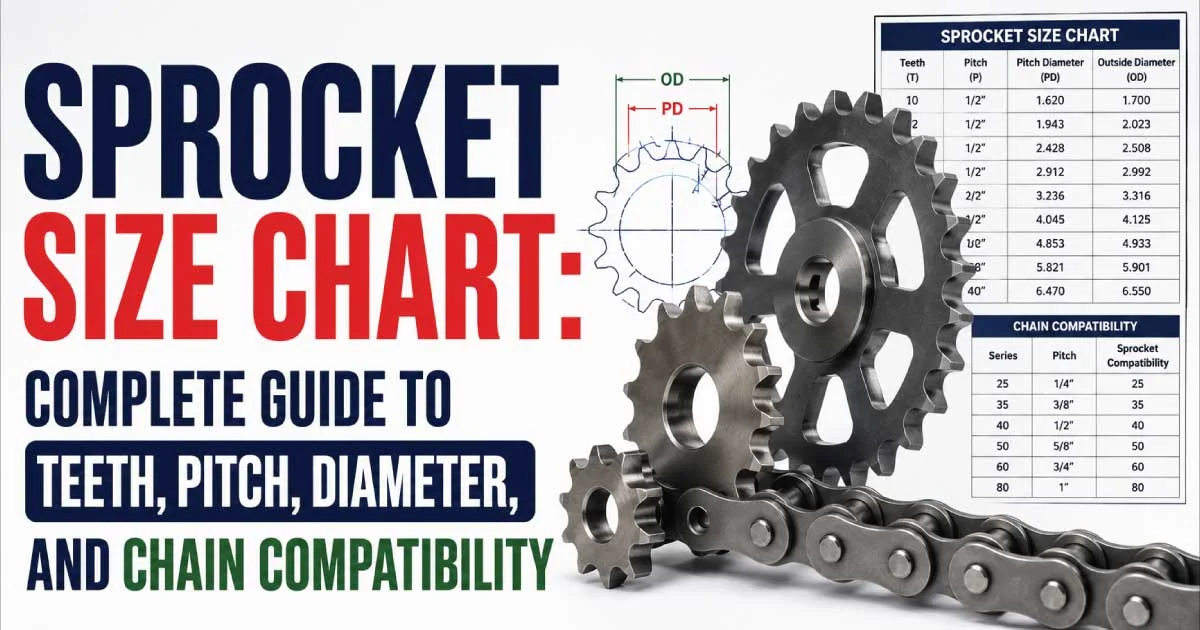
Choosing the correct sprocket size is essential for reliable chain drive performance, whether you are repairing a motorcycle, maintaining industrial machinery, building a go-kart, or replacing a bicycle drivetrain component. A sprocket that does not match the chain or application can cause poor engagement, excessive wear, noise, and inefficient power transmission.
This sprocket size chart guide explains sprocket dimensions, tooth counts, chain pitch, common chain sizes, and measurement methods. You will also learn how front and rear sprockets affect speed and torque, how to identify a replacement, and which specifications to verify before purchasing one.
What Is a Sprocket?
A sprocket is a toothed wheel designed to engage with a compatible chain and transmit rotary motion. Unlike a friction pulley, which relies on contact and friction, a sprocket uses its teeth to engage the chain links.
Sprockets are used in many mechanical systems, including:
- Motorcycles and dirt bikes
- Bicycles and electric bikes
- Go-karts and small engines
- Industrial conveyors
- Agricultural machinery
- Packaging and manufacturing equipment
- Timing and power transmission systems
A sprocket’s correct size depends on more than its outside diameter. Chain pitch, tooth count, tooth profile, sprocket thickness, mounting dimensions, and application compatibility all matter.
For example, two sprockets may have the same number of teeth but use different chain pitches. They are not necessarily interchangeable.
Main Parts of a Sprocket
The following terms are useful when reading a sprocket size chart:
- Teeth: The projections that engage with the chain.
- Tooth count: The total number of teeth around the sprocket.
- Pitch: The distance between corresponding points on adjacent chain links, measured along the chain.
- Pitch diameter: The effective diameter associated with the chain’s engagement points.
- Outside diameter: The diameter measured across the outermost tooth tips.
- Bore: The center opening that fits over a shaft.
- Hub: The central section that supports the mounting connection.
- Keyway: A slot used with a key to prevent a sprocket from rotating independently of its shaft.
- Mounting pattern: The bolt arrangement or other attachment geometry used to secure the sprocket.
Not every sprocket has a hub, keyway, or bolt pattern. The design depends on the intended machinery.
Sprocket Size Chart: Common Chain Sizes and Pitch
The most important starting point when selecting a sprocket is identifying the chain it must fit. Chain pitch and chain series help determine whether the sprocket teeth can engage correctly.
The table below lists examples of common roller-chain sizes using nominal pitch dimensions. ANSI roller-chain designations are common in North American industrial applications, while ISO and other standards may use different designation systems.
| Chain designation | Nominal pitch (inches) | Nominal pitch (mm) | Typical context |
|---|---|---|---|
| ANSI #25 | 1/4 | 6.35 | Compact mechanisms |
| ANSI #35 | 3/8 | 9.525 | Small machinery and some kart drives |
| ANSI #40 | 1/2 | 12.70 | General power transmission |
| ANSI #41 | 1/2 | 12.70 | Light-duty chain applications |
| ANSI #50 | 5/8 | 15.875 | Industrial drives |
| ANSI #60 | 3/4 | 19.05 | Heavier power transmission |
| ANSI #80 | 1 | 25.40 | Heavy-duty industrial drives |
These are nominal pitch references, not complete compatibility specifications. Chain width, roller diameter, sprocket tooth form, and applicable standards must also match.
How to Read a Chain and Sprocket Size
A chain designation identifies a particular chain series, but it does not tell you everything about the sprocket’s physical dimensions.
For example, ANSI #40 and ANSI #41 chains both have a nominal pitch of 1/2 inch, yet their other dimensions differ. A sprocket made for one should not automatically be assumed suitable for the other.
When identifying a replacement, check:
- Chain manufacturer’s designation
- Pitch and roller dimensions
- Internal chain width
- Sprocket tooth profile
- Sprocket thickness and clearance
- Applicable chain and sprocket standard
For motorcycles and bicycles, use the drivetrain manufacturer’s chain designation rather than assuming that industrial ANSI chain sizes apply.
Sprocket Tooth Count Chart
Sprocket tooth count is one of the most important factors in determining chain speed, torque characteristics, and drivetrain behavior. The same chain can work with sprockets that have different tooth counts, provided the sprockets are designed for that chain and application.
A smaller sprocket generally rotates faster for a given chain speed, while a larger sprocket rotates more slowly. In a driven system, changing the ratio between the driving and driven sprockets changes the output speed and torque relationship.
| Tooth count | Relative size | General characteristics |
|---|---|---|
| 9–11 | Very small | Compact diameter; application-specific limitations |
| 12–14 | Small | Often used where space is limited |
| 15–17 | Medium-small | Common in some motorcycle and machinery setups |
| 18–22 | Medium | Useful for a range of drive configurations |
| 23–30 | Large | Lower rotational speed at the same chain speed |
| 31+ | Very large | May provide substantial reduction, depending on the paired sprocket |
These tooth-count ranges are descriptive rather than universal standard sizes. Actual available counts depend on the chain series, sprocket type, and manufacturer.
Why Tooth Count Matters
Changing the number of teeth affects several characteristics:
- Output speed: The ratio between the driving and driven sprockets determines their relative rotational speeds.
- Torque: A reduction in rotational speed can increase output torque, subject to losses and system limitations.
- Chain articulation: Smaller sprockets force the chain to bend more sharply around each tooth engagement.
- Clearance: A larger sprocket may interfere with a frame, housing, guard, or nearby component.
- Chain length: Changing sprocket sizes can affect the required chain length and available adjustment range.
A larger sprocket is not automatically better. The correct tooth count depends on the desired performance, available space, load, and manufacturer’s recommendations.
Sprocket Dimensions Chart: Diameter and Measurement Basics
A sprocket size chart may list several different diameters. Understanding these measurements prevents confusion when comparing replacement parts.
| Dimension | What it measures | Why it matters |
|---|---|---|
| Pitch diameter | Effective diameter through the chain engagement geometry | Helps describe sprocket geometry and transmission ratio |
| Outside diameter | Diameter across the outer tooth tips | Useful for clearance checks |
| Bore diameter | Diameter of the center opening | Determines shaft fit |
| Hub diameter | Outside diameter of the central hub, if present | Affects mounting clearance |
| Face width | Axial width of the sprocket body or teeth, as applicable | Helps establish chain compatibility |
| Overall thickness | Total thickness of the sprocket body and relevant features | Important for mounting and clearance |
| Mounting dimensions | Bolt spacing, offset, keyway, or other interface measurements | Determines whether the sprocket fits the equipment |
Pitch Diameter Versus Outside Diameter
Pitch diameter and outside diameter are not the same measurement.
The outside diameter is measured across the tooth tips. Pitch diameter represents the effective circle associated with chain engagement and is influenced by chain pitch and tooth count.
For roller-chain sprockets, a useful theoretical relationship is:
Dp=psin(180∘/N)D_p=\frac{p}{\sin(180^\circ/N)}Dp=sin(180∘/N)p
Where:
- DpD_pDp = pitch diameter
- ppp = chain pitch
- NNN = number of sprocket teeth
The pitch and diameter must use the same units. For example, use millimeters for both if the chain pitch is given in millimeters.
This relationship is useful for understanding sprocket geometry, but it does not replace a manufacturer’s dimensional drawing. The actual tooth-tip diameter and tooth form must be verified for the particular sprocket.
Why Two Sprockets With the Same Tooth Count May Have Different Diameters
Two sprockets with the same number of teeth can have different diameters when they are designed for different chain pitches.
For example, a 15-tooth sprocket designed for a chain with a 1/2-inch pitch will not have the same pitch diameter as a 15-tooth sprocket designed for a chain with a 3/4-inch pitch.
This is why tooth count alone is insufficient for identifying a sprocket. Always match the chain specification first.
How to Measure Sprocket Size Correctly
If the original sprocket has no readable markings, measuring it can help you identify a replacement. However, measurements should be combined with chain identification and mounting specifications.
Step 1: Count the Teeth
Count every tooth around the sprocket and record the total.
Mark the first tooth with a pen or marker if necessary to avoid counting one twice. If the sprocket is badly worn, inspect the remaining tooth profiles carefully.
Step 2: Identify the Chain Pitch
Chain pitch is the distance between the centers of adjacent chain pins.
For a more reliable measurement, measure from the center of one pin to the center of another pin several links away, then divide the measured distance by the number of intervals.
For example, if the distance between the centers of two pins separated by 10 pitches is 127 mm:
p=12710=12.7 mmp=\frac{127}{10}=12.7\text{ mm}p=10127=12.7 mm
The result corresponds to a nominal 1/2-inch pitch.
This example illustrates the calculation; it does not identify the chain’s full series. You must still check the other chain dimensions.
Step 3: Measure the Outside Diameter
Use calipers or a suitable measuring tool to measure across the outermost tooth tips.
Record the result in millimeters or inches. If the tooth tips are worn or irregular, compare the measurement with the manufacturer’s drawing instead of relying on the measured value alone.
Step 4: Measure the Bore
Measure the diameter of the central opening. If the sprocket fits onto a shaft, check whether it uses a straight bore, keyed bore, spline, taper, or another mounting arrangement.
A bore that appears correct may still be incompatible if the keyway, spline profile, or fit tolerance differs.
Step 5: Check the Mounting Pattern and Offset
For a bolt-mounted sprocket, measure the number of holes, hole diameters, and mounting-hole spacing. If the sprocket has a hub or offset, record those dimensions too.
On motorcycles and bicycles, also verify the mounting interface and alignment with the surrounding drivetrain components.
Step 6: Confirm the Chain Compatibility
Compare your measurements against the sprocket manufacturer’s specifications. Check the chain series, pitch, roller dimensions, tooth profile, and applicable standard.
Do not buy a replacement based only on outside diameter or the number stamped on the old part.
Also Read:
How Sprocket Size Affects Speed and Torque
The relationship between driving and driven sprockets is central to power transmission. The driving sprocket supplies motion, while the driven sprocket receives it through the chain.
For a simple chain drive, the ideal speed relationship is:
Driven speed=Driving speed×T1T2\text{Driven speed}=\text{Driving speed}\times\frac{T_1}{T_2}Driven speed=Driving speed×T2T1
Where:
- T1T_1T1 = number of teeth on the driving sprocket
- T2T_2T2 = number of teeth on the driven sprocket
This calculation assumes compatible sprockets, a correctly engaged chain, and no chain skipping.
Sprocket Ratio Example
Suppose a motor turns a 15-tooth driving sprocket at 1,800 RPM, and the driven sprocket has 45 teeth.
Driven speed=1800×1545\text{Driven speed}=1800\times\frac{15}{45}Driven speed=1800×4515
Driven speed=600 RPM\text{Driven speed}=600\text{ RPM}Driven speed=600 RPM
The driven sprocket rotates at an ideal speed of 600 RPM.
The sprocket ratio can also be expressed as:
Reduction ratio=T2T1\text{Reduction ratio}=\frac{T_2}{T_1}Reduction ratio=T1T2
In this example, the reduction ratio is 3:1.
A larger driven sprocket generally reduces output speed and increases available output torque for a given input torque, ignoring losses. Actual performance depends on the motor, chain efficiency, loading, and other components.
What Happens When You Change Sprocket Sizes?
| Change | Typical effect | Important consideration |
|---|---|---|
| Larger driven sprocket | Lower output speed and greater torque multiplication | Check clearance and chain length |
| Smaller driven sprocket | Higher output speed and lower torque multiplication | Check minimum recommended tooth count |
| Larger driving sprocket | Higher driven speed for the same driven sprocket | Verify space and alignment |
| Smaller driving sprocket | Lower driven speed for the same driven sprocket | Increased chain articulation may affect wear |
For motorcycles, the practical effects of changing gearing depend on engine characteristics, tire size, transmission ratios, and riding conditions. A sprocket change does not guarantee a specific road speed or acceleration improvement.
Also Read:
Motorcycle and Bicycle Sprocket Size Charts
Motorcycles and bicycles both use toothed drivetrain components, but their sprocket systems are not interchangeable. The terminology, chain dimensions, mounting arrangements, and intended loads differ.
Motorcycle Sprocket Sizes
Motorcycle sprockets are commonly described by their tooth counts and compatible chain series. A typical setup has a front countershaft sprocket and a rear wheel sprocket.
When comparing motorcycle sprocket sizes, check:
- Front and rear tooth counts
- Chain series and pitch
- Sprocket thickness
- Countershaft spline or mounting design
- Rear hub bolt pattern
- Chain alignment and clearance
- Manufacturer-approved gearing options
A smaller front sprocket or larger rear sprocket generally produces a lower gearing ratio, increasing engine RPM at a given road speed. A larger front sprocket or smaller rear sprocket generally produces taller gearing.
However, changes can affect acceleration, cruising RPM, chain wear, speedometer accuracy on some motorcycles, and clearance. Check the motorcycle manufacturer’s service information before making changes.
Bicycle Sprocket Sizes
Bicycle drivetrains may include a front chainring and a rear cassette or freewheel. These components are commonly identified by tooth count and drivetrain compatibility.
A bicycle’s gear ratio is calculated by dividing the front chainring tooth count by the rear sprocket tooth count.
For example, a 40-tooth chainring paired with a 20-tooth rear sprocket gives a ratio of 2:1. The rear wheel turns approximately twice for each complete crank revolution, assuming a direct drivetrain without an intervening gear mechanism.
When choosing bicycle sprockets or chainrings, verify:
- Chain speed compatibility, such as the intended number of drivetrain speeds
- Chain width and tooth profile
- Cassette or freewheel compatibility
- Chainring bolt pattern or direct-mount interface
- Rear derailleur capacity and maximum sprocket size
- Manufacturer restrictions
Bicycle rear cassettes and freewheels may look similar, but their mounting systems differ. Confirm which system your wheel uses before ordering a replacement.
Also Read:
How to Choose the Right Sprocket Size
Selecting the correct sprocket involves more than choosing a diameter or tooth count. A suitable replacement must fit mechanically and perform appropriately under the intended load.
Match the Chain First
Start with the exact chain designation. Confirm the pitch, roller dimensions, width, and applicable standard.
A sprocket with an incompatible tooth profile may fail to engage correctly even if its pitch appears similar.
Determine the Required Ratio
If you need to change output speed, calculate the existing and proposed sprocket ratios.
For a simple chain drive:
R=Driven sprocket teethDriving sprocket teethR=\frac{\text{Driven sprocket teeth}}{\text{Driving sprocket teeth}}R=Driving sprocket teethDriven sprocket teeth
A larger value represents a greater speed reduction. Select a ratio based on the required output speed and torque rather than choosing tooth counts arbitrarily.
Check Space and Mounting
Measure the available space around the sprocket and inspect the shaft or mounting interface.
Verify bore size, keyway or spline, hub dimensions, bolt pattern, thickness, and offset. A sprocket that matches the chain but cannot align correctly is not a suitable replacement.
Consider Load and Operating Conditions
Industrial equipment may operate continuously, carry heavy loads, or experience shock loading. These conditions can influence the required chain series, sprocket material, tooth count, and design.
Consider:
- Operating speed
- Transmitted power and torque
- Start-up and shock loads
- Duty cycle
- Lubrication requirements
- Environmental exposure
- Required service life
For engineered machinery, use the manufacturer’s selection tables or a qualified mechanical designer. A general size chart cannot establish whether a sprocket is safe for a particular load.
Check the Manufacturer’s Documentation
Before ordering, compare the old component’s markings with the manufacturer’s catalog or engineering drawing. Confirm the chain series, tooth count, dimensions, mounting arrangement, material, and any application-specific requirements.
Common Sprocket Size Mistakes to Avoid
Several common errors can lead to poor fit, premature wear, or drivetrain problems.
- Matching only the tooth count: The chain pitch and tooth profile must also be compatible.
- Confusing pitch diameter with outside diameter: These dimensions describe different parts of the sprocket geometry.
- Assuming equal pitch means full compatibility: Chain width, roller size, and chain series can differ.
- Ignoring the mounting interface: Bore, keyway, spline, bolt pattern, and offset may determine whether a replacement fits.
- Choosing an excessively small sprocket: A smaller tooth count may increase chain articulation and wear.
- Ignoring alignment: Misalignment can contribute to uneven wear, noise, and chain tracking problems.
- Changing the ratio without checking clearance: A larger sprocket may interfere with guards, housings, frames, or adjacent components.
- Reusing a worn chain with a new sprocket without inspection: A worn chain can accelerate wear on the replacement sprocket.
Inspect the chain and both sprockets together when diagnosing unusual noise, vibration, or irregular wear. Replace components according to the equipment manufacturer’s recommendations.
Frequently Asked Questions About Sprocket Sizes
How do I know what size sprocket I need?
Identify the chain designation and pitch, count the teeth, and measure the mounting dimensions. Then compare the measurements with the manufacturer’s specifications. The correct sprocket must match the chain and the equipment’s mounting interface.
Does a larger sprocket increase speed?
It depends on which sprocket becomes larger. Increasing the size of the driven sprocket generally reduces output speed. Increasing the size of the driving sprocket generally increases output speed when the driven sprocket remains unchanged.
What is sprocket pitch?
Sprocket pitch refers to the chain pitch the sprocket is designed to accommodate. For a roller chain, pitch is the distance between the centers of adjacent chain pins. The sprocket tooth spacing must suit the intended chain.
Can I use different sprocket sizes with the same chain?
Yes, provided each sprocket is compatible with the chain series and application. Changing tooth counts may require checking chain length, adjustment range, alignment, and clearance.
How do I calculate a sprocket ratio?
Divide the number of teeth on the driven sprocket by the number of teeth on the driving sprocket. A 45-tooth driven sprocket paired with a 15-tooth driver has a 3:1 reduction ratio.
Are motorcycle and industrial sprocket sizes the same?
Not necessarily. Both use chain-engaging teeth, but their chain specifications, tooth profiles, materials, mounting interfaces, and design requirements can differ. Use the appropriate specifications for the intended application.
Why does my sprocket wear out quickly?
Possible causes include an incompatible chain, inadequate lubrication, misalignment, excessive loading, contamination, incorrect tension, or a worn chain. Inspect the complete drive system rather than replacing the sprocket without identifying the cause.
Is sprocket outside diameter enough to identify a replacement?
No. Outside diameter alone does not establish chain compatibility or mounting fit. Tooth count, chain pitch, tooth form, bore, thickness, and mounting dimensions should also be verified.
Conclusion
A reliable sprocket size selection starts with the chain specification, followed by tooth count, diameter, mounting dimensions, and the required speed ratio. A sprocket size chart helps narrow down suitable options, but it cannot replace the manufacturer’s dimensional drawings and compatibility guidance.
Whether you are selecting a motorcycle sprocket, bicycle chainring, or industrial chain-drive component, verify every critical dimension before purchasing. Matching the chain, sprocket geometry, and mounting interface helps support reliable operation and reduces avoidable wear.