
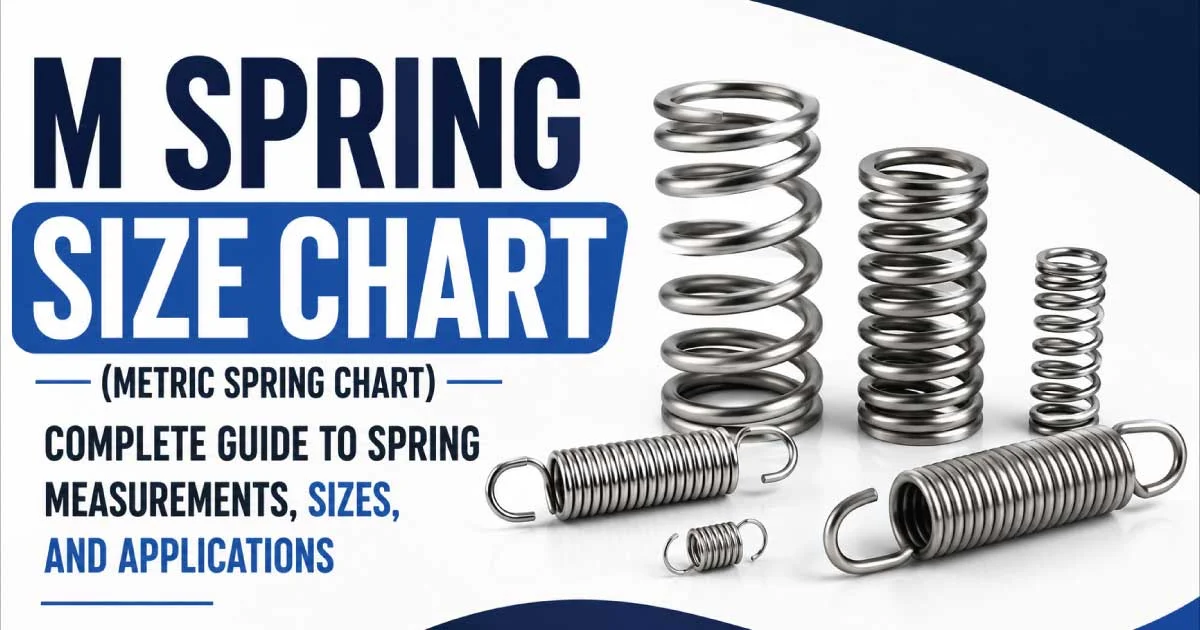
Metric springs, commonly identified with the “M” sizing system, are widely used in mechanical, automotive, industrial, and manufacturing applications. Choosing the correct spring size is important because springs must provide the required force, compression, extension, or tension while fitting properly into the assembly.
An M spring size chart helps engineers, technicians, and manufacturers identify spring dimensions based on metric measurements such as wire diameter, outer diameter, free length, coil count, and spring rate. This complete guide explains metric spring sizes, measurements, types, materials, and how to select the right spring for different applications.
M Spring Size Chart (Metric Spring Chart)
Metric spring sizes are generally measured using millimeters (mm). The most important dimensions include wire diameter, outside diameter, inside diameter, and free length.
| Spring Size | Wire Diameter | Outer Diameter | Free Length | Common Applications |
|---|---|---|---|---|
| M1 | 0.1 – 0.2 mm | 1 – 3 mm | 5 – 20 mm | Small mechanisms, electronics |
| M2 | 0.2 – 0.3 mm | 2 – 5 mm | 10 – 30 mm | Precision equipment |
| M3 | 0.3 – 0.5 mm | 3 – 8 mm | 15 – 40 mm | Small machinery |
| M4 | 0.5 – 0.8 mm | 5 – 12 mm | 20 – 50 mm | General mechanical parts |
| M5 | 0.8 – 1.2 mm | 8 – 16 mm | 30 – 70 mm | Automotive components |
| M6 | 1.2 – 2 mm | 12 – 25 mm | 40 – 100 mm | Industrial equipment |
The exact dimensions depend on spring type, manufacturer specifications, and application requirements.
What Is an M Spring?
An M spring refers to a spring that follows metric sizing standards. These springs are designed using millimeter-based measurements instead of inch-based dimensions. Metric springs are commonly used in countries and industries that follow ISO and DIN measurement systems.
Springs store mechanical energy and release it when compressed, stretched, or twisted. They are used to control movement, absorb shock, maintain pressure, and return components to their original position.
Common applications include:
- Automotive suspension systems
- Industrial machines
- Electrical devices
- Manufacturing equipment
- Mechanical tools
- Consumer products
- Precision instruments
Metric Compression Spring Size Chart
Compression springs are the most common type of spring. They are designed to resist compression forces and push components apart when compressed.
| Metric Spring Size | Wire Diameter | Outer Diameter | Typical Use |
|---|---|---|---|
| M3 × 10 mm | 0.4 mm | 3 mm | Small devices |
| M5 × 20 mm | 0.8 mm | 5 mm | Mechanical assemblies |
| M8 × 30 mm | 1.2 mm | 8 mm | Equipment components |
| M10 × 40 mm | 1.5 mm | 10 mm | Industrial applications |
| M12 × 50 mm | 2 mm | 12 mm | Heavy-duty systems |
Compression springs are selected based on the force required, available space, and operating conditions.
Metric Extension Spring Size Chart
Extension springs are designed to absorb pulling forces. They are commonly used where components need to return to their original position after movement.
| Spring Diameter | Length Range | Common Applications |
|---|---|---|
| 3 mm | 10 – 30 mm | Small mechanisms |
| 5 mm | 20 – 50 mm | Tools and equipment |
| 8 mm | 40 – 80 mm | Industrial parts |
| 10 mm | 50 – 100 mm | Heavy applications |
Extension springs usually include hooks or loops on both ends for attachment.
Metric Torsion Spring Size Chart
Torsion springs provide rotational force and are commonly used in hinges, clamps, and mechanical controls.
| Spring Size | Wire Diameter | Common Uses |
|---|---|---|
| M3 | 0.3 – 0.5 mm | Small hinges |
| M5 | 0.8 – 1 mm | Mechanical devices |
| M8 | 1.2 – 2 mm | Industrial mechanisms |
| M10 | 2 – 3 mm | Heavy-duty applications |
The correct torsion spring depends on torque requirements and rotation angle.
Also Read: Choosing the Correct Screw Size: Complete Guide 2026
How to Measure a Metric Spring Size
Accurate measurement is necessary when replacing or selecting a spring. Several important dimensions must be checked.
Measure Wire Diameter
Wire diameter is the thickness of the spring wire. It directly affects the strength and load capacity of the spring.
A thicker wire generally provides more force and higher durability.
Measure Outer Diameter
The outer diameter measures the total width of the spring from one outside edge to the opposite edge.
This measurement ensures the spring fits properly inside the available space.
Measure Free Length
Free length is the length of an unloaded spring. It is measured when the spring is not compressed, stretched, or under tension.
Count Active Coils
The number of active coils affects spring performance. More coils generally provide greater flexibility, while fewer coils increase stiffness.
Spring Rate and Load Capacity
Spring rate is one of the most important factors when selecting a spring. It describes how much force is required to compress or extend the spring by a specific distance.
A higher spring rate means the spring is stiffer and requires more force to move.
Factors affecting spring rate include:
- Wire diameter
- Number of coils
- Spring diameter
- Material type
- Free length
Choosing the correct spring rate ensures proper machine operation and prevents overloading.
Also Read: Machine Screw Sizes Guide for Builders and DIYers
Metric Spring Materials
Metric springs are manufactured from different materials depending on strength, environment, and temperature requirements.
Stainless Steel Springs
Stainless steel springs provide excellent corrosion resistance and are suitable for moisture-sensitive applications.
Advantages include:
- Rust resistance
- Long service life
- Good strength
- Suitable for outdoor environments
Carbon Steel Springs
Carbon steel springs are commonly used because they provide high strength at an affordable cost.
Benefits include:
- High durability
- Good elasticity
- Cost-effective performance
Alloy Steel Springs
Alloy steel springs are designed for heavy-duty applications where maximum strength and fatigue resistance are required.
They are commonly used in:
- Automotive systems
- Industrial machinery
- Heavy equipment
Metric Spring Standards
Metric springs are produced according to various international standards to maintain consistent dimensions and performance.
Common standards include:
- ISO spring specifications
- DIN spring standards
- Manufacturer-specific metric dimensions
Standardization makes it easier to replace springs and maintain compatibility between components.
When selecting a metric spring, consider:
- Required force
- Space limitations
- Temperature conditions
- Corrosion exposure
- Operating cycles
Common Metric Spring Problems
Using the wrong spring size can create several performance issues.
Spring Failure: Overloading or incorrect sizing can cause cracks, deformation, or complete spring breakage.
Loss of Spring Force: Repeated use may reduce spring strength over time, especially if the spring operates beyond its design limits.
Incorrect Fit: A spring with the wrong diameter or length may not function correctly inside the assembly.
Corrosion Damage: Exposure to moisture or chemicals can weaken spring materials and reduce service life.
How to Choose the Right M Spring Size
Selecting the correct metric spring requires understanding the application requirements.
Important factors include:
- Spring type
- Wire diameter
- Outer diameter
- Free length
- Spring rate
- Load requirements
- Operating environment
For general mechanical applications, standard carbon steel springs provide reliable performance. For environments exposed to moisture or chemicals, stainless steel springs are often a better choice.
Also Read: How to Choose Lag Bolt Sizes for Heavy-Duty Fixing
Final Thoughts on M Spring Sizes
An M spring size chart provides a useful reference for selecting metric springs in different mechanical applications. Understanding spring dimensions, materials, and performance characteristics helps ensure proper fit and reliable operation.
Whether used in automotive systems, industrial machinery, or precision devices, choosing the correct metric spring size improves efficiency, durability, and safety. Always verify spring measurements and manufacturer specifications before installation to achieve the best results.