
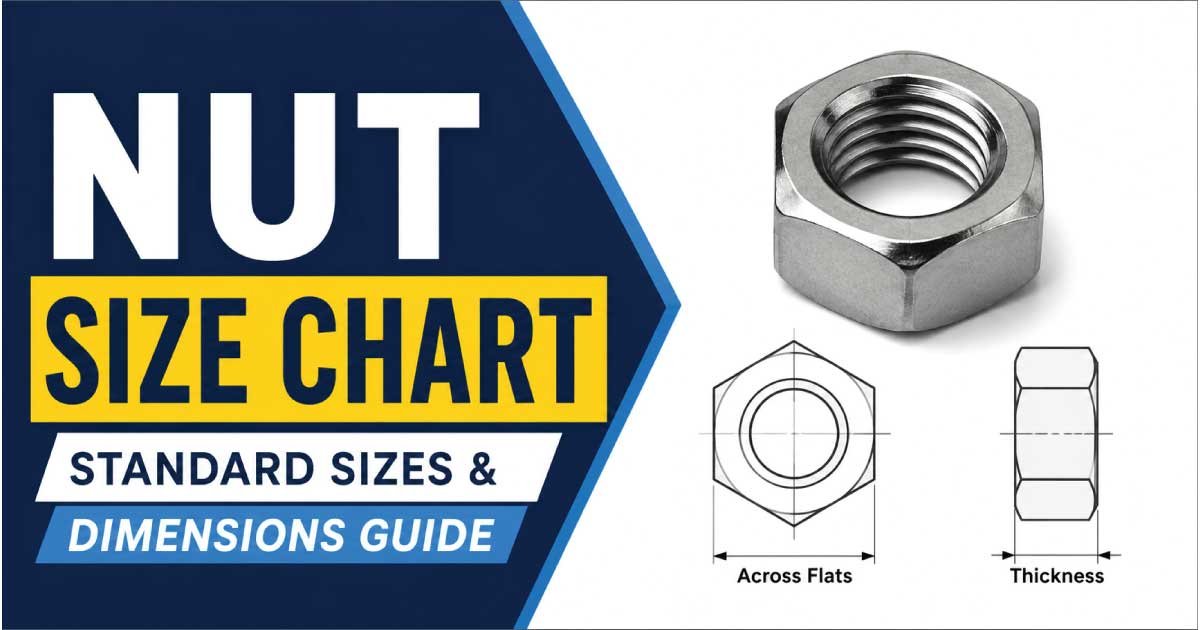
A nut size chart helps you quickly identify the correct nut for a metric or standard bolt by comparing nut size, thread diameter, thread pitch, wrench size, and thread type. Nuts are available in many sizes and designs, including hex nuts, lock nuts, flange nuts, wing nuts, and heavy hex nuts.
Choosing the correct nut is important because the nut must match the bolt’s diameter and thread specification. A nut that looks similar but has a different thread pitch or thread type may not fit correctly.
This guide covers common metric nut sizes, standard nut sizes, nut dimensions, wrench sizes, thread pitch, UNC and UNF threads, and nut-to-bolt compatibility.
Metric Nut Size Chart
Metric nuts are identified using the nominal diameter of the bolt they are designed to fit. For example, an M8 nut is designed for an M8 bolt with a matching thread pitch.
| Nut Size | Nominal Diameter | Coarse Thread Pitch | Common Wrench Size |
|---|---|---|---|
| M3 | 3 mm | 0.50 mm | 5.5 mm |
| M4 | 4 mm | 0.70 mm | 7 mm |
| M5 | 5 mm | 0.80 mm | 8 mm |
| M6 | 6 mm | 1.00 mm | 10 mm |
| M8 | 8 mm | 1.25 mm | 13 mm |
| M10 | 10 mm | 1.50 mm | 16 mm |
| M12 | 12 mm | 1.75 mm | 18 mm |
| M14 | 14 mm | 2.00 mm | 21 mm |
| M16 | 16 mm | 2.00 mm | 24 mm |
| M18 | 18 mm | 2.50 mm | 27 mm |
| M20 | 20 mm | 2.50 mm | 30 mm |
| M22 | 22 mm | 2.50 mm | 34 mm |
| M24 | 24 mm | 3.00 mm | 36 mm |
| M27 | 27 mm | 3.00 mm | 41 mm |
| M30 | 30 mm | 3.50 mm | 46 mm |
| M36 | 36 mm | 4.00 mm | 55 mm |
These are common reference dimensions. Exact nut dimensions can vary depending on the applicable standard and nut type.
Standard Nut Size Chart
Standard or inch nuts use fractional-inch sizes and thread specifications such as UNC (Unified National Coarse) and UNF (Unified National Fine).
| Nut Size | Nominal Diameter | UNC | UNF | Common Wrench Size |
|---|---|---|---|---|
| #6 | 0.138 in | 32 TPI | 40 TPI | 1/4 in |
| #8 | 0.164 in | 32 TPI | 36 TPI | 11/32 in |
| #10 | 0.190 in | 24 TPI | 32 TPI | 3/8 in |
| 1/4 in | 0.250 in | 20 TPI | 28 TPI | 7/16 in |
| 5/16 in | 0.3125 in | 18 TPI | 24 TPI | 1/2 in |
| 3/8 in | 0.375 in | 16 TPI | 24 TPI | 9/16 in |
| 7/16 in | 0.4375 in | 14 TPI | 20 TPI | 5/8 in |
| 1/2 in | 0.500 in | 13 TPI | 20 TPI | 3/4 in |
| 9/16 in | 0.5625 in | 12 TPI | 18 TPI | 7/8 in |
| 5/8 in | 0.625 in | 11 TPI | 18 TPI | 15/16 in |
| 3/4 in | 0.750 in | 10 TPI | 16 TPI | 1-1/8 in |
| 7/8 in | 0.875 in | 9 TPI | 14 TPI | 1-5/16 in |
| 1 in | 1.000 in | 8 TPI | 12 TPI | 1-1/2 in |
Always verify exact dimensions against the relevant fastener standard when precision is required.
What Does M Mean on a Nut?
The letter M indicates a metric thread. The number after M represents the nominal diameter of the matching bolt thread in millimeters.
For example:
- M6 nut = fits an M6 bolt
- M8 nut = fits an M8 bolt
- M10 nut = fits an M10 bolt
- M12 nut = fits an M12 bolt
- M16 nut = fits an M16 bolt
- M20 nut = fits an M20 bolt
The M number does not indicate the wrench size. An M10 nut, for example, commonly requires a 16 mm wrench under common hex-nut dimensions.
How to Read a Nut Size
A metric nut may be specified as M12 × 1.75.
This means:
- M12 = 12 mm nominal thread diameter
- 1.75 = 1.75 mm thread pitch
A standard nut may be specified as 1/2-13 UNC.
This means:
- 1/2 inch = nominal diameter
- 13 = 13 threads per inch
- UNC = Unified National Coarse
Understanding these specifications makes it much easier to find a matching nut.
Metric Nut Thread Pitch Chart
Thread pitch is one of the most important dimensions when matching a metric nut with a bolt. It represents the distance between adjacent thread crests.
| Nut Size | Common Coarse Pitch | Fine Pitch Example |
|---|---|---|
| M4 | 0.70 mm | 0.50 mm |
| M5 | 0.80 mm | 0.50 mm |
| M6 | 1.00 mm | 0.75 mm |
| M8 | 1.25 mm | 1.00 mm |
| M10 | 1.50 mm | 1.25 mm |
| M12 | 1.75 mm | 1.50 mm |
| M14 | 2.00 mm | 1.50 mm |
| M16 | 2.00 mm | 1.50 mm |
| M18 | 2.50 mm | 1.50 mm |
| M20 | 2.50 mm | 1.50 mm |
| M22 | 2.50 mm | 1.50 mm |
| M24 | 3.00 mm | 2.00 mm |
| M27 | 3.00 mm | 2.00 mm |
| M30 | 3.50 mm | 2.00 mm |
Fine thread options vary by diameter and standard, so the exact specification should be confirmed before purchasing.
Nut Wrench Size Chart
The wrench size is the distance across the flats of a hex nut. It determines the socket or wrench required to tighten or remove the nut.
| Metric Nut | Common Wrench Size |
|---|---|
| M3 | 5.5 mm |
| M4 | 7 mm |
| M5 | 8 mm |
| M6 | 10 mm |
| M8 | 13 mm |
| M10 | 16 mm |
| M12 | 18 mm |
| M14 | 21 mm |
| M16 | 24 mm |
| M18 | 27 mm |
| M20 | 30 mm |
| M22 | 34 mm |
| M24 | 36 mm |
| M27 | 41 mm |
| M30 | 46 mm |
| M36 | 55 mm |
The exact width across flats can vary according to the nut standard, series, and design.
Also Read: Lug Size Guide: Chart, Types, and Measurements
M6 Nut Size
The M6 nut size is commonly used in small mechanical assemblies, equipment, brackets, furniture, machinery, and general hardware.
An M6 nut has a nominal thread diameter of 6 mm and commonly uses a 1.0 mm coarse thread pitch.
| M6 Nut Specification | Dimension |
|---|---|
| Nominal Size | M6 |
| Diameter | 6 mm |
| Coarse Pitch | 1.00 mm |
| Common Wrench Size | 10 mm |
An M6 × 1.0 nut should be paired with an M6 × 1.0 bolt.
M8 Nut Size
The M8 nut is a widely used metric fastener for mechanical and general-purpose applications.
Its common coarse thread pitch is 1.25 mm, and a typical hex M8 nut uses a 13 mm wrench.
| M8 Nut Specification | Dimension |
|---|---|
| Nominal Size | M8 |
| Diameter | 8 mm |
| Coarse Pitch | 1.25 mm |
| Common Wrench Size | 13 mm |
M10 Nut Size
The M10 nut is one of the most common metric nut sizes used in machinery, automotive applications, brackets, frames, and equipment.
The common coarse thread pitch is 1.50 mm.
| M10 Nut Specification | Dimension |
|---|---|
| Nominal Size | M10 |
| Diameter | 10 mm |
| Coarse Pitch | 1.50 mm |
| Common Wrench Size | 16 mm |
An M10 × 1.25 nut and an M10 × 1.5 nut have the same nominal diameter but different thread pitches and are not interchangeable.
M12 Nut Size
An M12 nut is commonly used for larger mechanical assemblies, machinery, automotive components, frames, and equipment.
The common coarse pitch is 1.75 mm.
| M12 Nut Specification | Dimension |
|---|---|
| Nominal Size | M12 |
| Diameter | 12 mm |
| Coarse Pitch | 1.75 mm |
| Common Wrench Size | 18 mm |
UNC Nut Size Chart
UNC nuts use coarse threads and are widely used with inch-based bolts.
| Nut Size | UNC Threads Per Inch |
|---|---|
| #6 | 32 |
| #8 | 32 |
| #10 | 24 |
| 1/4 in | 20 |
| 5/16 in | 18 |
| 3/8 in | 16 |
| 7/16 in | 14 |
| 1/2 in | 13 |
| 9/16 in | 12 |
| 5/8 in | 11 |
| 3/4 in | 10 |
| 7/8 in | 9 |
| 1 in | 8 |
For example, a 1/2-13 UNC nut requires a matching 1/2-13 UNC bolt.
UNF Nut Size Chart
UNF nuts have finer threads than UNC nuts of the same nominal diameter.
| Nut Size | UNF Threads Per Inch |
|---|---|
| #6 | 40 |
| #8 | 36 |
| #10 | 32 |
| 1/4 in | 28 |
| 5/16 in | 24 |
| 3/8 in | 24 |
| 7/16 in | 20 |
| 1/2 in | 20 |
| 9/16 in | 18 |
| 5/8 in | 18 |
| 3/4 in | 16 |
| 7/8 in | 14 |
| 1 in | 12 |
A 1/2-20 UNF nut is different from a 1/2-13 UNC nut, even though both have a nominal diameter of 1/2 inch.
Also Read: Timing Belt Sizes Explained: Full Guide 2026 With Chart
UNC vs UNF Nuts
The primary difference between UNC and UNF nuts is thread spacing.
UNC stands for Unified National Coarse and has fewer threads per inch.
UNF stands for Unified National Fine and has more threads per inch.
For example:
1/2-13 UNC
has 13 threads per inch, while:
1/2-20 UNF
has 20 threads per inch.
The two nuts should not be mixed because their internal threads are different.
Nut and Bolt Compatibility
A nut must match the bolt in both nominal diameter and thread specification.
Correct examples include:
- M6 × 1.0 nut + M6 × 1.0 bolt
- M8 × 1.25 nut + M8 × 1.25 bolt
- M10 × 1.5 nut + M10 × 1.5 bolt
- M12 × 1.75 nut + M12 × 1.75 bolt
- 1/2-13 UNC nut + 1/2-13 UNC bolt
Diameter alone is not enough to determine compatibility.
Types of Nuts
Different nut designs are manufactured for different fastening requirements.
Hex nuts are the most common general-purpose nuts and are tightened using a wrench or socket.
Lock nuts are designed to resist loosening caused by vibration or movement.
Nylon insert lock nuts use a polymer insert to provide additional resistance to rotation.
Flange nuts have an integrated flange that distributes the clamping load over a larger area.
Wing nuts are designed for hand tightening and are useful where frequent adjustment is required.
Cap nuts cover the exposed end of a bolt and can provide a finished appearance while protecting the bolt end.
How to Measure a Nut
You can identify an unknown nut by measuring several important dimensions.
First, measure the width across the flats with a caliper. Then determine the internal thread diameter and thread pitch. For standard nuts, determine the threads per inch and identify whether the nut is UNC or UNF.
The basic process is:
- Measure the width across the flats.
- Measure the internal thread diameter.
- Determine the thread pitch or TPI.
- Identify metric or standard threading.
- Identify the nut type.
- Compare the measurements with a nut size chart.
A thread pitch gauge is particularly useful when the nut’s size is unknown.
Nut Thickness and Dimensions
Nut thickness varies depending on the nut type and applicable manufacturing standard. A standard hex nut, heavy hex nut, lock nut, and flange nut may have different thicknesses even when they fit the same bolt.
When exact nut dimensions are required, check:
- Width across flats
- Width across corners
- Nut thickness
- Internal thread diameter
- Thread pitch
- Thread length
- Nut type
This is particularly important when a nut must fit inside a restricted space.
Also Read: Marine Propeller Sizes Explained: Full Guide
Standard Nut vs Metric Nut
Metric and standard nuts use different measurement systems and thread specifications.
| Feature | Metric Nut | Standard Nut |
|---|---|---|
| Measurement System | Metric | Inch |
| Diameter | Millimeters | Inches |
| Example | M10 | 3/8 in |
| Thread Measurement | Pitch in mm | TPI |
| Common Thread Types | Coarse/Fine | UNC/UNF |
| Wrench Measurement | Millimeters | Inches |
A metric nut should not be substituted for an inch nut merely because the outside diameter appears similar.
Nut Size vs Wrench Size
One of the most common fastener mistakes is confusing the nut size with the wrench size.
For example:
M8 nut = 8 mm nominal thread diameter
but the common wrench size is:
13 mm
Similarly:
M10 nut = 10 mm nominal thread diameter
while the common wrench size is:
16 mm
The nut size identifies the thread, while the wrench size identifies the outside width across the flats.
How to Choose the Correct Nut
Choosing the correct nut requires more than matching its outside appearance with the existing hardware.
Before selecting a nut, check:
- Nominal diameter
- Thread pitch
- Thread series
- Wrench size
- Nut type
- Material
- Strength class
- Surface finish
- Bolt compatibility
- Application requirements
For structural, automotive, machinery, lifting, or other safety-critical applications, use the nut specified by the manufacturer or applicable engineering standard.
Nut Size Chart Quick Reference
| Nut Size | System | Thread | Common Wrench Size |
|---|---|---|---|
| M4 | Metric | 0.70 mm | 7 mm |
| M5 | Metric | 0.80 mm | 8 mm |
| M6 | Metric | 1.00 mm | 10 mm |
| M8 | Metric | 1.25 mm | 13 mm |
| M10 | Metric | 1.50 mm | 16 mm |
| M12 | Metric | 1.75 mm | 18 mm |
| 1/4 in | Standard | 20 TPI UNC | 7/16 in |
| 5/16 in | Standard | 18 TPI UNC | 1/2 in |
| 3/8 in | Standard | 16 TPI UNC | 9/16 in |
| 1/2 in | Standard | 13 TPI UNC | 3/4 in |
| 5/8 in | Standard | 11 TPI UNC | 15/16 in |
| 3/4 in | Standard | 10 TPI UNC | 1-1/8 in |
FAQs About Nut Sizes
What is the most common metric nut size?
M6, M8, M10, and M12 are among the most commonly encountered metric nut sizes. The appropriate size depends on the application and required fastening strength.
What size nut fits an M8 bolt?
An M8 nut fits an M8 bolt when the thread pitch matches. A common M8 coarse-thread combination is M8 × 1.25.
What size nut fits an M10 bolt?
An M10 nut fits an M10 bolt when the thread pitch is compatible. A common coarse-thread combination is M10 × 1.5.
Is an M10 nut 10 mm across?
No. M10 refers to the nominal thread diameter, not the outside width of the nut. A commonly used M10 hex nut has a 16 mm width across flats.
What nut fits a 1/2-inch bolt?
The correct nut depends on the bolt’s thread specification. A 1/2-inch bolt may use 1/2-13 UNC or 1/2-20 UNF, so the nut must have the matching thread.
Can metric and standard nuts be interchanged?
Generally, no. Even when a metric and standard nut have similar dimensions, their thread pitch and thread form may differ. Always verify the complete thread specification before substitution.
Final Thoughts
A nut size chart is an essential reference for identifying and selecting the correct nut for a bolt. The most important specifications are nominal diameter, thread pitch, thread type, wrench size, nut thickness, material, and strength class.
For metric fasteners, sizes such as M6, M8, M10, M12, M16, and M20 are widely used. Standard fasteners commonly include 1/4 inch, 5/16 inch, 3/8 inch, 1/2 inch, 5/8 inch, and 3/4 inch, with UNC and UNF being common thread series.
Before installing any nut, make sure it matches the bolt’s diameter and exact thread specification. If the nut does not start smoothly by hand, do not force it. Recheck the size and thread pitch to avoid damaging the fastener or threaded component.