
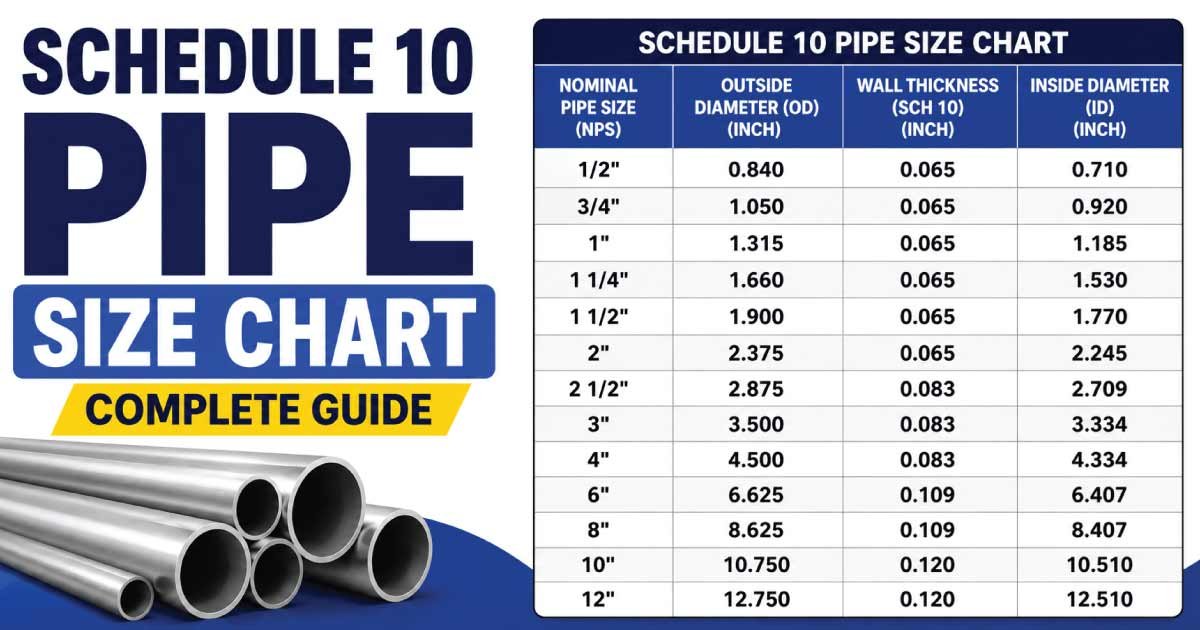
When selecting pipe for plumbing, mechanical, industrial, process, and fabrication applications, understanding wall thickness and actual pipe dimensions is essential. Schedule 10 pipe is commonly associated with relatively thin-wall construction, making it useful in applications where lower weight and a larger internal passage are desirable.
Schedule 10 pipe is identified using nominal pipe size (NPS), while its actual dimensions include outside diameter, wall thickness, inside diameter, and other dimensional characteristics. The nominal size should not be confused with the actual outside or inside diameter.
For example, a 2-inch Schedule 10 pipe has an actual outside diameter of approximately 2.375 inches, not 2 inches. Its wall thickness is approximately 0.065 inch, giving it an inside diameter of approximately 2.245 inches.
This complete guide explains Schedule 10 pipe dimensions, NPS, outside diameter, wall thickness, inside diameter, metric conversions, common sizes, comparisons with other schedules, measurement methods, applications, and frequently asked questions.
Schedule 10 Pipe Size Chart
The following table provides common Schedule 10 pipe dimensions.
| Nominal Pipe Size | Outside Diameter (in) | Outside Diameter (mm) | Wall Thickness (in) | Wall Thickness (mm) | Approx. ID (in) | Approx. ID (mm) |
|---|---|---|---|---|---|---|
| 1/8″ | 0.405 | 10.3 | 0.049 | 1.24 | 0.307 | 7.8 |
| 1/4″ | 0.540 | 13.7 | 0.065 | 1.65 | 0.410 | 10.4 |
| 3/8″ | 0.675 | 17.1 | 0.065 | 1.65 | 0.545 | 13.8 |
| 1/2″ | 0.840 | 21.3 | 0.083 | 2.11 | 0.674 | 17.1 |
| 3/4″ | 1.050 | 26.7 | 0.083 | 2.11 | 0.884 | 22.5 |
| 1″ | 1.315 | 33.4 | 0.109 | 2.77 | 1.097 | 27.9 |
| 1-1/4″ | 1.660 | 42.2 | 0.109 | 2.77 | 1.442 | 36.6 |
| 1-1/2″ | 1.900 | 48.3 | 0.109 | 2.77 | 1.682 | 42.7 |
| 2″ | 2.375 | 60.3 | 0.065 | 1.65 | 2.245 | 57.0 |
| 2-1/2″ | 2.875 | 73.0 | 0.083 | 2.11 | 2.709 | 68.8 |
| 3″ | 3.500 | 88.9 | 0.083 | 2.11 | 3.334 | 84.7 |
| 3-1/2″ | 4.000 | 101.6 | 0.083 | 2.11 | 3.834 | 97.4 |
| 4″ | 4.500 | 114.3 | 0.083 | 2.11 | 4.334 | 110.1 |
| 5″ | 5.563 | 141.3 | 0.109 | 2.77 | 5.345 | 135.8 |
| 6″ | 6.625 | 168.3 | 0.134 | 3.40 | 6.357 | 161.5 |
| 8″ | 8.625 | 219.1 | 0.148 | 3.76 | 8.329 | 211.6 |
| 10″ | 10.750 | 273.1 | 0.165 | 4.19 | 10.420 | 264.7 |
| 12″ | 12.750 | 323.9 | 0.180 | 4.57 | 12.390 | 314.7 |
| 14″ | 14.000 | 355.6 | 0.188 | 4.78 | 13.624 | 346.0 |
| 16″ | 16.000 | 406.4 | 0.188 | 4.78 | 15.624 | 396.8 |
| 18″ | 18.000 | 457.2 | 0.188 | 4.78 | 17.624 | 447.6 |
| 20″ | 20.000 | 508.0 | 0.218 | 5.54 | 19.564 | 496.9 |
| 22″ | 22.000 | 558.8 | 0.250 | 6.35 | 21.500 | 546.1 |
| 24″ | 24.000 | 609.6 | 0.250 | 6.35 | 23.500 | 596.9 |
| 26″ | 26.000 | 660.4 | 0.250 | 6.35 | 25.500 | 647.7 |
| 28″ | 28.000 | 711.2 | 0.250 | 6.35 | 27.500 | 698.5 |
| 30″ | 30.000 | 762.0 | 0.312 | 7.92 | 29.376 | 746.2 |
| 32″ | 32.000 | 812.8 | 0.312 | 7.92 | 31.376 | 797.0 |
| 36″ | 36.000 | 914.4 | 0.312 | 7.92 | 35.376 | 898.6 |
| 40″ | 40.000 | 1016.0 | 0.312 | 7.92 | 39.376 | 1000.2 |
| 42″ | 42.000 | 1066.8 | 0.312 | 7.92 | 41.376 | 1050.9 |
| 44″ | 44.000 | 1117.6 | 0.312 | 7.92 | 43.376 | 1101.7 |
| 48″ | 48.000 | 1219.2 | 0.312 | 7.92 | 47.376 | 1203.3 |
Important: Dimensions can vary according to the applicable standard, pipe material, manufacturing specification, size range, and product tolerance. Always verify the exact specification before engineering, fabrication, or purchasing.
What Is Schedule 10 Pipe?
Schedule 10 pipe is a standardized pipe wall-thickness designation used for certain nominal pipe sizes.
The word Schedule refers primarily to the pipe wall thickness classification rather than the pipe’s nominal diameter.
Schedule 10 is generally a relatively thin-wall option compared with heavier schedules such as:
- Schedule 40
- Schedule 80
- Schedule 120
- Schedule 160
For a given nominal pipe size, Schedule 10 generally provides a thinner wall and therefore a larger internal diameter than a heavier-wall schedule.
This makes Schedule 10 useful when the application does not require the additional wall thickness associated with heavier pipe.
What Does Schedule 10 Mean?
Schedule 10 does not mean that the pipe has a wall thickness of exactly 0.010 inch.
This is an important distinction.
The schedule designation is part of a standardized dimensional system. The actual wall thickness depends on the nominal pipe size.
For example:
- 1-inch Schedule 10 → approximately 0.109-inch wall
- 2-inch Schedule 10 → approximately 0.065-inch wall
- 4-inch Schedule 10 → approximately 0.083-inch wall
- 8-inch Schedule 10 → approximately 0.148-inch wall
- 12-inch Schedule 10 → approximately 0.180-inch wall
Therefore, Schedule 10 should be treated as a pipe wall classification rather than a universal wall measurement.
Nominal Pipe Size vs. Actual Dimensions
Nominal pipe size, commonly abbreviated as NPS, is a standardized designation.
It does not necessarily represent the actual outside diameter or inside diameter.
For example:
2-inch Schedule 10 pipe
has an actual OD of approximately:
2.375 inches
Its approximate ID is:
2.245 inches
Therefore, a nominal 2-inch pipe is not physically 2 inches across its exterior.
Understanding this distinction is important when selecting fittings, supports, clamps, valves, and other piping components.
Schedule 10 Pipe OD Chart
For a particular NPS, the outside diameter is standardized and generally remains the same when comparing different schedules.
| NPS | Schedule 10 OD (in) | OD (mm) |
|---|---|---|
| 1/8″ | 0.405 | 10.3 |
| 1/4″ | 0.540 | 13.7 |
| 3/8″ | 0.675 | 17.1 |
| 1/2″ | 0.840 | 21.3 |
| 3/4″ | 1.050 | 26.7 |
| 1″ | 1.315 | 33.4 |
| 1-1/4″ | 1.660 | 42.2 |
| 1-1/2″ | 1.900 | 48.3 |
| 2″ | 2.375 | 60.3 |
| 2-1/2″ | 2.875 | 73.0 |
| 3″ | 3.500 | 88.9 |
| 4″ | 4.500 | 114.3 |
| 6″ | 6.625 | 168.3 |
| 8″ | 8.625 | 219.1 |
| 10″ | 10.750 | 273.1 |
| 12″ | 12.750 | 323.9 |
| 16″ | 16.000 | 406.4 |
| 20″ | 20.000 | 508.0 |
| 24″ | 24.000 | 609.6 |
The OD is one of the most useful dimensions for identifying pipe and selecting compatible components.
Schedule 10 Pipe ID Chart
The internal diameter is determined by the outside diameter and wall thickness.
The basic formula is:
ID = OD − 2 × Wall Thickness
Common approximate Schedule 10 IDs include:
| NPS | Approx. ID (in) | Approx. ID (mm) |
|---|---|---|
| 1/2″ | 0.674 | 17.1 |
| 3/4″ | 0.884 | 22.5 |
| 1″ | 1.097 | 27.9 |
| 1-1/4″ | 1.442 | 36.6 |
| 1-1/2″ | 1.682 | 42.7 |
| 2″ | 2.245 | 57.0 |
| 2-1/2″ | 2.709 | 68.8 |
| 3″ | 3.334 | 84.7 |
| 4″ | 4.334 | 110.1 |
| 5″ | 5.345 | 135.8 |
| 6″ | 6.357 | 161.5 |
| 8″ | 8.329 | 211.6 |
| 10″ | 10.420 | 264.7 |
| 12″ | 12.390 | 314.7 |
| 14″ | 13.624 | 346.0 |
| 16″ | 15.624 | 396.8 |
| 20″ | 19.564 | 496.9 |
| 24″ | 23.500 | 596.9 |
Schedule 10 Pipe Wall Thickness
Wall thickness varies with nominal pipe size.
| NPS | Approx. Wall Thickness |
|---|---|
| 1/8″ | 0.049″ |
| 1/4″ | 0.065″ |
| 3/8″ | 0.065″ |
| 1/2″ | 0.083″ |
| 3/4″ | 0.083″ |
| 1″ | 0.109″ |
| 1-1/4″ | 0.109″ |
| 1-1/2″ | 0.109″ |
| 2″ | 0.065″ |
| 2-1/2″ | 0.083″ |
| 3″ | 0.083″ |
| 4″ | 0.083″ |
| 6″ | 0.134″ |
| 8″ | 0.148″ |
| 10″ | 0.165″ |
| 12″ | 0.180″ |
| 14″ | 0.188″ |
| 16″ | 0.188″ |
| 18″ | 0.188″ |
| 20″ | 0.218″ |
| 24″ | 0.250″ |
These values illustrate an important point: Schedule 10 does not correspond to one fixed wall thickness.
Schedule 10 Pipe Size in Millimeters
For readers working with metric dimensions, the most common Schedule 10 dimensions can be converted to millimeters.
| NPS | OD (mm) | Wall (mm) | Approx. ID (mm) |
|---|---|---|---|
| 1/2″ | 21.3 | 2.11 | 17.1 |
| 3/4″ | 26.7 | 2.11 | 22.5 |
| 1″ | 33.4 | 2.77 | 27.9 |
| 1-1/4″ | 42.2 | 2.77 | 36.6 |
| 1-1/2″ | 48.3 | 2.77 | 42.7 |
| 2″ | 60.3 | 1.65 | 57.0 |
| 2-1/2″ | 73.0 | 2.11 | 68.8 |
| 3″ | 88.9 | 2.11 | 84.7 |
| 4″ | 114.3 | 2.11 | 110.1 |
| 6″ | 168.3 | 3.40 | 161.5 |
| 8″ | 219.1 | 3.76 | 211.6 |
| 10″ | 273.1 | 4.19 | 264.7 |
| 12″ | 323.9 | 4.57 | 314.7 |
The conversion is based on:
1 inch = 25.4 mm
1/2-Inch Schedule 10 Pipe
A 1/2-inch Schedule 10 pipe has an approximate:
- OD: 0.840 inch
- OD: 21.3 mm
- Wall thickness: 0.083 inch
- Wall thickness: 2.11 mm
- ID: 0.674 inch
- ID: 17.1 mm
This size is commonly encountered in smaller piping installations.
3/4-Inch Schedule 10 Pipe
A 3/4-inch Schedule 10 pipe has approximately:
- OD: 1.050 inches
- OD: 26.7 mm
- Wall: 0.083 inch
- Wall: 2.11 mm
- ID: 0.884 inch
- ID: 22.5 mm
The actual application depends on the pipe material, connection system, pressure, and design requirements.
1-Inch Schedule 10 Pipe
1-inch Schedule 10 pipe has an approximate:
OD: 1.315 inches
Wall thickness: 0.109 inch
ID: 1.097 inches
In metric terms:
OD: 33.4 mm
Wall: 2.77 mm
ID: 27.9 mm
1-1/2-Inch Schedule 10 Pipe
The approximate dimensions are:
- OD: 1.900 inches
- Wall thickness: 0.109 inch
- ID: 1.682 inches
- OD: 48.3 mm
- Wall: 2.77 mm
- ID: 42.7 mm
2-Inch Schedule 10 Pipe
2-inch Schedule 10 is one of the most useful examples when comparing pipe schedules.
Its approximate dimensions are:
- OD: 2.375 inches
- Wall thickness: 0.065 inch
- ID: 2.245 inches
- OD: 60.3 mm
- Wall thickness: 1.65 mm
- ID: 57.0 mm
The relatively thin wall gives this pipe a larger internal opening than heavier schedules of the same nominal size.
3-Inch Schedule 10 Pipe
3-inch Schedule 10 pipe has approximately:
- OD: 3.500 inches
- Wall: 0.083 inch
- ID: 3.334 inches
Metric dimensions are approximately:
- OD: 88.9 mm
- Wall: 2.11 mm
- ID: 84.7 mm
4-Inch Schedule 10 Pipe
4-inch Schedule 10 pipe has approximately:
OD: 4.500 inches
Wall: 0.083 inch
ID: 4.334 inches
In metric units:
OD: 114.3 mm
Wall: 2.11 mm
ID: 110.1 mm
6-Inch Schedule 10 Pipe
6-inch Schedule 10 pipe has approximately:
- OD: 6.625 inches
- Wall thickness: 0.134 inch
- ID: 6.357 inches
Metric values are approximately:
- OD: 168.3 mm
- Wall: 3.40 mm
- ID: 161.5 mm
8-Inch Schedule 10 Pipe
8-inch Schedule 10 pipe has approximately:
- OD: 8.625 inches
- Wall: 0.148 inch
- ID: 8.329 inches
Metric:
- OD: 219.1 mm
- Wall: 3.76 mm
- ID: 211.6 mm
10-Inch Schedule 10 Pipe
10-inch Schedule 10 pipe has approximately:
- OD: 10.750 inches
- Wall: 0.165 inch
- ID: 10.420 inches
Metric:
- OD: 273.1 mm
- Wall: 4.19 mm
- ID: 264.7 mm
12-Inch Schedule 10 Pipe
12-inch Schedule 10 pipe has approximately:
- OD: 12.750 inches
- Wall: 0.180 inch
- ID: 12.390 inches
Metric:
- OD: 323.9 mm
- Wall: 4.57 mm
- ID: 314.7 mm
14-Inch Schedule 10 Pipe
14-inch Schedule 10 pipe has approximately:
- OD: 14.000 inches
- Wall: 0.188 inch
- ID: 13.624 inches
Metric:
- OD: 355.6 mm
- Wall: 4.78 mm
- ID: 346.0 mm
For larger-diameter pipe, actual product dimensions should be verified against the applicable dimensional standard.
Also Read:
16-Inch Schedule 10 Pipe
16-inch Schedule 10 pipe has approximately:
- OD: 16.000 inches
- Wall: 0.188 inch
- ID: 15.624 inches
Metric:
- OD: 406.4 mm
- Wall: 4.78 mm
- ID: 396.8 mm
20-Inch Schedule 10 Pipe
20-inch Schedule 10 pipe has approximately:
- OD: 20.000 inches
- Wall: 0.218 inch
- ID: 19.564 inches
Metric:
- OD: 508.0 mm
- Wall: 5.54 mm
- ID: 496.9 mm
24-Inch Schedule 10 Pipe
24-inch Schedule 10 pipe has approximately:
- OD: 24.000 inches
- Wall: 0.250 inch
- ID: 23.500 inches
Metric:
- OD: 609.6 mm
- Wall: 6.35 mm
- ID: 596.9 mm
Schedule 10 vs. Schedule 40
One of the most common questions is how Schedule 10 compares with Schedule 40.
For the same nominal pipe size, the outside diameter is generally the same, but the wall thickness differs.
For example, 2-inch pipe:
| Feature | Schedule 10 | Schedule 40 |
|---|---|---|
| OD | 2.375″ | 2.375″ |
| Wall | 0.065″ | 0.154″ |
| ID | 2.245″ | 2.067″ |
| Relative Wall | Thinner | Thicker |
| Relative ID | Larger | Smaller |
This means Schedule 10 can provide a larger internal flow passage, while Schedule 40 provides a thicker wall.
The correct choice depends on pressure, temperature, mechanical requirements, corrosion allowance, material, and applicable design standards.
Schedule 10 vs. Schedule 80
Schedule 80 generally has a substantially thicker wall than Schedule 10 for the same nominal size.
Consequently:
Schedule 10 → thinner wall and larger ID
Schedule 80 → thicker wall and smaller ID
The heavier wall of Schedule 80 may be beneficial where greater mechanical or pressure capability is required, but the correct pipe must be selected according to the actual design conditions.
Also Read:
Does Schedule 10 Have the Same OD as Schedule 40?
For the same NPS, standard Schedule 10 and Schedule 40 pipe generally have the same established outside diameter.
The difference is primarily the wall thickness.
For example:
2-inch NPS
OD:
2.375 inches
Schedule 10 has a thinner wall.
Schedule 40 has a thicker wall.
Therefore, the internal diameter differs even though the outside diameter is the same.
Does Schedule 10 Mean Thin-Wall Pipe?
Schedule 10 is generally considered a relatively thin-wall schedule compared with heavier common schedules.
However, “thin wall” is relative.
A Schedule 10 pipe’s suitability depends on:
- Pipe size
- Material
- Pressure
- Temperature
- Corrosion allowance
- Loading
- Design code
- Installation conditions
A pipe should never be selected solely because Schedule 10 appears to provide sufficient wall thickness.
Schedule 10 Pipe Applications
Schedule 10 pipe can be used in various applications where its dimensional and mechanical characteristics are appropriate.
Potential applications include:
- Low-pressure piping
- Process piping
- HVAC systems
- Water systems
- Drainage applications
- Compressed-air systems
- Industrial utility piping
- Structural applications
- Fabrication projects
- Certain sanitary piping systems
The exact suitability depends on the pipe material and applicable code.
Stainless Steel Schedule 10 Pipe
Schedule 10 is particularly common as a designation for stainless steel pipe.
Stainless steel Schedule 10 pipe may be used in applications where corrosion resistance and a relatively large internal flow area are important.
Potential environments include:
- Food processing
- Chemical processing
- Water treatment
- Pharmaceutical facilities
- Industrial process systems
- Architectural applications
However, material grade, temperature, pressure, corrosion environment, welding requirements, and applicable standards must be considered before selecting stainless steel pipe.
Schedule 10 Pipe for Flow Applications
The relatively thin wall of Schedule 10 can provide a larger ID compared with heavier schedules of the same nominal size.
A larger ID means:
- Greater flow area
- Lower velocity for a given flow rate
- Potentially lower friction loss
However, actual system performance also depends on pipe length, fluid properties, fittings, valves, elevation, and operating conditions.
Therefore, pipe ID is an important input to flow calculations, but it is not the only factor.
How to Calculate Schedule 10 Pipe ID
The basic calculation is simple:
ID = OD − 2 × Wall Thickness
For 2-inch Schedule 10 pipe:
OD = 2.375 inches
Wall = 0.065 inch
Therefore:
ID = 2.375 − (2 × 0.065)
ID = 2.245 inches
In metric units:
2.245 × 25.4 ≈ 57.0 mm
This provides the approximate internal diameter.
How to Measure Schedule 10 Pipe
If you have an unidentified pipe, several measurements can help establish its dimensions.
Measure the Outside Diameter
Use a caliper for smaller pipe or a suitable diameter measurement method for larger pipe.
Measure the Wall Thickness
An ultrasonic thickness gauge can be useful where the pipe cannot be cut or accessed internally.
Measure the Inside Diameter
If the end is accessible, an inside caliper or suitable gauge can be used.
Compare the Measurements
Compare OD and wall thickness against the relevant Schedule 10 dimensional table.
Verify the Material and Standard
Dimensional similarity alone does not prove that the pipe conforms to a particular specification.
Also Read:
Schedule 10 Pipe and Fittings
Fitting compatibility depends on more than nominal pipe size.
Consider:
- NPS
- OD
- Wall thickness
- Connection type
- Material
- Pressure rating
- Temperature
- Applicable standard
For welded systems, wall thickness can be particularly important because welding procedures may depend on the actual pipe dimensions and material.
Schedule 10 Pipe and Threaded Connections
Not every Schedule 10 pipe is suitable for every threaded connection.
The relatively thin wall can affect the available thread engagement and mechanical strength.
For threaded applications, the applicable pipe-thread standard and manufacturer’s requirements must be checked carefully.
Depending on the application, welded, flanged, grooved, or other connection methods may be more appropriate.
Schedule 10 Pipe Weight
Pipe weight depends on several factors, including:
- Outside diameter
- Wall thickness
- Pipe length
- Material density
Because Schedule 10 generally uses a thinner wall than heavier schedules, its weight per unit length is generally lower for the same nominal size and material.
However, exact weight should be taken from the manufacturer’s product data or calculated using the specified material density and dimensional standard.
Advantages of Schedule 10 Pipe
Potential advantages include:
- Lower material weight
- Larger internal diameter compared with heavier schedules
- Potentially lower material cost
- Easier handling for some applications
- Useful flow area
- Availability in various materials
These benefits must be evaluated against pressure, mechanical, temperature, and durability requirements.
Limitations of Schedule 10 Pipe
Schedule 10 is not suitable for every piping application.
Potential limitations include:
- Lower wall thickness
- Lower mechanical robustness than heavier-wall pipe
- Greater sensitivity to damage
- Potential limitations for high-pressure systems
- Different suitability depending on material and size
The correct schedule must be selected based on the design requirements rather than simply choosing the thinnest available wall.
Common Schedule 10 Pipe Mistakes
Mistake 1: Thinking Schedule 10 Means 0.010-Inch Wall
It does not. Wall thickness varies according to nominal pipe size.
Mistake 2: Assuming a 2-Inch Pipe Has a 2-Inch OD
A 2-inch NPS pipe has an OD of approximately 2.375 inches.
Mistake 3: Ignoring Pipe Material
Steel, stainless steel, and other materials have different mechanical and application characteristics.
Mistake 4: Selecting Pipe by ID Alone
Pressure, temperature, material, corrosion, and code requirements must also be considered.
Mistake 5: Assuming All Schedule 10 Dimensions Are Universal
Exact dimensions should be verified against the relevant standard and product specification.
Frequently Asked Questions About Schedule 10 Pipe
What is Schedule 10 pipe?
Schedule 10 is a standardized pipe wall-thickness classification generally associated with relatively thin-wall pipe.
Is Schedule 10 thinner than Schedule 40?
Yes. For many common nominal sizes, Schedule 10 has a thinner wall than Schedule 40.
Is Schedule 10 the same as Schedule 10S?
Not necessarily. The designation 10S is associated with specific stainless steel dimensional standards and should not automatically be treated as identical to every use of “Schedule 10.”
What is the OD of 2-inch Schedule 10 pipe?
The approximate OD is 2.375 inches, or 60.3 mm.
What is the ID of 2-inch Schedule 10 pipe?
The approximate ID is 2.245 inches, or 57.0 mm.
What is the wall thickness of 2-inch Schedule 10 pipe?
A commonly listed wall thickness is approximately 0.065 inch, or 1.65 mm.
What is the OD of 4-inch Schedule 10 pipe?
The approximate OD is 4.500 inches, or 114.3 mm.
What is the ID of 4-inch Schedule 10 pipe?
The approximate ID is 4.334 inches, or 110.1 mm.
What is the OD of 6-inch Schedule 10 pipe?
The approximate OD is 6.625 inches, or 168.3 mm.
What is the ID of 6-inch Schedule 10 pipe?
The approximate ID is 6.357 inches, or 161.5 mm.
What is the wall thickness of Schedule 10 pipe?
It depends on the nominal pipe size. There is no single wall thickness for all Schedule 10 pipe.
Does Schedule 10 have a larger ID than Schedule 40?
For the same nominal size, Schedule 10 generally has a larger ID because it has a thinner wall.
Does Schedule 10 have the same OD as Schedule 40?
For the same NPS under standard pipe dimensions, the OD is generally the same while wall thickness differs.
Is Schedule 10 suitable for high pressure?
Suitability depends on pipe material, size, temperature, pressure, design code, and other engineering conditions. The schedule should be selected based on the complete design requirement.
Can Schedule 10 pipe be threaded?
Threading suitability depends on pipe size, wall thickness, material, thread standard, and application. Thin-wall pipe may not be appropriate for every threaded connection.
Is Schedule 10 pipe good for water?
It can be used in certain water applications when the material, pressure, temperature, joining method, and applicable requirements are appropriate.
Is Schedule 10 pipe lighter than Schedule 40?
Generally, yes, because it has a thinner wall for the same nominal size and material.
What is the difference between Schedule 10 and Schedule 10S?
The exact distinction depends on the applicable dimensional and material standard. “10S” is commonly used within stainless steel pipe specifications, so the relevant standard should be checked rather than treating the terms as universally interchangeable.
Schedule 10 Pipe Quick Reference
For quick identification, these common sizes are useful:
| NPS | OD | Wall | ID |
|---|---|---|---|
| 1/2″ | 0.840″ | 0.083″ | 0.674″ |
| 3/4″ | 1.050″ | 0.083″ | 0.884″ |
| 1″ | 1.315″ | 0.109″ | 1.097″ |
| 1-1/4″ | 1.660″ | 0.109″ | 1.442″ |
| 1-1/2″ | 1.900″ | 0.109″ | 1.682″ |
| 2″ | 2.375″ | 0.065″ | 2.245″ |
| 2-1/2″ | 2.875″ | 0.083″ | 2.709″ |
| 3″ | 3.500″ | 0.083″ | 3.334″ |
| 4″ | 4.500″ | 0.083″ | 4.334″ |
| 6″ | 6.625″ | 0.134″ | 6.357″ |
| 8″ | 8.625″ | 0.148″ | 8.329″ |
| 10″ | 10.750″ | 0.165″ | 10.420″ |
| 12″ | 12.750″ | 0.180″ | 12.390″ |
Final Thoughts
Schedule 10 pipe is a useful option when a relatively thin wall, lower weight, and larger internal passage are appropriate for the application. However, the schedule number alone does not tell you the complete pipe dimensions.
The actual dimensions depend on the nominal pipe size.
For every pipe, it is useful to distinguish between:
- NPS — nominal pipe size
- OD — outside diameter
- Wall thickness — thickness of the pipe wall
- ID — inside diameter
- Schedule — standardized wall-thickness designation
The basic relationship is:
ID = OD − 2 × Wall Thickness
For example, a 2-inch Schedule 10 pipe has an approximate OD of 2.375 inches, wall thickness of 0.065 inch, and ID of 2.245 inches.
When comparing Schedule 10 with Schedule 40 or Schedule 80, remember that the outside diameter for the same NPS generally remains standardized while the wall thickness changes. A thinner wall produces a larger internal opening, while a thicker wall produces a smaller internal opening.
For purchasing, fabrication, pressure applications, and engineering design, always verify the exact dimensions, material grade, tolerances, pressure-temperature requirements, and applicable pipe standard before making a final selection.