
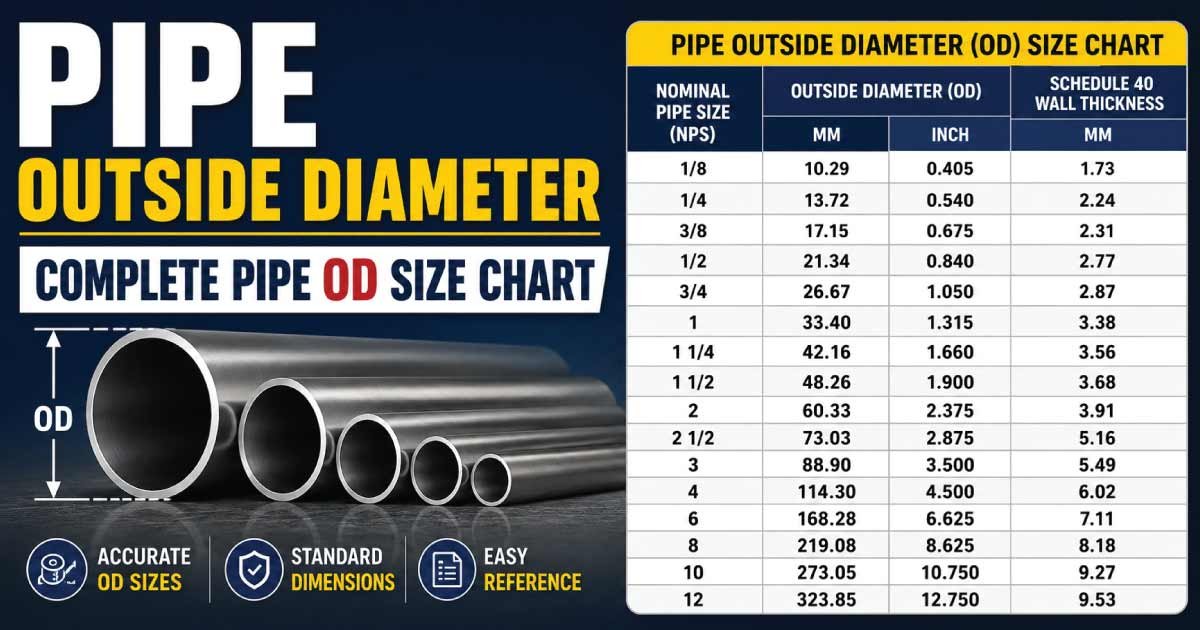
The outside diameter of a pipe is one of the most important measurements used when identifying pipe, selecting fittings, designing piping systems, and determining compatibility between different components.
A pipe’s outside diameter (OD) is the distance measured straight across the outside of the pipe from one outer surface to the opposite outer surface.
One important point is that nominal pipe size (NPS) does not always equal the actual outside diameter. For example, a 1-inch nominal steel pipe has an actual outside diameter of approximately 1.315 inches.
The actual OD is generally consistent across different wall thicknesses within the same nominal pipe size. What changes with schedule is primarily the wall thickness and resulting inside diameter.
Pipe OD Chart
The following chart provides common nominal pipe sizes and their standard outside diameters.
| Nominal Pipe Size | Outside Diameter (in) | Outside Diameter (mm) |
|---|---|---|
| 1/8″ | 0.405 | 10.3 |
| 1/4″ | 0.540 | 13.7 |
| 3/8″ | 0.675 | 17.1 |
| 1/2″ | 0.840 | 21.3 |
| 3/4″ | 1.050 | 26.7 |
| 1″ | 1.315 | 33.4 |
| 1-1/4″ | 1.660 | 42.2 |
| 1-1/2″ | 1.900 | 48.3 |
| 2″ | 2.375 | 60.3 |
| 2-1/2″ | 2.875 | 73.0 |
| 3″ | 3.500 | 88.9 |
| 3-1/2″ | 4.000 | 101.6 |
| 4″ | 4.500 | 114.3 |
| 5″ | 5.563 | 141.3 |
| 6″ | 6.625 | 168.3 |
| 8″ | 8.625 | 219.1 |
| 10″ | 10.750 | 273.1 |
| 12″ | 12.750 | 323.9 |
| 14″ | 14.000 | 355.6 |
| 16″ | 16.000 | 406.4 |
| 18″ | 18.000 | 457.2 |
| 20″ | 20.000 | 508.0 |
| 22″ | 22.000 | 558.8 |
| 24″ | 24.000 | 609.6 |
| 26″ | 26.000 | 660.4 |
| 28″ | 28.000 | 711.2 |
| 30″ | 30.000 | 762.0 |
| 32″ | 32.000 | 812.8 |
| 34″ | 34.000 | 863.6 |
| 36″ | 36.000 | 914.4 |
| 40″ | 40.000 | 1016.0 |
| 42″ | 42.000 | 1066.8 |
| 44″ | 44.000 | 1117.6 |
| 48″ | 48.000 | 1219.2 |
What Is Pipe Outside Diameter?
Pipe outside diameter, commonly abbreviated as OD, is the measured diameter across the exterior surface of a pipe.
If you place a caliper across a round pipe, the measurement from one outside edge to the opposite outside edge is the pipe’s outside diameter.
For example, a standard:
2-inch nominal pipe
has an actual OD of approximately:
2.375 inches
or:
60.3 mm
This is why a nominal 2-inch pipe cannot be assumed to measure exactly 2 inches across the outside.
Nominal Pipe Size vs. Actual Outside Diameter
Nominal Pipe Size (NPS) is a standardized designation rather than a direct measurement of pipe OD.
This is particularly important for smaller pipe sizes.
For example:
| Nominal Size | Actual OD |
|---|---|
| 1/2″ | 0.840″ |
| 3/4″ | 1.050″ |
| 1″ | 1.315″ |
| 1-1/4″ | 1.660″ |
| 1-1/2″ | 1.900″ |
| 2″ | 2.375″ |
| 3″ | 3.500″ |
| 4″ | 4.500″ |
As pipe sizes become larger, the nominal designation increasingly corresponds to the actual OD for many standard sizes. For example, 14-inch NPS has an OD of 14 inches.
Pipe OD in Inches and Millimeters
Pipe dimensions are frequently specified in both imperial and metric units.
The conversion is:
1 inch = 25.4 mm
For example:
2.375 × 25.4 = 60.325 mm
Therefore, the standard OD of 2-inch nominal pipe is approximately:
60.3 mm
Common Pipe OD Conversions
| Nominal Pipe Size | OD (in) | OD (mm) |
|---|---|---|
| 1/2″ | 0.840 | 21.3 |
| 3/4″ | 1.050 | 26.7 |
| 1″ | 1.315 | 33.4 |
| 1-1/4″ | 1.660 | 42.2 |
| 1-1/2″ | 1.900 | 48.3 |
| 2″ | 2.375 | 60.3 |
| 2-1/2″ | 2.875 | 73.0 |
| 3″ | 3.500 | 88.9 |
| 4″ | 4.500 | 114.3 |
| 6″ | 6.625 | 168.3 |
| 8″ | 8.625 | 219.1 |
| 10″ | 10.750 | 273.1 |
| 12″ | 12.750 | 323.9 |
Does Pipe Schedule Change Outside Diameter?
For most standard NPS steel pipe, the outside diameter remains the same across different schedules for a given nominal size.
What changes is primarily the wall thickness.
For example, 2-inch pipe can be manufactured in several schedules, such as:
- Schedule 10
- Schedule 40
- Schedule 80
- Schedule 160
The OD remains approximately:
2.375 inches
while the wall thickness changes.
Because the wall becomes thicker, the inside diameter becomes smaller.
Pipe OD and Wall Thickness
The relationship between OD, wall thickness, and inside diameter is:
ID = OD − 2 × Wall Thickness
For example, if a pipe has:
- OD = 2.375 inches
- Wall thickness = 0.154 inch
Then:
ID = 2.375 − (2 × 0.154)
ID = 2.067 inches
This calculation demonstrates why outside diameter alone does not determine the inside diameter.
Pipe OD Chart for Common Small Sizes
| NPS | OD in Inches | OD in mm |
|---|---|---|
| 1/8″ | 0.405 | 10.3 |
| 1/4″ | 0.540 | 13.7 |
| 3/8″ | 0.675 | 17.1 |
| 1/2″ | 0.840 | 21.3 |
| 3/4″ | 1.050 | 26.7 |
| 1″ | 1.315 | 33.4 |
| 1-1/4″ | 1.660 | 42.2 |
| 1-1/2″ | 1.900 | 48.3 |
| 2″ | 2.375 | 60.3 |
| 2-1/2″ | 2.875 | 73.0 |
| 3″ | 3.500 | 88.9 |
| 3-1/2″ | 4.000 | 101.6 |
| 4″ | 4.500 | 114.3 |
These sizes are widely used in industrial, commercial, plumbing, and mechanical piping applications.
Pipe OD Chart for Large Sizes
| NPS | OD (in) | OD (mm) |
|---|---|---|
| 6″ | 6.625 | 168.3 |
| 8″ | 8.625 | 219.1 |
| 10″ | 10.750 | 273.1 |
| 12″ | 12.750 | 323.9 |
| 14″ | 14.000 | 355.6 |
| 16″ | 16.000 | 406.4 |
| 18″ | 18.000 | 457.2 |
| 20″ | 20.000 | 508.0 |
| 22″ | 22.000 | 558.8 |
| 24″ | 24.000 | 609.6 |
| 26″ | 26.000 | 660.4 |
| 28″ | 28.000 | 711.2 |
| 30″ | 30.000 | 762.0 |
| 32″ | 32.000 | 812.8 |
| 36″ | 36.000 | 914.4 |
| 40″ | 40.000 | 1016.0 |
| 42″ | 42.000 | 1066.8 |
| 48″ | 48.000 | 1219.2 |
Pipe OD vs. Pipe ID
Pipe OD and pipe ID are different measurements.
OD is the outside diameter.
ID is the inside diameter.
The ID depends on:
- Outside diameter
- Wall thickness
- Pipe schedule
- Manufacturing specification
For the same nominal pipe size, increasing the wall thickness decreases the available inside diameter.
For example, a 2-inch pipe with a thin wall will have a larger ID than a 2-inch pipe with a much thicker wall.
Also Read:
How to Measure Pipe Outside Diameter
Measuring pipe OD is straightforward when the pipe is accessible.
Using a Caliper
A caliper provides a direct measurement of the outside diameter.
Place the jaws around the outside of the pipe and ensure that they are positioned across the widest point.
Using a Tape Measure
For larger pipes, you can measure the outside circumference and calculate OD.
The formula is:
OD = Circumference ÷ π
For example, if the measured circumference is approximately 7.46 inches:
7.46 ÷ 3.14159 ≈ 2.375 inches
This corresponds closely to the standard OD of 2-inch nominal pipe.
How to Identify Pipe Size From OD
If you have an unknown pipe, measuring its OD can help identify its nominal size.
For example, suppose the measured OD is approximately:
2.375 inches
Compare this measurement with a standard pipe OD table.
The corresponding nominal size is:
NPS 2
If the OD is approximately:
4.500 inches
the nominal size is:
NPS 4
This method is particularly useful when pipe markings are unavailable or unreadable.
Common Pipe OD Examples
1/2-Inch Pipe
Nominal size:
1/2 inch
Actual OD:
0.840 inch
Approximately:
21.3 mm
1-Inch Pipe
Nominal size:
1 inch
Actual OD:
1.315 inches
Approximately:
33.4 mm
2-Inch Pipe
Nominal size:
2 inches
Actual OD:
2.375 inches
Approximately:
60.3 mm
4-Inch Pipe
Nominal size:
4 inches
Actual OD:
4.500 inches
Approximately:
114.3 mm
6-Inch Pipe
Nominal size:
6 inches
Actual OD:
6.625 inches
Approximately:
168.3 mm
Pipe OD and Fittings
Outside diameter is important when selecting compatible components.
Depending on the piping system, components can include:
- Couplings
- Flanges
- Unions
- Clamps
- Pipe supports
- Compression fittings
- Weld fittings
- Threaded fittings
- Grooved fittings
However, fitting compatibility cannot always be determined from OD alone.
You may also need to know:
- Pipe standard
- Nominal size
- Wall thickness
- Material
- Connection type
- Pressure rating
- Thread specification
Also Read:
Pipe OD and Flanges
Flange selection involves more than simply matching the pipe outside diameter.
Important flange characteristics can include:
- Nominal pipe size
- Pressure class
- Bolt-hole pattern
- Flange outside diameter
- Bore diameter
- Flange thickness
- Facing type
- Material
A flange designed for a particular nominal pipe size must be compatible with the pipe and the piping standard being used.
Pipe OD and Threaded Pipe
Threaded pipe requires additional consideration.
A threaded fitting may be specified according to nominal pipe size and a pipe-thread standard rather than simply the measured outside diameter.
For example, NPT thread dimensions include more than the basic pipe OD.
When working with threaded pipe, identify:
- Nominal pipe size
- Thread type
- Thread pitch
- Taper
- Thread length
- Fitting standard
Do not assume that two pipes with similar measured diameters have compatible threads.
Pipe OD and Tubing Are Different
One of the most common sources of confusion is treating pipe and tubing as the same sizing system.
Pipe is often identified by nominal pipe size and schedule.
Tubing is commonly specified directly by its outside diameter and wall thickness.
For example:
2-inch nominal pipe
has an OD of approximately:
2.375 inches
while:
2-inch tubing
typically has an actual OD of:
2.000 inches
Therefore, a 2-inch pipe and 2-inch tubing are not necessarily the same physical size.
Pipe OD vs. Tube OD
| Product | Typical Identification |
|---|---|
| Pipe | Nominal pipe size |
| Tubing | Actual outside diameter |
| Pipe wall | Schedule or wall thickness |
| Tube wall | Direct wall thickness |
| Pipe ID | Depends on OD and wall |
| Tube ID | OD minus two wall thicknesses |
This distinction is extremely important when selecting clamps, fittings, sleeves, and connectors.
Schedule and Outside Diameter
Pipe schedules such as:
- Schedule 10
- Schedule 20
- Schedule 30
- Schedule 40
- Schedule 60
- Schedule 80
- Schedule 100
- Schedule 120
- Schedule 140
- Schedule 160
are primarily related to pipe wall thickness.
For a given NPS, the standard OD generally remains unchanged while schedule changes the wall thickness.
Therefore, a 2-inch Schedule 40 pipe and 2-inch Schedule 80 pipe have the same nominal OD but different wall thicknesses and IDs.
Why Pipe OD Is Important
Pipe OD affects many aspects of a piping installation.
It can influence:
- Fitting compatibility
- Pipe supports
- Clamps
- Insulation
- Sleeves
- Structural penetrations
- Welding preparation
- Connection dimensions
- Mechanical clearances
Accurate OD information helps prevent incorrect component selection.
Also Read:
Pipe OD Measurement Tolerances
Real-world pipe measurements may differ slightly from the nominal or tabulated value.
Manufacturing standards specify allowable dimensional tolerances.
Factors affecting measurements can include:
- Manufacturing tolerance
- Ovality
- Surface condition
- Measurement location
- Temperature
- Measuring instrument accuracy
- Pipe deformation
For ordinary identification, a small difference may be expected. For precision fabrication or critical applications, always use the applicable pipe standard and manufacturer’s dimensional requirements.
Pipe Outside Diameter Conversion Chart
| OD (in) | OD (mm) |
|---|---|
| 0.405 | 10.3 |
| 0.540 | 13.7 |
| 0.675 | 17.1 |
| 0.840 | 21.3 |
| 1.050 | 26.7 |
| 1.315 | 33.4 |
| 1.660 | 42.2 |
| 1.900 | 48.3 |
| 2.375 | 60.3 |
| 2.875 | 73.0 |
| 3.500 | 88.9 |
| 4.000 | 101.6 |
| 4.500 | 114.3 |
| 5.563 | 141.3 |
| 6.625 | 168.3 |
| 8.625 | 219.1 |
| 10.750 | 273.1 |
| 12.750 | 323.9 |
How to Calculate Pipe Inside Diameter
If the OD and wall thickness are known, the approximate inside diameter can be calculated with:
ID = OD − 2 × Wall Thickness
For example:
OD = 4.500 inches
Wall thickness = 0.237 inches
Then:
ID = 4.500 − (2 × 0.237)
ID = 4.026 inches
The actual dimensional value should be verified against the applicable pipe standard because nominal and calculated values may not account for all manufacturing details.
Also Read:
Common Pipe OD Mistakes
Mistake 1: Assuming Nominal Size Equals OD
A 1-inch nominal pipe does not have a 1-inch outside diameter.
Mistake 2: Confusing Pipe With Tubing
Nominal pipe size and tube OD are different sizing conventions.
Mistake 3: Assuming Schedule Changes OD
For standard NPS pipe, schedule primarily changes wall thickness rather than OD.
Mistake 4: Choosing Fittings by OD Alone
Connection type, standard, material, and pressure rating also matter.
Mistake 5: Ignoring Measurement Tolerance
A physical measurement may vary slightly from the published nominal dimension.
Frequently Asked Questions About Pipe OD
What does OD mean in pipe sizing?
OD means outside diameter. It is the distance across the exterior of the pipe.
What is the OD of 1/2-inch pipe?
Standard 1/2-inch nominal pipe has an OD of approximately 0.840 inch (21.3 mm).
What is the OD of 1-inch pipe?
Standard 1-inch nominal pipe has an OD of approximately 1.315 inches (33.4 mm).
What is the OD of 2-inch pipe?
Standard 2-inch nominal pipe has an OD of approximately 2.375 inches (60.3 mm).
What is the OD of 3-inch pipe?
Standard 3-inch nominal pipe has an OD of approximately 3.500 inches (88.9 mm).
What is the OD of 4-inch pipe?
Standard 4-inch nominal pipe has an OD of approximately 4.500 inches (114.3 mm).
What is the OD of 6-inch pipe?
Standard 6-inch nominal pipe has an OD of approximately 6.625 inches (168.3 mm).
Does Schedule 40 change pipe OD?
For a given standard NPS, Schedule 40 does not normally change the established outside diameter. It primarily specifies wall thickness.
Does Schedule 80 have a larger OD than Schedule 40?
For the same NPS, standard Schedule 80 pipe generally has the same OD as Schedule 40, but a thicker wall and smaller ID.
Is pipe OD the same as tube OD?
No. Pipe is commonly identified by nominal pipe size, while tubing is commonly identified by actual outside diameter.
How do I measure pipe OD?
Use a caliper for smaller pipe or measure the circumference and divide by π for larger pipe.
Why is 2-inch pipe actually 2.375 inches?
Nominal pipe size is a standardized designation and does not necessarily represent the actual outside diameter.
Final Thoughts
Understanding pipe outside diameter is essential for correctly identifying pipe and selecting compatible components. The most important point to remember is that nominal pipe size and actual outside diameter are not always the same.
For example:
- 1/2-inch NPS → 0.840-inch OD
- 1-inch NPS → 1.315-inch OD
- 2-inch NPS → 2.375-inch OD
- 3-inch NPS → 3.500-inch OD
- 4-inch NPS → 4.500-inch OD
- 6-inch NPS → 6.625-inch OD
- 8-inch NPS → 8.625-inch OD
- 10-inch NPS → 10.750-inch OD
- 12-inch NPS → 12.750-inch OD
For standard NPS pipe, the outside diameter generally stays the same as the schedule changes, while the wall thickness and inside diameter change.
When identifying an unknown pipe, measure the outside diameter, compare it with a reliable pipe OD table, and then verify the nominal size, schedule, material, and applicable standard. For fabrication and critical industrial applications, always confirm dimensions against the relevant specification rather than relying solely on a general reference chart.