
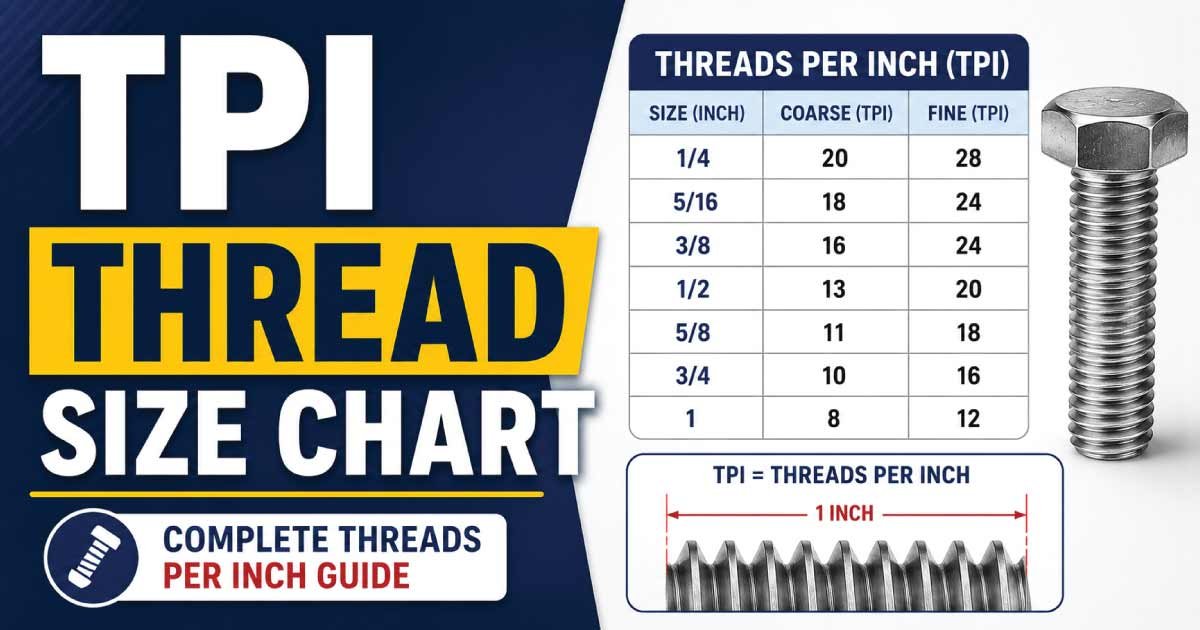
Threads are one of the most important parts of bolts, nuts, screws, studs, threaded rods, fittings, and other mechanical fasteners. When working with imperial or inch-based fasteners, thread identification often depends on TPI, which means Threads Per Inch.
TPI tells you how many complete thread peaks are present within one inch of thread length. For example, a fastener with 20 TPI has 20 threads in one inch.
Understanding TPI is essential when identifying an unknown bolt, selecting a matching nut, comparing coarse and fine threads, converting between thread specifications, and avoiding cross-threading.
This complete guide explains TPI, common thread sizes, UNC, UNF, UNEF, thread pitch, diameter, TPI measurement, metric-to-imperial comparisons, and how to identify an unknown threaded fastener.
What Does TPI Mean?
TPI stands for Threads Per Inch.
It describes the number of thread peaks measured along one inch of a threaded fastener.
For example:
- 8 TPI = 8 threads per inch
- 10 TPI = 10 threads per inch
- 12 TPI = 12 threads per inch
- 16 TPI = 16 threads per inch
- 20 TPI = 20 threads per inch
- 24 TPI = 24 threads per inch
TPI is primarily used with imperial or Unified inch thread systems.
The higher the TPI number, the smaller the distance between individual threads.
For example, a 24 TPI thread has more closely spaced threads than a 12 TPI thread.
TPI Thread Size Chart
The following table provides common Unified inch thread sizes and their typical coarse and fine thread counts.
| Nominal Diameter | UNC TPI | UNF TPI | UNEF TPI |
|---|---|---|---|
| #0 | 80 | 80 | — |
| #1 | 64 | 72 | — |
| #2 | 56 | 64 | — |
| #3 | 48 | 56 | — |
| #4 | 40 | 48 | — |
| #5 | 40 | 44 | — |
| #6 | 32 | 40 | — |
| #8 | 32 | 36 | — |
| #10 | 24 | 32 | — |
| #12 | 24 | 28 | — |
| 1/4 in | 20 | 28 | 32 |
| 5/16 in | 18 | 24 | 32 |
| 3/8 in | 16 | 24 | 32 |
| 7/16 in | 14 | 20 | 28 |
| 1/2 in | 13 | 20 | 28 |
| 9/16 in | 12 | 18 | 24 |
| 5/8 in | 11 | 18 | 24 |
| 3/4 in | 10 | 16 | 20 |
| 7/8 in | 9 | 14 | 20 |
| 1 in | 8 | 12 | 20 |
| 1-1/8 in | 7 | 12 | 18 |
| 1-1/4 in | 7 | 12 | 18 |
| 1-3/8 in | 6 | 12 | 18 |
| 1-1/2 in | 6 | 12 | 18 |
| 1-5/8 in | 5 | 8 | 18 |
| 1-3/4 in | 5 | 8 | 16 |
| 2 in | 4.5 | 8 | 16 |
The table provides common Unified thread combinations. Not every diameter is manufactured in every possible thread series.
What Is a Thread Size?
Thread size is a combination of the thread’s nominal diameter and thread pitch or TPI.
For example:
1/2-13 UNC
means:
- 1/2 inch nominal diameter
- 13 threads per inch
- UNC = Unified National Coarse
Another example is:
1/2-20 UNF
which means:
- 1/2 inch nominal diameter
- 20 threads per inch
- UNF = Unified National Fine
Both are 1/2-inch threads, but their TPI values are different.
A nut designed for 1/2-13 UNC should not be forced onto a 1/2-20 UNF bolt.
TPI vs. Thread Pitch
TPI and thread pitch describe the spacing between threads, but they use different units.
TPI
TPI tells you how many threads occur in one inch.
Thread Pitch
Pitch is the distance from one thread crest to the next.
For inch threads:
Pitch in inches = 1 ÷ TPI
For example:
20 TPI
has a pitch of:
1 ÷ 20 = 0.050 inch
Therefore, adjacent thread crests are approximately 0.050 inch apart.
TPI to Thread Pitch Conversion Chart
| TPI | Pitch in Inches | Approx. Pitch in mm |
|---|---|---|
| 4 | 0.2500 | 6.350 mm |
| 5 | 0.2000 | 5.080 mm |
| 6 | 0.1667 | 4.233 mm |
| 7 | 0.1429 | 3.629 mm |
| 8 | 0.1250 | 3.175 mm |
| 9 | 0.1111 | 2.822 mm |
| 10 | 0.1000 | 2.540 mm |
| 11 | 0.0909 | 2.309 mm |
| 12 | 0.0833 | 2.117 mm |
| 13 | 0.0769 | 1.954 mm |
| 14 | 0.0714 | 1.814 mm |
| 16 | 0.0625 | 1.588 mm |
| 18 | 0.0556 | 1.411 mm |
| 20 | 0.0500 | 1.270 mm |
| 24 | 0.0417 | 1.058 mm |
| 28 | 0.0357 | 0.907 mm |
| 32 | 0.03125 | 0.794 mm |
| 36 | 0.0278 | 0.706 mm |
| 40 | 0.0250 | 0.635 mm |
| 48 | 0.0208 | 0.529 mm |
| 56 | 0.0179 | 0.454 mm |
| 64 | 0.0156 | 0.397 mm |
| 72 | 0.0139 | 0.353 mm |
| 80 | 0.0125 | 0.318 mm |
This conversion is useful when comparing inch-based threads with metric thread pitches.
What Is UNC Thread?
UNC stands for Unified National Coarse.
UNC is one of the major thread series used for inch-based fasteners.
Coarse threads have fewer threads per inch than fine threads of the same diameter.
For example:
1/2-13 UNC
has 13 threads per inch.
UNC threads are commonly used for general-purpose fastening applications.
They are often selected where ease of assembly, robustness, and general-purpose performance are important.
What Is UNF Thread?
UNF stands for Unified National Fine.
UNF threads have more threads per inch than the corresponding UNC thread for the same nominal diameter.
For example:
- 1/2-13 UNC
- 1/2-20 UNF
Both are 1/2-inch diameter threads, but UNF has 20 TPI compared with 13 TPI for UNC.
Fine threads can provide greater adjustment per unit length and are commonly used in various mechanical and automotive applications.
What Is UNEF Thread?
UNEF stands for Unified National Extra Fine.
UNEF threads have an even higher TPI than UNF threads for applicable diameters.
For example, a 1/2-inch thread can have:
- UNC = 13 TPI
- UNF = 20 TPI
- UNEF = 28 TPI
The higher thread count produces a smaller pitch.
UNEF threads are used for specialized applications where an extra-fine thread is appropriate.
UNC vs. UNF vs. UNEF
| Thread Series | Meaning | General Characteristics |
|---|---|---|
| UNC | Unified National Coarse | Larger pitch, fewer TPI |
| UNF | Unified National Fine | Smaller pitch, more TPI |
| UNEF | Unified National Extra Fine | Very small pitch, high TPI |
The correct thread series depends on the application, material, joint design, manufacturing requirements, and applicable standard.
Common TPI Thread Sizes
Some TPI combinations are especially common in inch-based fasteners.
1/4-20 UNC
This is a widely encountered coarse thread.
- Diameter: 1/4 inch
- TPI: 20
- Series: UNC
1/4-28 UNF
A fine-thread version of the 1/4-inch diameter.
- Diameter: 1/4 inch
- TPI: 28
- Series: UNF
5/16-18 UNC
A common coarse thread.
- Diameter: 5/16 inch
- TPI: 18
5/16-24 UNF
Fine-thread version.
- Diameter: 5/16 inch
- TPI: 24
3/8-16 UNC
A common 3/8-inch coarse thread.
3/8-24 UNF
A common 3/8-inch fine thread.
1/2-13 UNC
One of the most recognizable coarse inch thread sizes.
1/2-20 UNF
The corresponding common fine thread.
TPI Chart for Common Inch Bolts
| Bolt Diameter | Coarse TPI | Fine TPI |
|---|---|---|
| 1/4 in | 20 | 28 |
| 5/16 in | 18 | 24 |
| 3/8 in | 16 | 24 |
| 7/16 in | 14 | 20 |
| 1/2 in | 13 | 20 |
| 9/16 in | 12 | 18 |
| 5/8 in | 11 | 18 |
| 3/4 in | 10 | 16 |
| 7/8 in | 9 | 14 |
| 1 in | 8 | 12 |
| 1-1/8 in | 7 | 12 |
| 1-1/4 in | 7 | 12 |
| 1-3/8 in | 6 | 12 |
| 1-1/2 in | 6 | 12 |
| 1-3/4 in | 5 | 8 |
| 2 in | 4.5 | 8 |
This table is a convenient reference for common UNC and UNF thread sizes.
How to Measure TPI
There are several ways to determine TPI.
Using a Thread Pitch Gauge
A thread pitch gauge is the easiest method.
Select an inch-based blade and place it against the threads.
When the teeth align perfectly with the thread profile, the number printed on the blade indicates the TPI.
Counting Threads
You can also count threads manually.
Measure a one-inch section and count the thread peaks.
For example, if you count 16 complete threads over one inch, the thread is approximately 16 TPI.
Using a Shorter Measurement
If the threaded section is shorter than one inch, count the number of thread spaces over a known distance.
For example, if you count 8 threads over 1/2 inch:
8 × 2 = 16 TPI
This method is useful but less convenient than using a thread gauge.
How to Identify an Unknown Imperial Bolt
Identifying an unknown bolt requires more than measuring its diameter.
Step 1: Measure Diameter
Use a caliper to measure the outside diameter of the threaded section.
Step 2: Determine Whether It Is Metric or Imperial
Compare the measurement against common metric and inch diameters.
Step 3: Measure TPI
Use a thread pitch gauge or count the threads.
Step 4: Identify Thread Series
Once you know diameter and TPI, compare them with UNC, UNF, or UNEF charts.
Step 5: Verify the Nut
If a matching nut is available, check that it threads smoothly without force.
Never force an unknown nut onto a bolt because this can damage the thread.
TPI Identification Example
Suppose you measure an unknown bolt and find:
- Diameter ≈ 0.500 inch
- Thread count = 13 TPI
The likely identification is:
1/2-13 UNC
If the same diameter has 20 TPI, it would likely be:
1/2-20 UNF
If it has 28 TPI, it may be:
1/2-28 UNEF
This demonstrates why both diameter and TPI are necessary for proper thread identification.
Also Read:
TPI and Metric Threads
Metric threads are normally identified by thread pitch in millimeters, rather than TPI.
For example:
M10 × 1.5
means:
- 10 mm nominal diameter
- 1.5 mm thread pitch
However, metric pitch can be converted to an approximate TPI value.
The formula is:
TPI = 25.4 ÷ Pitch in mm
For a 1.5 mm pitch:
25.4 ÷ 1.5 ≈ 16.93 TPI
This does not make the metric thread equivalent to a 17 TPI imperial thread. Thread diameter, profile, pitch, and standard all matter.
Metric Pitch to TPI Conversion
| Metric Pitch | Approx. TPI |
|---|---|
| 0.25 mm | 101.6 |
| 0.30 mm | 84.67 |
| 0.35 mm | 72.57 |
| 0.40 mm | 63.50 |
| 0.45 mm | 56.44 |
| 0.50 mm | 50.80 |
| 0.60 mm | 42.33 |
| 0.70 mm | 36.29 |
| 0.75 mm | 33.87 |
| 0.80 mm | 31.75 |
| 1.00 mm | 25.40 |
| 1.25 mm | 20.32 |
| 1.50 mm | 16.93 |
| 1.75 mm | 14.51 |
| 2.00 mm | 12.70 |
| 2.50 mm | 10.16 |
| 3.00 mm | 8.47 |
| 3.50 mm | 7.26 |
| 4.00 mm | 6.35 |
These are mathematical conversions only and do not establish interchangeability between metric and inch threads.
Why Similar TPI Threads Can Still Be Incompatible
Thread compatibility depends on more than TPI.
Two threads may appear similar but still be incompatible because of differences in:
- Nominal diameter
- Thread pitch
- Thread form
- Thread angle
- Thread standard
- Major diameter
- Minor diameter
- Tolerance class
For example, a metric M8 × 1.25 thread has a pitch of 1.25 mm, which converts to approximately 20.32 TPI.
A nearby imperial thread may have 20 TPI, but that does not mean the two threads are interchangeable.
Even a small pitch difference can cause cross-threading or joint failure.
Coarse vs. Fine Threads
Thread pitch is one of the most important distinctions between coarse and fine threads.
Coarse Threads
Coarse threads have:
- Fewer TPI
- Larger thread spacing
- Larger pitch
For example:
1/2-13 UNC
Fine Threads
Fine threads have:
- More TPI
- Smaller thread spacing
- Smaller pitch
For example:
1/2-20 UNF
Both have the same nominal diameter, but the thread spacing is different.
Advantages of Coarse Threads
Coarse threads are commonly selected because they can offer several practical benefits.
They generally:
- Assemble quickly
- Are easier to start
- Are less sensitive to minor thread damage
- Are suitable for general-purpose fastening
- Work well in many common applications
Coarse threads are often a practical choice for general mechanical assemblies.
Advantages of Fine Threads
Fine threads can offer different benefits.
They generally:
- Provide more threads over a given length
- Allow finer adjustment
- Can provide greater thread engagement per unit length
- Are useful for certain mechanical applications
- Can be suitable where material thickness or adjustment requirements favor fine threads
Fine threads are not automatically stronger or better. The appropriate thread depends on the specific application.
Also Read:
TPI and Thread Engagement
Thread engagement refers to the amount of threaded contact between mating components.
For example, when a bolt is inserted into a tapped hole, the number of threads engaged contributes to the joint’s ability to transfer load.
Thread engagement requirements depend on:
- Bolt diameter
- Material
- Thread type
- Strength
- Loading
- Joint design
Using a fine thread does not automatically eliminate the need for adequate thread engagement.
For critical connections, follow the relevant engineering specification.
TPI and Bolt Strength
TPI can influence thread geometry and the effective cross-sectional area of a threaded fastener, but TPI alone does not determine bolt strength.
Fastener strength depends on:
- Material
- Grade
- Diameter
- Thread size
- Thread engagement
- Heat treatment
- Loading conditions
- Manufacturing standard
A high-strength bolt with an appropriate thread specification may perform very differently from a low-strength fastener with the same TPI.
TPI and Nut Compatibility
The nut must have the same basic thread specification as the bolt.
For example:
1/2-13 UNC bolt
requires a compatible:
1/2-13 UNC nut
It should not be paired with:
1/2-20 UNF
because the thread pitch is different.
Likewise, a metric nut should not be substituted simply because its diameter appears close.
TPI Thread Chart for Numbered Screws
Smaller inch fasteners are often identified using numbered sizes.
| Screw Size | UNC TPI | UNF TPI |
|---|---|---|
| #0 | 80 | 80 |
| #1 | 64 | 72 |
| #2 | 56 | 64 |
| #3 | 48 | 56 |
| #4 | 40 | 48 |
| #5 | 40 | 44 |
| #6 | 32 | 40 |
| #8 | 32 | 36 |
| #10 | 24 | 32 |
| #12 | 24 | 28 |
Numbered fasteners are common in smaller screws and machine fasteners.
The number does not directly represent the diameter in inches.
Also Read:
What Is a Thread Series?
A thread series defines a standardized combination of thread diameter, pitch, and geometry.
Common Unified thread series include:
- UNC
- UNF
- UNEF
- UNS
UNC
Unified National Coarse.
UNF
Unified National Fine.
UNEF
Unified National Extra Fine.
UNS
Unified Special.
UNS is used for thread combinations that do not fall within the standard coarse, fine, or extra-fine series.
What Is UNS Thread?
UNS means Unified National Special.
UNS threads are used when a specific diameter and pitch combination is required that does not fit the standard UNC, UNF, or UNEF series.
For example, a specialized application may specify a particular TPI that is not part of the standard series for that diameter.
UNS threads should always be identified from the complete specification rather than guessed from appearance.
TPI for Common Pipe Threads
TPI is also used with certain inch-based pipe threads, but pipe threads are a separate subject from standard Unified bolt threads.
Examples include:
- NPT
- NPS
- BSP-related systems
A pipe thread specification includes more than just TPI.
For example, pipe thread compatibility may depend on:
- Nominal pipe size
- Thread form
- TPI
- Taper
- Thread angle
- Standard
Therefore, an NPT thread should not be identified solely by counting TPI.
TPI vs. Thread Size
A common mistake is assuming that TPI alone identifies the thread size.
It does not.
For example, several different bolt diameters can have similar TPI values.
A complete identification normally requires:
Diameter + TPI + Thread Series
For example:
3/8-16 UNC
This provides significantly more information than simply saying “16 TPI.”
How to Read an Imperial Thread Marking
An imperial thread marking often looks like:
3/8-16 UNC × 2
The components mean:
- 3/8 = nominal diameter
- 16 = threads per inch
- UNC = Unified National Coarse
- 2 = nominal bolt length in inches
Another example:
1/2-20 UNF × 1-1/2
means:
- 1/2-inch nominal diameter
- 20 TPI
- Unified National Fine
- 1-1/2-inch nominal length
This format makes it easier to order an exact replacement.
TPI and Thread Pitch Formula
The relationship between TPI and pitch is simple.
Pitch in Inches
Pitch = 1 ÷ TPI
For 16 TPI:
1 ÷ 16 = 0.0625 inch
Pitch in Millimeters
Multiply inch pitch by 25.4:
0.0625 × 25.4 = 1.5875 mm
Therefore, a 16 TPI thread has a theoretical pitch of approximately 1.588 mm.
This conversion is useful when comparing thread spacing, but it should not be used alone to determine thread compatibility.
Common TPI Mistakes
Counting Threads Incorrectly
Make sure you measure a known distance and count consistently.
Confusing TPI With Diameter
TPI describes thread spacing, not bolt diameter.
Ignoring Thread Series
13 TPI on a 1/2-inch bolt is different from 13 TPI on another diameter.
Mixing UNC and UNF
The same diameter can have different TPI values.
Forcing Metric and Imperial Threads Together
Similar dimensions do not guarantee compatibility.
Using TPI to Identify Pipe Threads Without Checking the Standard
Pipe threads have additional dimensional requirements.
How to Choose the Correct TPI
The correct TPI depends on the fastener specification and application.
Consider:
- Nominal diameter
- Required thread series
- TPI
- Thread engagement
- Material
- Strength requirement
- Application
- Nut or tapped-hole specification
- Operating environment
- Applicable standard
If replacing an existing fastener, the safest approach is usually to match the original diameter, TPI, thread series, length, material, and strength class.
TPI Thread Size Quick Reference
| Size | UNC | UNF |
|---|---|---|
| #6 | 32 TPI | 40 TPI |
| #8 | 32 TPI | 36 TPI |
| #10 | 24 TPI | 32 TPI |
| 1/4 | 20 TPI | 28 TPI |
| 5/16 | 18 TPI | 24 TPI |
| 3/8 | 16 TPI | 24 TPI |
| 7/16 | 14 TPI | 20 TPI |
| 1/2 | 13 TPI | 20 TPI |
| 9/16 | 12 TPI | 18 TPI |
| 5/8 | 11 TPI | 18 TPI |
| 3/4 | 10 TPI | 16 TPI |
| 7/8 | 9 TPI | 14 TPI |
| 1 | 8 TPI | 12 TPI |
| 1-1/4 | 7 TPI | 12 TPI |
| 1-1/2 | 6 TPI | 12 TPI |
| 2 | 4.5 TPI | 8 TPI |
Frequently Asked Questions About TPI
What does TPI stand for?
TPI stands for Threads Per Inch. It describes the number of thread peaks along one inch of a threaded fastener.
What does 20 TPI mean?
20 TPI means that there are 20 thread intervals per inch of thread length, corresponding to a pitch of 0.050 inch.
Is higher TPI a finer thread?
Yes. For the same nominal diameter, a higher TPI generally means a finer thread with smaller spacing.
What is the difference between 1/2-13 and 1/2-20?
Both have a nominal diameter of 1/2 inch, but 1/2-13 has 13 TPI while 1/2-20 has 20 TPI. The former is a common UNC thread, while the latter is a common UNF thread.
How do I measure TPI?
Use an inch thread pitch gauge or count the threads over a known one-inch distance.
Can I convert TPI to millimeters?
Yes. Thread pitch in millimeters can be calculated approximately as:
25.4 ÷ TPI
Is TPI the same as metric thread pitch?
No. TPI is expressed as threads per inch, while metric thread pitch is expressed as the distance between threads in millimeters.
Can a metric bolt replace an imperial bolt with a similar TPI?
Not automatically. Diameter, pitch, thread form, tolerances, and standard must all be compatible.
What is UNC?
UNC stands for Unified National Coarse, a common inch thread series.
What is UNF?
UNF stands for Unified National Fine, a finer thread series than UNC for the same nominal diameter.
What is UNEF?
UNEF stands for Unified National Extra Fine and uses a still finer thread for applicable diameters.
What is the most common TPI for a 1/2-inch bolt?
Common Unified thread options include 1/2-13 UNC and 1/2-20 UNF.
What TPI is a 3/8-inch bolt?
Common options include 3/8-16 UNC and 3/8-24 UNF.
What TPI is a 1/4-inch bolt?
Common options include 1/4-20 UNC and 1/4-28 UNF.
Does TPI determine bolt strength?
No. Bolt strength depends on diameter, material, grade, thread geometry, engagement, loading, and other engineering factors.
Final Thoughts on TPI Thread Sizes
TPI is an essential measurement for identifying and selecting imperial threaded fasteners. It tells you how many threads occur in one inch and provides a quick way to distinguish coarse and fine thread combinations.
However, TPI alone is not enough to identify a complete thread. You should also determine the nominal diameter and thread series. For example, 1/2-13 UNC and 1/2-20 UNF have the same nominal diameter but different thread spacing and are not interchangeable.
For common inch fasteners, the most useful combinations to remember include 1/4-20 UNC, 1/4-28 UNF, 5/16-18 UNC, 5/16-24 UNF, 3/8-16 UNC, 3/8-24 UNF, 1/2-13 UNC, and 1/2-20 UNF.
When identifying an unknown fastener, measure the outside diameter, determine the TPI, and then compare both measurements with a recognized thread standard. For critical mechanical, automotive, structural, or industrial applications, also verify the material, strength grade, thread tolerance, and applicable specification before selecting a replacement.