
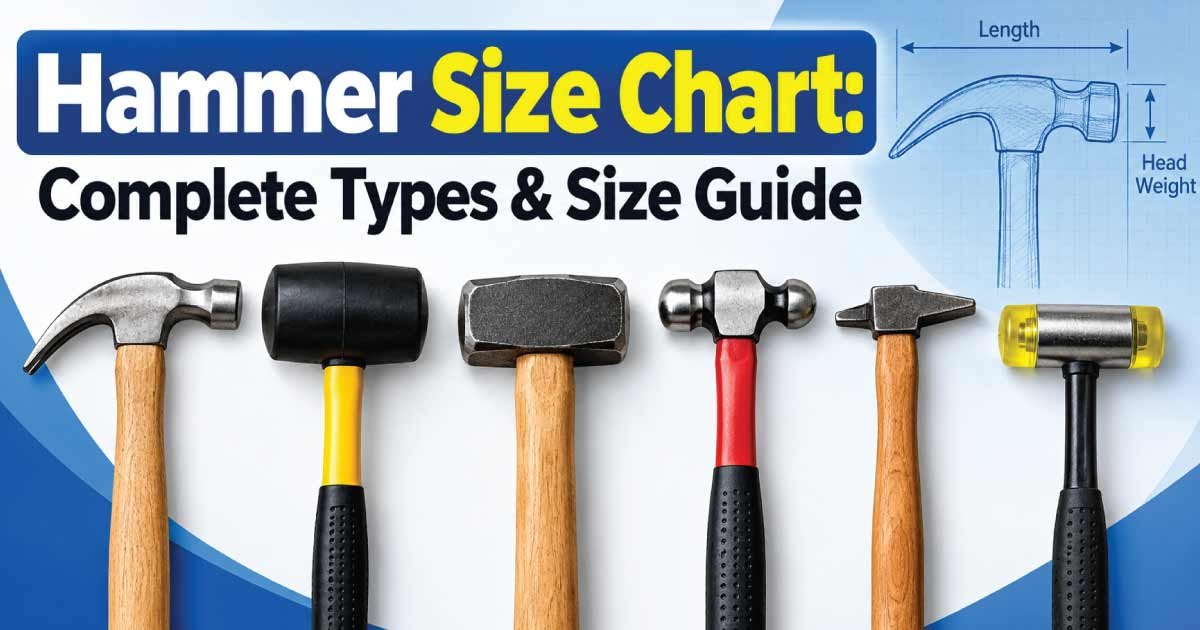
Choosing the right hammer is not simply a matter of picking the heaviest tool available. Hammer size, head weight, handle length, face shape, and hammer type all affect how much force you can apply, how accurately you can strike, and what materials you can safely work with.
A hammer size chart makes it easier to compare common hammer weights and understand which size is appropriate for carpentry, framing, metalworking, automotive repair, masonry, demolition, and general maintenance.
Hammer sizes are commonly identified by head weight, especially for claw, ball-peen, framing, and sledge hammers. A lighter hammer generally provides greater control and can reduce fatigue, while a heavier hammer can deliver more impact when the job requires it. Manufacturer catalogs illustrate the wide range of available sizes; for example, Stanley currently lists claw and framing hammers from lightweight models through 28 oz framing hammers, while other hammer categories extend into several pounds.
This guide explains common hammer sizes, major hammer types, typical applications, weight conversions, how to choose the right hammer, and mistakes to avoid.
What Does Hammer Size Mean?
For many traditional hammers, size refers primarily to the weight of the hammer head, rather than the total weight of the complete tool.
For example, a 16 oz claw hammer has a head weighing approximately 16 ounces, while the handle adds additional weight.
Hammer size can therefore be described using:
- Head weight — commonly ounces or pounds
- Overall length — the complete hammer length
- Handle length — from grip to head
- Face diameter — the size of the striking surface
- Head dimensions — the physical dimensions of the hammer head
Head weight is particularly important because it influences the balance and striking characteristics of the tool. Grainger notes that heavier heads generally provide harder impacts, while lighter heads offer greater control and can reduce arm fatigue during extended use.
However, weight alone does not determine hammer performance. A 16 oz framing hammer and a 16 oz ball-peen hammer are designed for completely different jobs.
Hammer Size Chart by Common Head Weight
The following chart provides a practical reference for commonly encountered hammer weights. These are general size categories, not universal standards. Actual available sizes vary by hammer type and manufacturer.
| Hammer Head Weight | Approx. Metric Weight | General Size Category | Typical Applications |
|---|---|---|---|
| 4 oz | 113 g | Very light | Small craft and light work |
| 8 oz | 227 g | Light | Finishing and light assembly |
| 10 oz | 283 g | Light | Light carpentry and household work |
| 12 oz | 340 g | Light-medium | General light-duty work |
| 16 oz | 454 g | Medium | General carpentry and maintenance |
| 20 oz | 567 g | Medium-heavy | Framing and heavier carpentry |
| 24 oz | 680 g | Heavy | Metalwork and masonry-related tasks |
| 28 oz | 794 g | Heavy | Framing and demanding construction work |
| 32 oz | 907 g | Heavy | Metalworking and heavy striking |
| 2 lb | 907 g | Heavy | Engineering and striking work |
| 3 lb | 1.36 kg | Very heavy | Heavy-duty maintenance |
| 4 lb | 1.81 kg | Sledge/heavy | Demolition and driving tasks |
| 6 lb | 2.72 kg | Heavy sledge | Heavy demolition |
| 8 lb | 3.63 kg | Heavy sledge | Major striking and demolition |
| 10 lb+ | 4.54 kg+ | Very heavy | Specialized heavy-duty work |
The same weight can represent very different tools. For example, a 32 oz ball-peen hammer is intended for metalworking, while a 4 lb sledge hammer is designed for substantially heavier striking tasks.
Claw Hammer Size Chart
The claw hammer is one of the most versatile hammers for carpentry and household work. It normally has a striking face on one end and a claw on the other.
Claw hammers are commonly available in several head weights.
| Head Weight | Approx. Metric Weight | Typical Use |
|---|---|---|
| 8 oz | 227 g | Light finishing work |
| 10 oz | 283 g | Small carpentry tasks |
| 12 oz | 340 g | Light general work |
| 16 oz | 454 g | General-purpose carpentry |
| 20 oz | 567 g | Heavier carpentry and framing |
| 24 oz | 680 g | Heavy-duty construction |
| 28 oz | 794 g | Heavy framing |
A 16 oz claw hammer is a common general-purpose choice because it offers a balance between striking power and control. Stanley’s current hammer range, for example, includes 10 oz, 16 oz, 20 oz, and 28 oz claw/framing configurations.
Curved Claw vs Rip Claw
The claw design affects how the hammer behaves.
Curved-claw hammers are commonly associated with pulling nails and general carpentry. The curved claw can provide useful leverage when removing fasteners.
Rip-claw or straight-claw hammers are often preferred for framing and demolition because the straighter claw can provide additional utility for pulling, prying, and separating materials.
Grainger describes curved claws as characteristic of claw hammers and straight claws as characteristic of framing hammers.
Framing Hammer Size Chart
Framing hammers are built for demanding construction work, especially wood framing. They are generally heavier than lightweight finish hammers and may feature a straighter claw, larger striking face, and textured or milled face depending on the design.
| Common Head Weight | Approx. Metric Weight | Typical Application |
|---|---|---|
| 16 oz | 454 g | General framing |
| 20 oz | 567 g | Heavy framing |
| 22 oz | 624 g | Heavy construction |
| 24 oz | 680 g | Demanding framing |
| 28 oz | 794 g | Heavy framing and construction |
There is no single universal framing-hammer size. Stanley’s current range, for example, includes 17 oz, 20 oz, and 28 oz framing configurations.
A heavier framing hammer can increase striking force, but it can also increase fatigue. For repetitive work, the best hammer is often the one that provides sufficient driving force without requiring excessive effort.
Ball-Peen Hammer Size Chart
A ball-peen hammer is primarily associated with metalworking. It has a flat striking face on one side and a rounded peen on the other.
The ball-shaped peen is useful for shaping and peening metal, while the flat face can be used for driving punches, setting rivets, and other controlled striking operations.
| Head Weight | Approx. Metric Weight | Typical Use |
|---|---|---|
| 2 oz | 57 g | Very light metalwork |
| 4 oz | 113 g | Small precision work |
| 8 oz | 227 g | Light metalworking |
| 12 oz | 340 g | General metalworking |
| 16 oz | 454 g | General engineering work |
| 24 oz | 680 g | Heavy metalworking |
| 32 oz | 907 g | Heavy striking and forming |
The appropriate size depends heavily on the thickness and type of material being worked. A small ball-peen hammer gives more control for delicate work, while larger versions provide more impact.
For example, a current 32 oz ball-peen model listed by Grainger has a 1¾-inch striking face and a 14-inch overall length, illustrating how head weight and physical dimensions work together rather than independently.
Sledge Hammer Size Chart
Sledge hammers are designed for high-impact work. They typically have a heavy head and a longer handle that allows the user to generate substantial striking force.
| Head Weight | Approx. Metric Weight | Typical Application |
|---|---|---|
| 2 lb | 0.91 kg | Light heavy-duty work |
| 3 lb | 1.36 kg | General heavy striking |
| 4 lb | 1.81 kg | Driving and demolition |
| 6 lb | 2.72 kg | Heavy demolition |
| 8 lb | 3.63 kg | Heavy-duty striking |
| 10 lb | 4.54 kg | Major demolition |
| 12 lb | 5.44 kg | Specialized heavy work |
| 16 lb | 7.26 kg | Very heavy striking |
Sledge hammers generally require more clearance than smaller hammers. Grainger describes sledge-type dead-blow models as having heavy double-faced heads and longer handles, with two-handed use providing the space needed to build momentum.
A larger sledge is not automatically better. The correct size depends on the material, task, available swing space, and user’s ability to control the tool.
Dead Blow Hammer Sizes
A dead blow hammer is designed to reduce rebound after impact. Many designs contain material or an internal mechanism that helps control the hammer after striking.
This makes dead-blow hammers useful when you want impact without excessive bounce or unnecessary damage to a work surface. Grainger describes dead-blow designs as tools that minimize rebound and transfer impact effectively to the workpiece.
Common head-weight ranges include:
| Typical Size | Approx. Metric Weight | Common Use |
|---|---|---|
| 12 oz | 340 g | Light assembly |
| 16 oz | 454 g | General maintenance |
| 24 oz | 680 g | Automotive and mechanical work |
| 28 oz | 794 g | Heavier maintenance |
| 3.5 lb | 1.59 kg | Heavy mechanical work |
| 4 lb | 1.81 kg | Heavy assembly and striking |
Actual dead-blow construction varies considerably. Some models use urethane heads, internal shot, removable faces, or other mechanisms. A manufacturer’s specifications should therefore be checked before selecting a particular model.
Rubber Mallet and Soft-Face Hammer Sizes
Rubber mallets and soft-face hammers are useful when a metal striking face could damage the workpiece.
Typical applications include:
- Furniture assembly
- Positioning components
- Installing trim
- Working with finished surfaces
- Aligning parts
- Light fabrication
- Assembly work
Common sizes include 8 oz, 12 oz, 16 oz, 24 oz, and larger models, although availability varies by design.
The important feature is not simply weight. The face material and hardness determine how the hammer interacts with the surface.
A soft face can reduce marking, but it does not mean the tool can be used safely for every application. Always make sure the face material is compatible with the workpiece.
Brick Hammer and Masonry Hammer Sizes
Masonry work uses specialized hammer designs rather than ordinary claw hammers.
A bricklayer’s hammer generally combines a striking face with a blade or chisel-like end for cutting and shaping masonry materials.
Typical examples include:
- Brick hammers
- Mason’s hammers
- Club hammers
- Chipping hammers
- Drilling hammers
Weight varies by design and manufacturer. Stanley, for example, currently lists a 24 oz bricklayer’s hammer, demonstrating that masonry hammer sizes can overlap with the heavier end of general-purpose hand hammers.
For masonry work, choose the hammer based on the specific material and task rather than selecting it solely by weight.
Hammer Types and Their Uses
Different hammer designs solve different problems.
| Hammer Type | Primary Use | Typical Size Consideration |
|---|---|---|
| Claw hammer | Carpentry and nails | Light to heavy |
| Framing hammer | Framing and construction | Medium-heavy to heavy |
| Ball-peen hammer | Metalworking | Small to heavy |
| Cross-peen hammer | Metal shaping | Light to medium |
| Sledge hammer | Demolition and heavy striking | Heavy |
| Dead-blow hammer | Controlled impact | Light to heavy |
| Rubber mallet | Surface-safe assembly | Light to medium |
| Soft-face hammer | Positioning and assembly | Light to medium |
| Brick hammer | Masonry | Medium-heavy |
| Tack hammer | Small fastening work | Very light |
| Drywall hammer | Drywall installation | Light |
| Blacksmith hammer | Forging and metalwork | Medium to heavy |
Hammer categories can overlap. A manufacturer may offer multiple designs within the same general category, so specifications should be checked before purchase.
Hammer Weight Conversion Chart
Hammer weights are often listed in ounces and pounds in the United States, while metric specifications may use grams or kilograms.
The basic conversions are:
1 pound = 16 ounces
1 pound ≈ 453.6 grams
1 ounce ≈ 28.35 grams
| Imperial Weight | Approx. Metric Equivalent |
|---|---|
| 4 oz | 113 g |
| 8 oz | 227 g |
| 10 oz | 283 g |
| 12 oz | 340 g |
| 16 oz | 454 g |
| 20 oz | 567 g |
| 24 oz | 680 g |
| 28 oz | 794 g |
| 32 oz | 907 g |
| 2 lb | 0.91 kg |
| 3 lb | 1.36 kg |
| 4 lb | 1.81 kg |
| 6 lb | 2.72 kg |
| 8 lb | 3.63 kg |
| 10 lb | 4.54 kg |
| 16 lb | 7.26 kg |
These are mathematical conversions and are provided for reference. A manufacturer’s stated product weight can differ slightly from the nominal head weight because the complete hammer includes the handle and other components.
Also Read:
How to Choose the Right Hammer Size
The best hammer is the one that provides enough impact for the task while remaining controllable.
Consider the Material
Soft materials generally require less aggressive impact than hard materials.
For example:
- Wood framing may require a claw or framing hammer.
- Sheet metal may require a smaller peening hammer.
- Finished surfaces may require a rubber or soft-face hammer.
- Demolition may require a sledge.
Consider the Required Force
Do not select a heavier hammer simply because it delivers more force.
A heavier tool can become difficult to control and may increase fatigue during repetitive work.
Consider the Strike Accuracy
Small, controlled tasks often benefit from lighter hammers.
Examples include:
- Small nails
- Pins
- Delicate assembly
- Light metal shaping
- Furniture fitting
Heavy hammers are more appropriate when impact energy is a priority and the workpiece can tolerate it.
Consider Handle Length
Handle length affects leverage, swing speed, reach, and control.
A long-handled sledge can generate substantial momentum, while a short-handled shop hammer provides more control in confined areas.
Consider Frequency of Use
If you will swing the hammer repeatedly for long periods, balance and ergonomics become especially important.
A tool that is slightly heavier but appropriate for occasional use may be unsuitable for continuous production work.
Also Read:
Head Weight vs Overall Hammer Weight
This distinction is important when comparing hammer specifications.
Suppose a manufacturer lists a hammer as 20 oz. That commonly refers to the head weight in traditional hammer classifications, not necessarily the total weight of the tool.
The complete hammer also includes:
- Handle
- Grip
- Head attachment components
- Protective materials
- Other design elements
Therefore, two 20 oz hammers can have different overall weights and different balances.
This is one reason why comparing head weight alone does not provide a complete picture of hammer performance.
How to Measure a Hammer
If you need to identify an unknown hammer, several measurements can be recorded.
Measure the Head Weight
Remove the handle only if the tool is designed to permit safe disassembly and you have an appropriate reason to do so. Otherwise, use the manufacturer’s identification information or product markings.
Do not modify a hammer merely to determine its nominal size.
Measure Overall Length
Measure from the end of the handle to the furthest point of the head.
Measure Face Diameter
Measure across the striking face where applicable.
Identify the Head Shape
Record whether the hammer has:
- Flat face
- Ball peen
- Cross peen
- Claw
- Rip claw
- Double face
- Soft face
- Specialty face
These details can often identify the hammer type more reliably than length alone.
Also Read:
Common Hammer Selection Mistakes
Several mistakes are easy to make when choosing or using a hammer.
Choosing the Heaviest Hammer
More weight is not always better. Excessive weight can reduce control and increase fatigue.
Using the Wrong Hammer Type
A claw hammer is not a substitute for a ball-peen hammer when controlled metal shaping is required. Likewise, a steel hammer may damage a finished surface where a soft-face hammer is appropriate.
Ignoring Handle Condition
A damaged, loose, cracked, or otherwise compromised handle can make a hammer unsafe to use.
Striking With the Wrong Face
Use the intended striking surface. Do not improvise with parts of the hammer that are not designed for impact.
Ignoring the Work Environment
Confined spaces may require a smaller tool. Outdoor demolition may permit a larger sledge. The available swing space should always be considered.
Ignoring Manufacturer Specifications
Hammer construction differs among manufacturers. For specialized work, check the manufacturer’s instructions, weight, handle material, face material, and intended application.
Hammer Safety and Maintenance Tips
Proper hammer selection is only part of safe operation.
Before using a hammer:
- Inspect the head and handle.
- Check for cracks, looseness, or damage.
- Make sure the striking face is appropriate for the task.
- Wear suitable eye protection when fragments or chips could be produced.
- Keep other people outside the swing area.
- Use two hands when the hammer design and task require it.
- Do not use a damaged hammer.
- Keep the striking face clean and free from contamination.
- Store hammers where the head and handle will not be damaged.
For heavy striking, make sure there is sufficient clearance and stable footing before swinging.
Frequently Asked Questions About Hammer Sizes
What is the standard hammer size?
There is no single standard size for every hammer. A 16 oz claw hammer is a common general-purpose size, but framing, ball-peen, dead-blow, and sledge hammers use very different weight ranges.
Is a 16 oz hammer good for general use?
A 16 oz claw hammer is a versatile choice for many general carpentry and household tasks. Whether it is ideal depends on the specific work and the user’s preferred balance and control.
What is the difference between a 16 oz and 20 oz hammer?
The primary difference is head weight. A 20 oz hammer generally provides greater impact potential, while a 16 oz hammer can offer easier control and may cause less fatigue during repetitive light-to-medium work.
What size hammer is best for framing?
Medium-to-heavy framing hammers are commonly used. Examples include 16, 20, 24, and 28 oz configurations, but the best choice depends on the framing method, hammer design, and user preference. Current manufacturer ranges include 17, 20, and 28 oz framing options.
What size ball-peen hammer should I use?
Choose the smallest ball-peen hammer that provides enough force for the material and task. Small hammers offer greater control, while heavier models are useful for more substantial metalworking.
What size sledge hammer should I buy?
For general heavy-duty work, common choices include 4, 6, 8, and 10 lb heads. Larger sizes are available for specialized applications. Choose according to the material, required impact, available swing space, and your ability to control the tool.
Does a heavier hammer hit harder?
Generally, a heavier head can deliver greater impact, but actual performance also depends on swing speed, handle length, hammer design, striking technique, and the workpiece. Heavier does not automatically mean more effective.
Are hammer sizes measured by the whole hammer?
Usually, traditional hammer classifications refer to head weight, not the complete tool weight. Always check the manufacturer’s specification to determine exactly what the listed weight represents.
Final Hammer Size Guide
A good hammer size chart should help you understand more than just ounces and pounds. The correct hammer depends on the relationship between head weight, hammer type, handle length, face design, material, application, and user control.
For general carpentry, a 16 oz claw hammer is a practical starting point. Framing often calls for heavier options, while ball-peen hammers are selected according to the scale of metalworking. Sledge hammers cover substantially heavier striking tasks, and dead-blow or soft-face hammers are useful when controlled impact and reduced surface damage are priorities.
The most important rule is to match the hammer to the job rather than automatically choosing the largest size. Check the manufacturer’s specifications for specialized tools, inspect the hammer before use, and choose a weight you can control accurately throughout the task.