
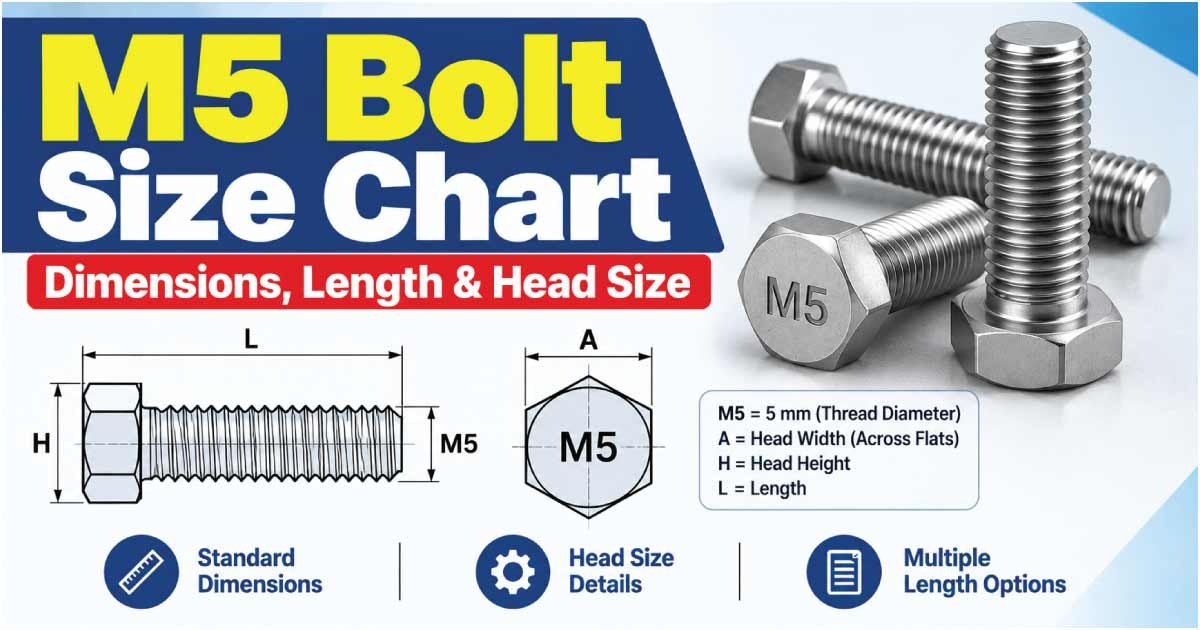
Choosing the correct fastener becomes much easier when you understand what M5 actually means and how its diameter, thread pitch, length, and head dimensions relate to one another. An M5 bolt has a nominal metric thread diameter of 5 mm, but its overall dimensions depend on the bolt type and applicable standard.
This M5 bolt size chart covers the most useful specifications, including M5 diameter, thread pitch, common bolt lengths, head size, wrench size, socket dimensions, and measurement methods. It also explains how to select the right M5 bolt when replacing an existing fastener or designing a new assembly.
What Does M5 Mean on a Bolt?
The designation M5 refers primarily to the nominal diameter of the bolt’s metric thread. The letter M indicates a metric ISO thread, while 5 represents a nominal thread diameter of approximately 5 mm.
An M5 bolt does not necessarily have one universal head shape or length. You can find M5 fasteners as hex-head bolts, socket head cap screws, button head screws, flange bolts, and other designs.
For a typical M5 coarse-thread fastener:
Nominal diameter: 5 mm
Standard coarse thread pitch: 0.8 mm
Thread designation: M5 × 0.8
Nominal major diameter: approximately 5 mm
Common applications: machinery, brackets, electronics, automotive components, appliances, furniture, and general mechanical assemblies
The M5 × 0.8 designation is particularly useful because it identifies both the nominal diameter and thread pitch.
M5 Bolt vs. M5 Screw
The terms bolt and screw are often used interchangeably in everyday hardware descriptions, but fastener standards distinguish products by their design and intended method of assembly.
For example, an M5 hex-head fastener may be described as a bolt, while an M5 socket head cap screw is normally called a screw. Both can have the same nominal thread diameter while having very different head dimensions.
Therefore, when ordering an M5 fastener, do not rely on the M5 designation alone. You should also identify the head style, length, thread type, material, strength class, and applicable standard.
M5 Bolt Size Chart
The following chart provides common reference dimensions for M5 metric fasteners. Exact head dimensions can vary according to the fastener design and standard, so always verify the manufacturer’s drawing when dimensional accuracy is critical.
| M5 Specification | Typical Dimension |
|---|---|
| Nominal thread diameter | 5 mm |
| Standard coarse pitch | 0.8 mm |
| Thread designation | M5 × 0.8 |
| Common length range | 6–50 mm |
| Typical hex-head wrench size | 8 mm |
| Typical socket-head hex key | 4 mm |
| Length measurement | Under head to tip |
| Nominal diameter in inches | 0.197 in |
| Coarse thread pitch in inches | 0.0315 in |
The length range shown above represents commonly encountered sizes rather than a universal standard range. Manufacturers may offer considerably shorter or longer M5 fasteners.
M5 Bolt Diameter and Thread Dimensions
Diameter is one of the most important specifications when identifying an M5 bolt. The 5 mm designation refers to the nominal major diameter of the external thread.
Because a threaded bolt has ridges and valleys, measuring across the threads with a caliper may produce a value slightly different from exactly 5 mm. This does not automatically mean the bolt is the wrong size.
M5 Thread Pitch
The standard coarse M5 thread has a 0.8 mm pitch. Thread pitch is the axial distance from one thread crest to the next.
For example, with an M5 × 0.8 thread, every complete thread is spaced 0.8 mm from the next.
| Thread Specification | M5 Value |
|---|---|
| Nominal diameter | 5 mm |
| Coarse pitch | 0.8 mm |
| Threads per inch equivalent | 31.75 TPI approximately |
| Thread form | Metric ISO |
A fine-pitch M5 thread can also exist. Consequently, if you are replacing an M5 fastener, matching the diameter alone is not enough. The replacement must have the correct pitch so that it engages properly with the mating thread.
M5 Coarse vs. Fine Thread
The standard M5 coarse thread is M5 × 0.8, but fine-pitch versions are available for applications requiring different thread characteristics.
A fine thread has a smaller pitch and therefore more threads over the same length.
Fine-pitch threads can offer useful characteristics such as finer adjustment and greater thread engagement per unit length, but they should only be used when the mating component is designed for that thread.
Never force an M5 × 0.8 bolt into a hole designed for a different M5 pitch. A bolt can initially appear to fit while damaging the internal threads.
M5 Bolt Length Chart
Bolt length is measured differently depending on the head design. For most conventional bolts with a head that sits outside the joint, length is measured from directly underneath the head to the end of the threaded or unthreaded shank.
The following are common M5 nominal lengths:
| M5 Bolt Length | Length in Inches, Approx. | Typical Use |
|---|---|---|
| 6 mm | 0.24 in | Thin components |
| 8 mm | 0.31 in | Light assemblies |
| 10 mm | 0.39 in | General fastening |
| 12 mm | 0.47 in | Brackets and panels |
| 16 mm | 0.63 in | General mechanical work |
| 20 mm | 0.79 in | Thicker assemblies |
| 25 mm | 0.98 in | Multiple components |
| 30 mm | 1.18 in | Deeper assemblies |
| 35 mm | 1.38 in | Thick joint applications |
| 40 mm | 1.57 in | Longer fastening requirements |
| 45 mm | 1.77 in | Deep assemblies |
| 50 mm | 1.97 in | Extended fastening |
These are nominal lengths commonly encountered in M5 hardware catalogs. Availability and thread length can differ between standards and manufacturers.
How to Choose M5 Bolt Length
The correct length depends on the total thickness of the parts being joined, washer thickness, nut thickness when applicable, and the amount of thread engagement required.
A bolt that is too short may not provide enough thread engagement. A bolt that is unnecessarily long can interfere with nearby components or create an unwanted protrusion.
As a practical starting point:
Required bolt length ≈ total clamped material thickness + washer thickness + required thread engagement
The final selection should be checked against the fastener’s application, material, strength class, and manufacturer recommendations.
M5 Hex Bolt Head Size
Not all M5 bolt heads have the same dimensions. Head size is determined by the fastener design and standard.
For a common ISO-style M5 hex-head bolt, the across-flats dimension is typically 8 mm, meaning an 8 mm wrench or socket fits across the six flat sides of the head.
| M5 Hex-Head Feature | Typical Dimension |
|---|---|
| Across flats | 8 mm |
| Nominal wrench/socket size | 8 mm |
| Across corners | Approximately 9.2 mm |
| Head height | Approximately 3.5 mm maximum for common ISO designs |
These values should be treated as standard-reference dimensions rather than universal dimensions for every M5 hex-head product.
Some manufacturers produce reduced-head, flange-head, or specialized M5 bolts with different dimensions.
What Wrench Size Fits an M5 Bolt?
For a typical M5 hex-head bolt conforming to common ISO dimensions, an 8 mm wrench or socket is generally used.
However, M5 does not mean 5 mm wrench size. The M5 number identifies the nominal thread diameter, not the head’s across-flats measurement.
This distinction is important when buying tools:
- M5 = approximately 5 mm nominal thread diameter
- 8 mm = typical wrench size for an M5 standard hex head
- 4 mm = common internal hex key size for an M5 socket-head cap screw
M5 Socket Head Cap Screw Dimensions
An M5 socket head cap screw is different from a standard hex-head bolt. Instead of an external hexagonal head, it has a cylindrical head with an internal hexagonal socket.
A common M5 socket head cap screw has approximately:
| Dimension | Typical M5 Socket Head Value |
|---|---|
| Nominal thread diameter | 5 mm |
| Standard coarse pitch | 0.8 mm |
| Head diameter | About 8.5 mm |
| Head height | About 5 mm |
| Internal hex socket | 4 mm |
Exact dimensions depend on the standard and product specification.
Socket head cap screws are especially useful where the fastener must fit into a relatively narrow space or where an internal hex drive is preferred.
They are commonly found in:
- Machinery
- Machine guards
- Fixtures
- Bicycle components
- Equipment frames
- Industrial assemblies
- Mechanical prototypes
How to Measure an M5 Bolt
If you have an unidentified fastener and need to determine whether it is M5, measure several features rather than relying on appearance.
1. Measure the Thread Diameter
Use a caliper to measure the outside diameter of the threaded portion.
An M5 bolt should have a nominal major diameter of approximately 5 mm.
Do not confuse the nominal diameter with the smaller diameter measured between the thread roots.
2. Measure the Thread Pitch
Thread pitch is the distance between adjacent thread crests.
For standard M5 coarse thread, the pitch is 0.8 mm.
A thread pitch gauge makes this measurement easier. You can also compare the bolt with a known M5 × 0.8 nut, provided the nut and bolt engage smoothly without forcing.
3. Measure the Bolt Length
For most conventional hex-head and socket-head fasteners, place the caliper at the surface directly under the head and measure to the tip.
Do not include the head height when determining the nominal bolt length.
For example, an M5 × 20 bolt is nominally 20 mm long from underneath the head to the end.
4. Identify the Head Style
Look at the head before selecting a replacement.
Common M5 head styles include:
- Hex head
- Socket head cap
- Button head
- Flat or countersunk head
- Flange head
- Pan head
Two M5 fasteners can have identical threads but require completely different tools and provide different clamping arrangements.
Discover More:
M5 Bolt Size in Inches
M5 is a metric designation, so it is normally specified in millimeters. However, inch conversions can be useful when working with imperial drawings or tools.
An M5 nominal diameter is approximately 0.197 inch.
The standard 0.8 mm thread pitch is approximately 0.0315 inch.
| Metric M5 Dimension | Approximate Imperial Equivalent |
|---|---|
| 5 mm diameter | 0.197 in |
| 0.8 mm pitch | 0.0315 in |
| 8 mm hex width | 0.315 in |
| 10 mm length | 0.394 in |
| 20 mm length | 0.787 in |
| 25 mm length | 0.984 in |
| 50 mm length | 1.969 in |
These conversions are useful for reference only. M5 is not interchangeable with a similarly sized imperial fastener.
An imperial thread may have a different pitch, thread angle, or diameter. Even when two fasteners look close in size, forcing them together can damage the threads.
M5 Bolt Head Types and Their Uses
Selecting an M5 fastener involves more than choosing its length. The head style determines how the bolt interacts with the tool, surface, and surrounding components.
Hex Head M5 Bolt
A hex-head bolt has six external flats and is normally tightened with a wrench or socket.
It is a good choice when:
- A conventional wrench is accessible
- A robust external drive is preferred
- The assembly does not require a flush head
M5 Socket Head Cap Screw
A socket head cap screw uses an internal hex drive.
It is useful when:
- Space around the head is limited
- A compact drive arrangement is required
- The design uses recessed or machine components
M5 Button Head Screw
Button head fasteners have a rounded, low-profile appearance. They are often selected when appearance, reduced sharp edges, or a lower-profile head is desirable.
M5 Countersunk Screw
A countersunk M5 fastener is designed to sit approximately flush with a suitably countersunk surface.
It should not simply be substituted for a standard hex-head bolt because the head geometry and load distribution are different.
Discover More:
How to Select the Correct M5 Bolt
When choosing an M5 bolt, check the complete specification instead of selecting based only on diameter.
Consider These Factors
- Diameter: Confirm that the required thread is M5.
- Pitch: Verify whether the application requires M5 × 0.8 or another pitch.
- Length: Measure the complete clamped thickness and determine suitable engagement.
- Head style: Make sure the head fits the available space and required tool.
- Material: Consider corrosion resistance, temperature, environment, and mechanical requirements.
- Strength class: For structural or highly loaded applications, select the appropriate property class specified by the design.
- Finish: Zinc-plated, stainless steel, black oxide, and other finishes may be available depending on the fastener.
- Standard: Confirm the relevant ISO, DIN, or manufacturer specification where dimensional interchangeability matters.
For critical assemblies, the engineering drawing or manufacturer’s specification should take priority over a general size chart.
Common M5 Bolt Size Mistakes
Small fasteners are easy to misidentify because several dimensions can appear similar.
Mistake 1: Assuming M5 Means 5 mm Wrench Size
M5 refers to the nominal thread diameter, not the head size.
A common M5 hex-head bolt uses an 8 mm wrench, while an M5 socket head cap screw commonly uses a 4 mm hex key.
Mistake 2: Ignoring Thread Pitch
Two M5 fasteners can have the same nominal diameter but different thread pitches.
Always check the pitch when replacing a bolt in a threaded hole.
Mistake 3: Measuring Length Including the Head
For most conventional M5 bolts and socket head screws, nominal length is measured from underneath the head to the tip.
Countersunk fasteners are an important exception because their length is generally measured from the top of the head to the tip.
Mistake 4: Choosing Length by Appearance
A bolt may look like the correct length but provide insufficient engagement once washers and joined materials are considered.
Measure the actual joint and determine the required engagement.
Mistake 5: Treating All M5 Bolts as Identical
M5 describes the thread size, not the entire fastener.
Head dimensions, drive type, material, strength class, thread length, and standard can all differ.
Discover More:
M5 Bolt Applications
M5 fasteners are common because their relatively small diameter works well in many mechanical and equipment assemblies.
Typical applications include:
- Electronic equipment
- Machinery and machine guards
- Metal brackets
- Automotive components
- Appliances
- Furniture hardware
- Bicycle and recreational equipment
- Electrical enclosures
- Prototypes and fabricated assemblies
- General maintenance and repair
The appropriate M5 fastener depends heavily on the load, environment, joint design, and required corrosion resistance.
For example, stainless steel may be selected for corrosion resistance, while a higher-strength alloy steel fastener may be appropriate for a mechanically demanding application when specified by the design.
M5 Bolt Strength and Property Classes
M5 bolts are available in different materials and strength classes. The M5 designation itself does not specify how strong the bolt is.
For carbon and alloy steel metric fasteners, property classes such as 8.8, 10.9, and 12.9 may be encountered depending on the fastener type and standard.
A higher property class generally indicates higher specified tensile and yield strength, but the appropriate fastener must still be selected based on the complete engineering requirements.
For critical applications, do not choose a bolt solely because it has a higher number. Joint design, preload, material compatibility, fatigue, corrosion, temperature, and the applicable standard all matter.
M5 Bolt vs. M4 and M6 Bolts
Comparing nearby metric sizes can help explain where M5 fits in the metric fastener range.
| Metric Size | Nominal Diameter | Common Coarse Pitch | Typical Hex-Head Wrench Size |
|---|---|---|---|
| M4 | 4 mm | 0.7 mm | 7 mm |
| M5 | 5 mm | 0.8 mm | 8 mm |
| M6 | 6 mm | 1.0 mm | 10 mm |
The exact head dimensions can vary by fastener standard, so the wrench sizes should be treated as typical reference values rather than universal specifications for every product.
M5 sits between M4 and M6 and is widely used when an assembly needs more thread diameter than M4 but does not require the larger physical size of M6.
Frequently Asked Questions About M5 Bolts
What is the diameter of an M5 bolt?
An M5 bolt has a nominal thread diameter of 5 mm. The actual measured outside diameter of the thread may vary slightly because of manufacturing tolerances and measurement location.
What is the standard M5 thread pitch?
The commonly used coarse M5 thread has a pitch of 0.8 mm, written as M5 × 0.8.
What size wrench fits an M5 hex bolt?
A typical ISO-style M5 hex-head bolt uses an 8 mm wrench or socket. However, reduced-head and specialized fasteners can have different head dimensions.
What size Allen key fits an M5 bolt?
If you mean an M5 socket head cap screw, a 4 mm hex key is commonly used. The M5 thread designation itself does not determine the drive size.
How is M5 bolt length measured?
For a standard bolt with an external head, length is normally measured from directly underneath the head to the tip. Countersunk fasteners are generally measured differently.
Is M5 the same as 5 mm?
M5 indicates a metric nominal thread diameter of 5 mm. It does not mean every dimension of the fastener is 5 mm.
Can I use an M5 × 0.8 bolt in any M5 threaded hole?
No. The mating thread must have the correct pitch and compatible thread specification. An M5 hole with a different pitch is not automatically compatible with M5 × 0.8.
What lengths are available for M5 bolts?
Common M5 lengths include 6, 8, 10, 12, 16, 20, 25, 30, 35, 40, 45, and 50 mm, although manufacturers may offer many additional lengths.
Final M5 Bolt Size Reference
The most important point to remember is that M5 identifies the nominal metric thread diameter, not the complete bolt specification.
For a common M5 coarse-thread fastener, the core specifications are:
- Nominal diameter: 5 mm
- Standard coarse pitch: 0.8 mm
- Thread designation: M5 × 0.8
- Common lengths: 6–50 mm and beyond
- Typical hex-head wrench size: 8 mm
- Common socket-head hex key: 4 mm
- Length measurement: Usually underneath the head to the tip
When replacing or purchasing an M5 bolt, verify diameter, pitch, length, head style, material, strength class, and standard. This prevents common problems such as incorrect thread engagement, insufficient clamping length, or incompatible head dimensions.
For non-critical general-purpose work, the chart provides a useful starting point. For precision machinery, structural assemblies, safety-related equipment, or other critical applications, always confirm the exact dimensions and mechanical requirements against the applicable fastener standard or manufacturer’s technical documentation.