
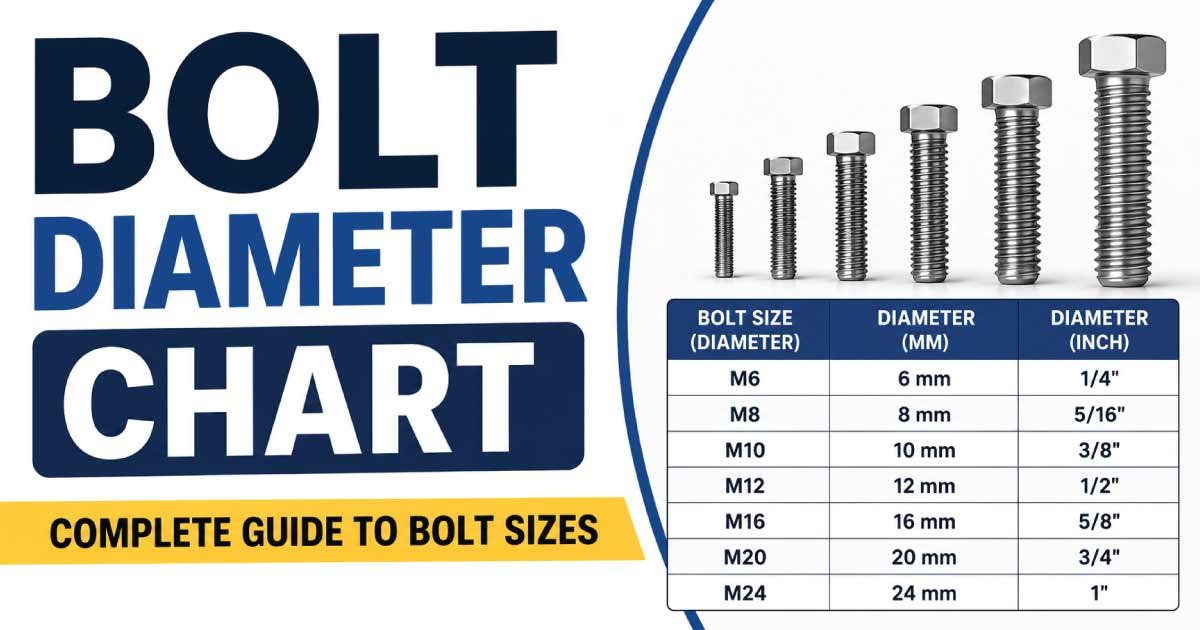
Understanding bolt diameter is essential when selecting fasteners for automotive repairs, machinery, construction projects, structural assemblies, and general maintenance. The correct bolt diameter affects strength, fit, thread compatibility, washer selection, nut size, and the overall reliability of a bolted connection.
A bolt may look suitable simply because it passes through a hole, but choosing the correct diameter requires more than checking the outside measurement. You also need to consider the bolt’s nominal diameter, thread type, thread pitch, shank diameter, hole size, material, grade, and application.
This complete guide explains how bolt diameter is measured, how metric and imperial bolt diameters compare, how to choose the correct hole size, and how diameter relates to bolt strength. It also includes practical reference tables and answers to common questions about bolt sizing.
What Is Bolt Diameter?
Bolt diameter is the nominal measurement used to identify the size of a bolt. For most standard bolts, diameter refers to the approximate outside diameter of the threaded portion rather than the length of the bolt.
For example, an M8 bolt has a nominal diameter of approximately 8 mm, while a 1/2-inch bolt has a nominal diameter of 1/2 inch.
The actual measured diameter can vary slightly depending on manufacturing tolerances, thread form, and where the measurement is taken. This is why the measured value may not be exactly identical to the nominal bolt size.
Bolt diameter is normally expressed using either:
- Metric measurements: M5, M6, M8, M10, M12, M16, and so on
- Imperial measurements: 1/4″, 5/16″, 3/8″, 7/16″, 1/2″, and so on
- Decimal measurements: Used when calculating or comparing dimensions
- Fractional measurements: Common with U.S. customary fasteners
The diameter is only one part of a complete bolt specification. A bolt described as M10 × 1.5 × 50, for example, includes diameter, thread pitch, and length.
How to Measure Bolt Diameter
Measuring a bolt diameter is relatively simple when you have a caliper, micrometer, or suitable measuring tool.
Measure Across the Threads
For a standard externally threaded bolt, place the jaws of a caliper across the outside of the threads. Measure from the crest of one side of the thread to the crest on the opposite side.
This gives you the approximate major diameter.
For example, if your measurement is close to 10 mm, the bolt is likely an M10 fastener.
Do Not Measure the Bolt Head
The bolt head is not used to determine the nominal bolt diameter.
A larger bolt head does not necessarily mean that the bolt has a larger diameter. Different head styles and standards can use different head dimensions.
For identification, measure the threaded section rather than the head.
Use a Thread Gauge When Necessary
Diameter alone cannot always identify a bolt.
Two bolts can have nearly identical outside diameters while having different thread pitches. For example, an M10 bolt can commonly be found with different pitches depending on the standard and application.
A thread pitch gauge can help determine the distance between threads.
Metric Bolt Diameter Chart
The following table provides common metric nominal bolt diameters and their approximate inch equivalents.
| Metric Bolt Size | Nominal Diameter | Approx. Inch Equivalent |
|---|---|---|
| M3 | 3 mm | 0.118 in |
| M4 | 4 mm | 0.157 in |
| M5 | 5 mm | 0.197 in |
| M6 | 6 mm | 0.236 in |
| M8 | 8 mm | 0.315 in |
| M10 | 10 mm | 0.394 in |
| M12 | 12 mm | 0.472 in |
| M14 | 14 mm | 0.551 in |
| M16 | 16 mm | 0.630 in |
| M18 | 18 mm | 0.709 in |
| M20 | 20 mm | 0.787 in |
| M22 | 22 mm | 0.866 in |
| M24 | 24 mm | 0.945 in |
| M27 | 27 mm | 1.063 in |
| M30 | 30 mm | 1.181 in |
| M33 | 33 mm | 1.299 in |
| M36 | 36 mm | 1.417 in |
| M39 | 39 mm | 1.535 in |
| M42 | 42 mm | 1.654 in |
| M45 | 45 mm | 1.772 in |
| M48 | 48 mm | 1.890 in |
These are nominal dimensions. The actual manufactured diameter can vary according to the applicable fastener standard and tolerance class.
Common Imperial Bolt Diameters
Imperial bolts are commonly identified using fractional inch sizes. Some smaller fasteners may also use numbered sizes.
Common fractional diameters include:
| Imperial Bolt Size | Decimal Diameter |
|---|---|
| 1/4 in | 0.250 in |
| 5/16 in | 0.3125 in |
| 3/8 in | 0.375 in |
| 7/16 in | 0.4375 in |
| 1/2 in | 0.500 in |
| 9/16 in | 0.5625 in |
| 5/8 in | 0.625 in |
| 3/4 in | 0.750 in |
| 7/8 in | 0.875 in |
| 1 in | 1.000 in |
| 1-1/8 in | 1.125 in |
| 1-1/4 in | 1.250 in |
| 1-3/8 in | 1.375 in |
| 1-1/2 in | 1.500 in |
| 1-5/8 in | 1.625 in |
| 1-3/4 in | 1.750 in |
| 1-7/8 in | 1.875 in |
| 2 in | 2.000 in |
Imperial bolt diameter is normally written as a fractional size followed by the thread specification.
For example, 1/2-13 identifies a nominal 1/2-inch diameter bolt with 13 threads per inch.
Metric vs. Imperial Bolt Diameter
Metric and imperial fasteners use different sizing systems, and they should not automatically be treated as interchangeable.
An M10 bolt has a nominal diameter of 10 mm, which converts to approximately 0.394 inch. A 3/8-inch bolt is 0.375 inch, so the two sizes are relatively close but not identical.
The difference becomes especially important when threads are involved.
A bolt can have a similar outside diameter to another bolt while using a completely different thread pitch. Forcing one into a threaded hole designed for another fastener can damage the threads or create an unsafe connection.
When replacing a bolt, always match:
- Diameter
- Thread pitch
- Thread type
- Length
- Grade or property class
- Head style
- Material
- Application requirements
Understanding Bolt Thread Diameter
Bolt diameter and thread diameter are closely related, but thread terminology can become confusing.
Major Diameter
The major diameter is the largest diameter of an externally threaded fastener. It is measured across the thread crests.
This is generally the measurement people mean when they refer to the nominal diameter of a bolt.
Minor Diameter
The minor diameter is measured across the roots of the threads.
Because material has been removed to form the threads, the minor diameter is smaller than the major diameter.
The minor diameter becomes particularly important when engineers calculate the effective tensile area of a threaded fastener.
Pitch Diameter
The pitch diameter is an imaginary diameter associated with the thread profile. It is important for determining how mating threads engage with one another.
For everyday bolt identification, you usually do not need to calculate the pitch diameter manually. However, it is important in engineering, manufacturing, and precision fastener applications.
Bolt Diameter and Thread Pitch
Knowing the diameter is not enough to identify a threaded bolt.
Thread pitch describes the distance from one thread crest to the next in metric systems. It is normally expressed in millimeters.
For example:
- M8 × 1.25 = 8 mm diameter with 1.25 mm pitch
- M10 × 1.5 = 10 mm diameter with 1.5 mm pitch
- M12 × 1.75 = 12 mm diameter with 1.75 mm pitch
Imperial fasteners normally use threads per inch, or TPI.
For example:
- 1/2-13 = 1/2-inch diameter and 13 threads per inch
- 3/8-16 = 3/8-inch diameter and 16 threads per inch
Therefore, an accurate bolt identification should include both diameter and thread information.
How Bolt Diameter Affects Strength
Bolt diameter has a major influence on fastener strength.
Generally, increasing bolt diameter increases the available cross-sectional area of the fastener. This can increase its ability to withstand tensile and shear loads, provided the material, grade, thread geometry, and installation are appropriate.
However, a larger bolt is not automatically the correct choice.
The strength of a bolted connection depends on multiple factors, including:
- Bolt diameter
- Bolt grade
- Material
- Thread engagement
- Tensile stress area
- Clamping force
- Joint design
- Load direction
- Hole diameter
- Washer dimensions
- Nut strength
- Installation torque
For structural or safety-critical applications, bolt selection should follow the applicable engineering standard rather than simply choosing the largest available fastener.
Also Read:
Bolt Diameter and Hole Size
The hole through which a bolt passes generally needs to be slightly larger than the nominal bolt diameter.
This additional clearance allows the bolt to pass through the hole without requiring excessive force.
For example, an M10 clearance hole will normally be larger than 10 mm. The exact recommended hole diameter depends on the relevant standard and whether a close, normal, or loose fit is required.
Why Clearance Matters
A hole that is too small can make installation difficult and may damage the bolt or surrounding material.
A hole that is excessively large can reduce bearing area, affect alignment, and potentially weaken the joint.
For precision or structural applications, use the hole-size requirements specified by the applicable fastener or engineering standard.
Bolt Diameter and Nut Compatibility
The nut must match the bolt’s diameter and thread specification.
An M12 nut is designed for a compatible M12 threaded bolt, but the thread pitch must also match.
For example, simply finding an M12 nut does not guarantee that it will fit every M12 bolt. The pitch must correspond.
The same principle applies to imperial fasteners.
A 1/2-inch nut must have the appropriate thread specification for the 1/2-inch bolt. A 1/2-13 nut and a 1/2-20 nut have different thread pitches and should not be treated as interchangeable.
How to Identify an Unknown Bolt
If you have an unidentified bolt and need to determine its size, use a systematic process.
Step 1: Measure the Diameter
Use a caliper to measure across the threaded section.
Record the measurement in millimeters or inches.
Step 2: Determine the Thread Pitch
For metric bolts, measure the distance between adjacent thread crests or use a metric thread gauge.
For imperial bolts, determine the number of threads per inch.
Step 3: Measure the Length
Bolt length is normally measured from the underside of the head to the end of the bolt for most common head styles.
Countersunk bolts are measured differently because the head sits within the material.
Step 4: Inspect the Head Markings
Many high-strength bolts have markings on their heads that can help identify their grade or property class.
These markings should not be ignored when replacing a fastener.
Step 5: Check the Original Application
If the bolt came from machinery, a vehicle, structural equipment, or another engineered assembly, consult the manufacturer’s specifications whenever possible.
Bolt Diameter vs. Bolt Length
Diameter and length describe two different dimensions.
For example, an M10 × 60 bolt has:
- 10 mm nominal diameter
- 60 mm nominal length
Increasing the length does not increase the bolt’s diameter.
Similarly, a short M12 bolt and a long M12 bolt can have the same nominal diameter while serving very different applications.
When ordering or replacing bolts, always specify both diameter and length.
Also Read:
Common Bolt Sizes for General Applications
Several bolt diameters appear frequently in general mechanical and maintenance work.
M6 Bolts
M6 bolts are relatively small and are frequently used in equipment, brackets, panels, machinery components, and light mechanical assemblies.
M8 Bolts
M8 fasteners are common in machinery, automotive components, mounting brackets, furniture hardware, and general fabrication.
M10 Bolts
M10 bolts provide a useful combination of size and strength and are widely encountered in mechanical assemblies, automotive applications, brackets, and equipment.
M12 Bolts
M12 bolts are frequently used when higher clamping force and greater mechanical strength are required.
M16 and Larger Bolts
Larger diameters such as M16, M20, M24, and above are commonly associated with heavy machinery, structural assemblies, industrial equipment, and demanding mechanical applications.
The appropriate size always depends on the design load and applicable specifications.
What Does M10 Mean on a Bolt?
The M indicates that the fastener uses a metric thread system, while 10 represents the nominal diameter in millimeters.
Therefore, an M10 bolt has a nominal diameter of approximately 10 mm.
M10 by itself does not completely identify the fastener. You may also need the thread pitch, length, grade, and head style.
For example, M10 × 1.5 × 50 identifies a 10 mm nominal diameter, 1.5 mm thread pitch, and 50 mm length.
What Does 1/2-13 Mean on a Bolt?
A designation such as 1/2-13 describes an imperial threaded bolt.
The first number, 1/2, represents the nominal diameter in inches.
The second number, 13, represents the number of threads per inch.
Therefore, a 1/2-13 bolt has a nominal diameter of 0.500 inch and 13 threads per inch.
A 1/2-inch bolt can have different thread counts, so the thread specification is necessary for proper identification.
Bolt Diameter Conversion
Converting between metric and imperial measurements can help when identifying unknown fasteners.
The basic conversion is:
1 inch = 25.4 millimeters
Therefore:
Metric diameter = Inch diameter × 25.4
And:
Inch diameter = Metric diameter ÷ 25.4
For example, a 1/2-inch bolt converts to:
0.5 × 25.4 = 12.7 mm
So a 1/2-inch bolt has a nominal diameter of 12.7 mm.
However, this does not mean that a 12.7 mm metric bolt is an interchangeable replacement. Metric and imperial threads have different standards, so actual compatibility must be verified.
Also Read:
Factors to Consider When Choosing Bolt Diameter
Selecting a bolt diameter should be based on the requirements of the complete joint rather than diameter alone.
Load Requirements
Determine the expected tensile, shear, and other loads acting on the joint.
Material Thickness
The thickness and strength of the connected materials influence the required fastener dimensions.
Thread Engagement
The bolt needs adequate thread engagement with the nut or internally threaded component.
Bolt Grade
A higher-strength bolt can provide greater load capacity, but the entire joint must be designed for the intended load.
Environmental Conditions
Corrosion, temperature, moisture, chemicals, and outdoor exposure can affect fastener selection.
Installation Requirements
Consider access, tightening method, torque requirements, and available tools.
Applicable Standards
For critical applications, use the relevant industry, engineering, automotive, structural, or manufacturer’s specifications.
Common Bolt Diameter Measurement Mistakes
Several mistakes can lead to incorrect bolt identification.
Measuring the Head Instead of the Threads
The head width is not the nominal bolt diameter.
Ignoring Thread Pitch
Two bolts with similar diameters may use different threads.
Assuming Similar Sizes Are Interchangeable
A close metric and imperial diameter does not automatically mean the fasteners can replace each other.
Ignoring Bolt Grade
Replacing a high-strength bolt with a lower-grade fastener can create a serious safety issue.
Choosing Diameter Without Considering Length
A correctly sized diameter can still be unsuitable if the bolt is too short or excessively long.
Bolt Diameter Chart for Quick Reference
For quick identification, the following reference summarizes common nominal diameters.
| Bolt Size | Diameter |
|---|---|
| M4 | 4 mm |
| M5 | 5 mm |
| M6 | 6 mm |
| M8 | 8 mm |
| M10 | 10 mm |
| M12 | 12 mm |
| M14 | 14 mm |
| M16 | 16 mm |
| M18 | 18 mm |
| M20 | 20 mm |
| M22 | 22 mm |
| M24 | 24 mm |
| 1/4 in | 6.35 mm |
| 5/16 in | 7.94 mm |
| 3/8 in | 9.53 mm |
| 7/16 in | 11.11 mm |
| 1/2 in | 12.70 mm |
| 9/16 in | 14.29 mm |
| 5/8 in | 15.88 mm |
| 3/4 in | 19.05 mm |
| 7/8 in | 22.23 mm |
| 1 in | 25.40 mm |
The metric and imperial values shown are nominal conversions and should be used for identification rather than assuming interchangeability.
How Bolt Diameter Relates to Washer Size
Washers are selected according to the bolt size and the requirements of the joint.
A washer distributes the clamping force over a larger area and can help prevent the bolt head or nut from damaging the material.
The outside diameter and thickness of a washer can vary significantly depending on the washer standard and application.
For that reason, choosing a washer only by its outside diameter can lead to an incorrect fit. The washer’s internal hole should be compatible with the bolt diameter, while its outside diameter should provide the required bearing area.
How Bolt Diameter Relates to Torque
Torque is commonly used to tighten bolts and produce the desired clamping force.
However, there is no universal torque value for a particular diameter.
The appropriate torque can depend on:
- Bolt diameter
- Bolt grade
- Thread pitch
- Lubrication
- Surface condition
- Nut material
- Washer type
- Joint design
- Manufacturer specifications
A larger bolt does not automatically mean that you can apply an arbitrary amount of additional torque.
For automotive, structural, pressure-containing, and safety-critical assemblies, always use the specified torque values from the manufacturer or applicable engineering documentation.
Frequently Asked Questions About Bolt Diameter
Is bolt diameter measured across the threads?
Yes. For most standard externally threaded bolts, nominal diameter corresponds to the approximate major diameter measured across the outside of the threads.
Is M8 exactly 8 mm?
M8 represents a nominal 8 mm diameter. The actual measured diameter can vary slightly because of manufacturing tolerances.
Is a 1/2-inch bolt the same as an M12 bolt?
No. A 1/2-inch bolt has a nominal diameter of 12.7 mm, while an M12 bolt has a nominal diameter of 12 mm. Their threads are also based on different systems.
Can metric and imperial bolts be substituted?
They should not be considered interchangeable simply because their diameters appear similar. Diameter, thread pitch, grade, length, and application must all be compatible.
How do I know what size nut fits a bolt?
Match the nut to the bolt’s nominal diameter and thread specification. Both the diameter and thread pitch or thread count must correspond.
Does a larger bolt always have greater strength?
Not necessarily. Diameter is an important factor, but strength also depends on bolt material, grade, thread geometry, joint design, installation, and loading conditions.
What is the most important measurement when identifying a bolt?
Start with the nominal diameter, then determine thread pitch or threads per inch. Length and grade should also be identified before selecting a replacement.
Final Thoughts on Bolt Diameter
Bolt diameter is one of the most important measurements used when identifying and selecting fasteners, but it is only part of the complete specification. A reliable fastener selection requires consideration of diameter, thread pitch, length, material, grade, hole size, nut compatibility, and application requirements.
Metric sizes such as M6, M8, M10, M12, and M16 are widely used across mechanical and industrial applications, while imperial sizes such as 1/4 inch, 3/8 inch, 1/2 inch, 5/8 inch, and 3/4 inch remain common in applications using U.S. customary fasteners.
When identifying an unknown bolt, begin by measuring the threaded diameter with a caliper. Then determine the thread pitch, measure the length, inspect head markings, and verify the original equipment specifications when available.
Most importantly, do not select a replacement based on diameter alone. A bolt that physically appears to fit may have an incompatible thread, incorrect grade, unsuitable length, or inadequate strength.
Using the correct bolt diameter together with the correct thread and strength specification helps create a secure, reliable, and properly fitted bolted connection.