
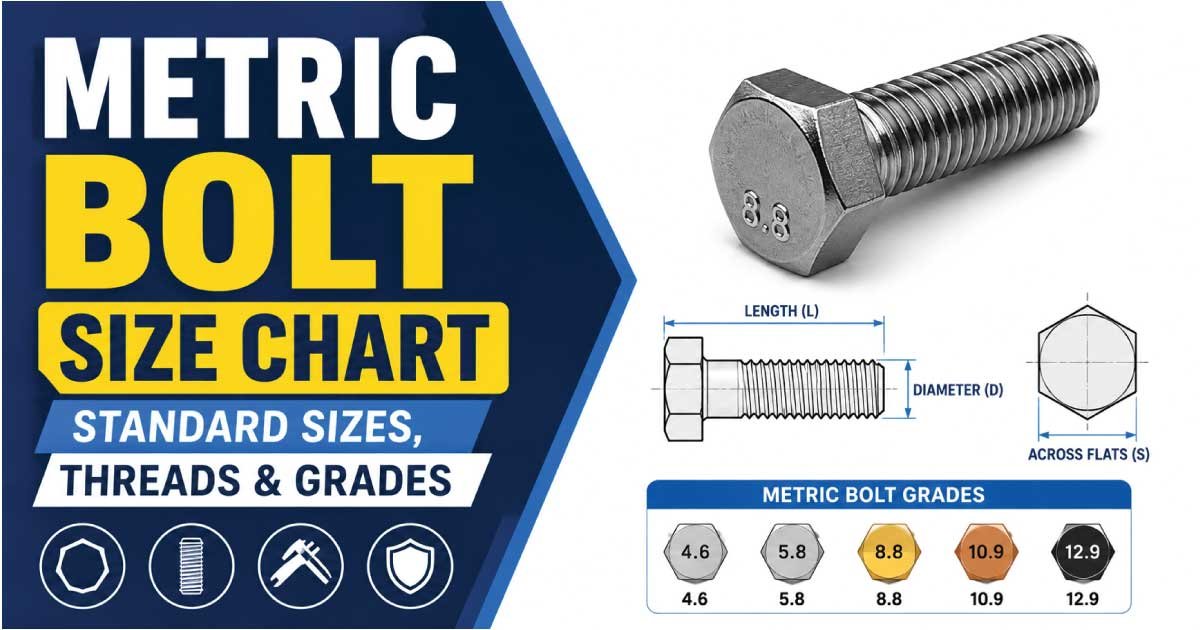
A metric bolt size chart is a useful reference for identifying metric bolt diameters, thread pitches, head dimensions, and common bolt sizes. Metric bolts are widely used in automotive, mechanical, construction, manufacturing, machinery, furniture, and general hardware applications. Unlike imperial bolts, which are measured in inches, metric bolts are identified primarily by measurements in millimeters.
A typical metric bolt designation looks like M8 × 1.25 × 40. In this example, M8 represents the nominal bolt diameter, 1.25 represents the thread pitch in millimeters, and 40 represents the bolt length.
Metric Bolt Size Chart in mm
The following chart provides common metric bolt sizes and their standard coarse thread pitches. It is useful for quickly identifying the most frequently used metric fasteners.
| Metric Bolt Size | Nominal Diameter | Coarse Thread Pitch | Approx. Diameter in Inches |
|---|---|---|---|
| M3 | 3 mm | 0.50 mm | 0.118 in |
| M4 | 4 mm | 0.70 mm | 0.157 in |
| M5 | 5 mm | 0.80 mm | 0.197 in |
| M6 | 6 mm | 1.00 mm | 0.236 in |
| M8 | 8 mm | 1.25 mm | 0.315 in |
| M10 | 10 mm | 1.50 mm | 0.394 in |
| M12 | 12 mm | 1.75 mm | 0.472 in |
| M14 | 14 mm | 2.00 mm | 0.551 in |
| M16 | 16 mm | 2.00 mm | 0.630 in |
| M18 | 18 mm | 2.50 mm | 0.709 in |
| M20 | 20 mm | 2.50 mm | 0.787 in |
| M22 | 22 mm | 2.50 mm | 0.866 in |
| M24 | 24 mm | 3.00 mm | 0.945 in |
| M27 | 27 mm | 3.00 mm | 1.063 in |
| M30 | 30 mm | 3.50 mm | 1.181 in |
| M33 | 33 mm | 3.50 mm | 1.299 in |
| M36 | 36 mm | 4.00 mm | 1.417 in |
| M39 | 39 mm | 4.00 mm | 1.535 in |
| M42 | 42 mm | 4.50 mm | 1.654 in |
| M45 | 45 mm | 4.50 mm | 1.772 in |
| M48 | 48 mm | 5.00 mm | 1.890 in |
What Does M Mean on a Metric Bolt?
The letter M indicates that the bolt uses a metric thread system. The number following M represents the bolt’s nominal diameter in millimeters.
For example:
- M6 = approximately 6 mm nominal diameter
- M8 = approximately 8 mm nominal diameter
- M10 = approximately 10 mm nominal diameter
- M12 = approximately 12 mm nominal diameter
- M16 = approximately 16 mm nominal diameter
- M20 = approximately 20 mm nominal diameter
The number does not indicate the head size. An M10 bolt, for example, does not necessarily have a 10 mm hex head. The head dimension is specified separately.
How to Read Metric Bolt Sizes
Metric bolt specifications are generally easy to understand once the basic format is known.
Consider the example:
M10 × 1.5 × 50
This designation means:
- M10 = 10 mm nominal thread diameter
- 1.5 = 1.5 mm thread pitch
- 50 = 50 mm bolt length
If a bolt is listed simply as M10 × 50, the thread pitch may be omitted because the standard coarse pitch is assumed in many general descriptions. However, the exact specification should always be confirmed when ordering replacement hardware.
Metric Bolt Diameter Chart
Bolt diameter is one of the most important dimensions when identifying a metric fastener. The nominal diameter refers to the approximate outside diameter of the threaded section.
| Bolt Size | Nominal Diameter |
|---|---|
| M3 | 3 mm |
| M4 | 4 mm |
| M5 | 5 mm |
| M6 | 6 mm |
| M8 | 8 mm |
| M10 | 10 mm |
| M12 | 12 mm |
| M14 | 14 mm |
| M16 | 16 mm |
| M18 | 18 mm |
| M20 | 20 mm |
| M22 | 22 mm |
| M24 | 24 mm |
| M27 | 27 mm |
| M30 | 30 mm |
| M36 | 36 mm |
| M42 | 42 mm |
| M48 | 48 mm |
Metric Bolt Thread Pitch Chart
Thread pitch is the distance between corresponding points on adjacent threads. It is measured in millimeters.
For example, an M8 bolt with a 1.25 mm pitch has 1.25 mm between adjacent thread crests.
| Bolt Size | Coarse Pitch | Fine Pitch Example |
|---|---|---|
| M4 | 0.70 mm | 0.50 mm |
| M5 | 0.80 mm | 0.50 mm |
| M6 | 1.00 mm | 0.75 mm |
| M8 | 1.25 mm | 1.00 mm |
| M10 | 1.50 mm | 1.25 mm |
| M12 | 1.75 mm | 1.50 mm |
| M14 | 2.00 mm | 1.50 mm |
| M16 | 2.00 mm | 1.50 mm |
| M18 | 2.50 mm | 1.50 mm |
| M20 | 2.50 mm | 1.50 mm |
| M22 | 2.50 mm | 1.50 mm |
| M24 | 3.00 mm | 2.00 mm |
| M27 | 3.00 mm | 2.00 mm |
| M30 | 3.50 mm | 2.00 mm |
Fine-thread availability varies by diameter and applicable standard, so the exact specification should be checked before purchasing.
Also Read: Seamless Pipe Size Chart: Your Complete Guide
Metric Bolt Length Chart
Bolt length is another important part of metric bolt identification. For most standard hex-head bolts, length is measured from the underside of the bolt head to the threaded end.
| Bolt Length | Length in Inches |
|---|---|
| 10 mm | 0.394 in |
| 15 mm | 0.591 in |
| 20 mm | 0.787 in |
| 25 mm | 0.984 in |
| 30 mm | 1.181 in |
| 35 mm | 1.378 in |
| 40 mm | 1.575 in |
| 50 mm | 1.969 in |
| 60 mm | 2.362 in |
| 70 mm | 2.756 in |
| 80 mm | 3.150 in |
| 90 mm | 3.543 in |
| 100 mm | 3.937 in |
| 120 mm | 4.724 in |
| 150 mm | 5.906 in |
| 200 mm | 7.874 in |
Bolt lengths are available in many additional increments depending on the bolt diameter, standard, manufacturer, and application.
Metric Hex Bolt Head Size Chart
The bolt head size determines the wrench or socket required to tighten or remove a hex-head bolt. Head dimensions are not necessarily equal to the nominal bolt diameter.
| Metric Bolt | Common Head Width Across Flats |
|---|---|
| M4 | 7 mm |
| M5 | 8 mm |
| M6 | 10 mm |
| M8 | 13 mm |
| M10 | 16 mm |
| M12 | 18 mm |
| M14 | 21 mm |
| M16 | 24 mm |
| M18 | 27 mm |
| M20 | 30 mm |
| M22 | 34 mm |
| M24 | 36 mm |
| M27 | 41 mm |
| M30 | 46 mm |
| M36 | 55 mm |
Exact head dimensions can vary according to the bolt standard and specification, so this table should be treated as a general reference.
Most Common Metric Bolt Sizes
Some metric bolt sizes are encountered much more frequently in general mechanical and hardware applications.
M6 bolts are commonly used for smaller mechanical components, equipment, brackets, and assemblies.
M8 bolts are widely used for machinery, automotive components, brackets, frames, and general hardware.
M10 bolts are common in machinery, automotive applications, equipment, structural components, and heavier assemblies.
M12 bolts are frequently used where a larger fastener is required, including machinery, automotive components, frames, and construction-related applications.
M16 and larger bolts are generally used for larger or higher-load applications, depending on the required engineering specification.
M6 Bolt Size Chart
M6 is one of the common smaller metric bolt sizes. Its nominal diameter is 6 mm and its standard coarse thread pitch is 1.0 mm.
| M6 Specification | Dimension |
|---|---|
| Nominal Diameter | 6 mm |
| Coarse Pitch | 1.00 mm |
| Common Fine Pitch | 0.75 mm |
| Common Head Width | 10 mm |
| Common Lengths | 10–100 mm+ |
An M6 × 30 bolt, for example, has a nominal diameter of 6 mm and a length of 30 mm.
M8 Bolt Size Chart
An M8 bolt has a nominal diameter of 8 mm. The standard coarse pitch is commonly 1.25 mm.
| M8 Specification | Dimension |
|---|---|
| Nominal Diameter | 8 mm |
| Coarse Pitch | 1.25 mm |
| Common Fine Pitch | 1.00 mm |
| Common Head Width | 13 mm |
| Common Lengths | 15–120 mm+ |
M8 fasteners are widely used for mechanical assemblies, equipment, brackets, automotive components, and general hardware.
M10 Bolt Size Chart
M10 bolts have a nominal diameter of 10 mm and commonly use a 1.5 mm coarse thread pitch.
| M10 Specification | Dimension |
|---|---|
| Nominal Diameter | 10 mm |
| Coarse Pitch | 1.50 mm |
| Common Fine Pitch | 1.25 mm |
| Common Head Width | 16 mm |
| Common Lengths | 20–150 mm+ |
Always confirm whether an M10 replacement requires coarse or fine threads before installation.
Also Read: Reamer Tool Size Chart: Complete Guide
M12 Bolt Size Chart
M12 bolts have a nominal diameter of 12 mm. The standard coarse pitch is commonly 1.75 mm.
| M12 Specification | Dimension |
|---|---|
| Nominal Diameter | 12 mm |
| Coarse Pitch | 1.75 mm |
| Common Fine Pitch | 1.50 mm |
| Common Head Width | 18 mm |
| Common Lengths | 25–200 mm+ |
M12 fasteners are frequently used in heavier mechanical assemblies, machinery, automotive components, frames, and equipment.
Metric Bolt Size vs Wrench Size
One common mistake is assuming that the metric bolt size and wrench size are identical. They are different measurements.
For example, a commonly encountered M8 hex-head bolt may require a 13 mm wrench, while an M10 bolt may require a 16 mm wrench under common modern metric hex-head dimensions.
The M number identifies the nominal thread diameter, while the wrench size refers to the width across the flats of the bolt head.
Therefore:
M8 ≠ 8 mm wrench
and
M10 ≠ 10 mm wrench
Always identify the correct head dimension before selecting a socket or wrench.
Metric Bolt Size Conversion to Inches
Metric bolts can be converted to approximate inch diameters for comparison purposes.
| Metric Bolt | Diameter in mm | Approx. Diameter in inches |
|---|---|---|
| M6 | 6 mm | 0.236 in |
| M8 | 8 mm | 0.315 in |
| M10 | 10 mm | 0.394 in |
| M12 | 12 mm | 0.472 in |
| M14 | 14 mm | 0.551 in |
| M16 | 16 mm | 0.630 in |
| M18 | 18 mm | 0.709 in |
| M20 | 20 mm | 0.787 in |
| M22 | 22 mm | 0.866 in |
| M24 | 24 mm | 0.945 in |
| M27 | 27 mm | 1.063 in |
| M30 | 30 mm | 1.181 in |
| M36 | 36 mm | 1.417 in |
These conversions show diameter similarities but do not mean the metric and inch bolts are interchangeable. Thread pitch and thread form must also match.
How to Measure a Metric Bolt
If the bolt size is unknown, you can identify it by measuring several dimensions.
First, measure the outside diameter of the threaded section using a digital caliper. Next, use a thread pitch gauge to determine the distance between the threads. Measure the bolt length from the underside of the head to the end for a typical hex-head bolt.
Finally, measure the head width across the flats.
The basic process is:
- Measure the threaded diameter.
- Determine whether the bolt is metric.
- Measure the thread pitch.
- Measure bolt length.
- Measure the head width.
- Check the bolt head markings.
- Compare the measurements with a metric bolt size chart.
Metric Bolt Grade and Strength
Metric bolt dimensions do not tell you everything about a fastener. The strength class is also important.
Common metric strength classes include 8.8, 10.9, and 12.9. These markings are associated with mechanical properties specified by the relevant fastener standard.
For example, two bolts can both be M10 × 50 but have different strength classes. Their dimensions may be similar while their mechanical properties differ.
When replacing a bolt, match the required diameter, length, thread pitch, material, and strength class rather than selecting a bolt based on size alone.
Also Read: Torque Wrench Size Chart: Complete Guide
How to Choose the Correct Metric Bolt Size
Choosing the correct metric bolt involves more than finding a bolt that physically fits through a hole. The bolt must have compatible threads, sufficient length, and the appropriate strength for the application.
Before purchasing a replacement, check:
- Metric diameter
- Thread pitch
- Bolt length
- Head style
- Head dimensions
- Thread length
- Strength class
- Material
- Surface coating
- Application requirements
For important mechanical or structural connections, always follow the manufacturer’s specifications or applicable engineering standards.
Metric Bolt Size Chart: Quick Reference
For quick identification, these are some of the most commonly encountered metric sizes:
| Bolt Size | Diameter | Coarse Pitch | Common Head Width |
|---|---|---|---|
| M4 | 4 mm | 0.70 mm | 7 mm |
| M5 | 5 mm | 0.80 mm | 8 mm |
| M6 | 6 mm | 1.00 mm | 10 mm |
| M8 | 8 mm | 1.25 mm | 13 mm |
| M10 | 10 mm | 1.50 mm | 16 mm |
| M12 | 12 mm | 1.75 mm | 18 mm |
| M14 | 14 mm | 2.00 mm | 21 mm |
| M16 | 16 mm | 2.00 mm | 24 mm |
| M18 | 18 mm | 2.50 mm | 27 mm |
| M20 | 20 mm | 2.50 mm | 30 mm |
| M22 | 22 mm | 2.50 mm | 34 mm |
| M24 | 24 mm | 3.00 mm | 36 mm |
| M27 | 27 mm | 3.00 mm | 41 mm |
| M30 | 30 mm | 3.50 mm | 46 mm |
| M36 | 36 mm | 4.00 mm | 55 mm |
Final Thoughts on Metric Bolt Sizes
A metric bolt size chart makes it easier to identify and compare common metric fasteners. The M designation identifies the nominal diameter, while the thread pitch identifies the spacing between threads. Bolt length and head dimensions are separate measurements that must also be considered.
For example, an M10 × 1.5 × 50 bolt has a 10 mm nominal diameter, a 1.5 mm thread pitch, and a 50 mm length. Understanding this format allows you to quickly identify thousands of metric fastener combinations.
When selecting a bolt, always verify the diameter, thread pitch, length, head dimensions, and strength class. For safety-critical applications, use the applicable manufacturer or engineering specification rather than relying solely on a general metric bolt size chart.