
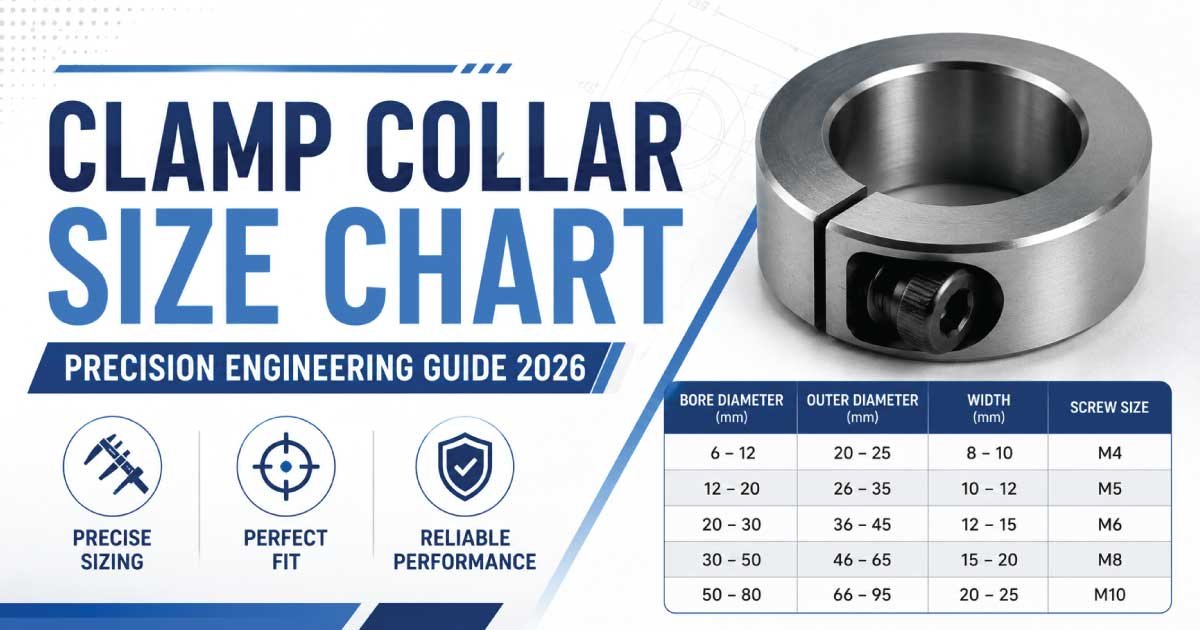
A clamp collar is a small but extremely important mechanical component used in shafts, rods, bearings, and machine assemblies. It is designed to hold parts in place using friction and compression, preventing unwanted movement along a shaft.
Whether you are working in machining, automotive repair, robotics, or industrial equipment, choosing the correct size from a clamp collar size chart is essential for performance and safety.
This guide explains clamp collar sizes, types, measurements, and a full size chart so you can easily select the right one.
What Is a Clamp Collar?
A clamp collar is a ring-shaped mechanical fastening device used to securely lock onto a rotating or stationary shaft by tightening screws. It creates uniform radial pressure around the shaft, ensuring a strong grip, better alignment, reduced wear, and improved performance in mechanical and industrial applications.
Key Features of Clamp Collar
Clamp collars are designed with a split circular body that allows easy installation and removal. They tighten using screws or bolts, providing strong axial positioning, preventing unwanted shaft movement, and offering reusable, adjustable performance in various machinery setups requiring precise and reliable shaft locking systems.
Key Features:
- Circular split design
- Tightens using one or more screws
- Provides strong axial positioning
- Prevents shaft movement
- Reusable and adjustable
Clamp collars are widely used in mechanical systems where precise positioning is required.
Why Clamp Collar Size Matters
Clamp collar size plays a crucial role in ensuring proper shaft grip, alignment accuracy, and machine safety. The correct size improves performance and stability, while incorrect sizing may cause slipping, vibration, surface damage, or premature failure of mechanical components in industrial and engineering systems.
Problems Caused by Wrong Clamp Collar Size
Using an incorrect clamp collar size can negatively affect machine performance. It may lead to shaft slippage, uneven pressure distribution, misalignment of connected parts, increased wear on components, reduced efficiency, and potential mechanical breakdowns, especially in high-load or precision engineering applications requiring stability.
Choosing the wrong clamp collar size can lead to:
- Slipping on the shaft
- Damage to shaft surface
- Misalignment of machine parts
- Reduced machine efficiency
- Premature wear of components
That’s why understanding a clamp collar size chart is important for engineers, technicians, and DIY users.
How Clamp Collar Sizes Are Measured
Clamp collar sizes are measured primarily based on inner diameter, which must match the shaft size exactly. Additional factors such as outer diameter, width, and bore tolerance also influence strength, fit accuracy, and load-handling capability in mechanical and industrial applications requiring precision assembly.
1. Inner Diameter (ID) Measurement
The inner diameter is the most critical measurement because it determines how tightly the collar fits onto the shaft. A precise match ensures maximum grip, prevents slippage, and maintains alignment, making it essential for selecting the correct clamp collar in mechanical systems.
2. Outer Diameter (OD) Measurement
Outer diameter defines the overall size of the clamp collar and affects its strength and load-bearing capacity. A larger OD generally provides more structural support, helping distribute pressure evenly and improving durability in demanding mechanical and industrial environments requiring stable shaft locking solutions.
3. Width (Thickness) Measurement
Width or thickness determines the contact surface area between the clamp collar and the shaft. Greater thickness increases holding strength and stability, allowing better resistance against vibration, axial movement, and mechanical stress in heavy-duty applications where secure shaft positioning is essential for performance.
4. Bore Tolerance Measurement
Bore tolerance refers to the allowable variation between the shaft diameter and clamp collar inner diameter. Proper tolerance ensures smooth installation, secure fitting, and optimal performance while preventing excessive tightness or looseness that could affect accuracy, efficiency, and lifespan of mechanical components.
Standard Clamp Collar Size Chart (Metric)
The metric clamp collar size chart is widely used in industrial machinery, automation systems, and engineering applications. It helps engineers and technicians select the correct collar based on shaft diameter, ensuring proper fit, strong grip, and reliable performance in mechanical assemblies where precision is essential.
Metric Clamp Collar Size Chart Overview
This chart provides standard sizes for clamp collars in millimeters, including inner diameter, outer diameter, and width. Each size is matched with typical applications to help users choose the right collar for robotics, CNC machines, industrial shafts, and heavy-duty mechanical systems.
| Shaft Size (mm) | Collar Inner Diameter (mm) | Outer Diameter (mm) | Width (mm) | Typical Application |
|---|---|---|---|---|
| 6 mm | 6 mm | 16–18 | 8–10 | Small robotics, instruments |
| 8 mm | 8 mm | 18–22 | 8–12 | 3D printers, light machinery |
| 10 mm | 10 mm | 20–25 | 10–12 | Automation systems |
| 12 mm | 12 mm | 25–30 | 10–15 | CNC machines |
| 14 mm | 14 mm | 28–32 | 12–15 | Mechanical assemblies |
| 15 mm | 15 mm | 30–35 | 12–15 | Industrial equipment |
| 16 mm | 16 mm | 32–38 | 12–18 | Heavy-duty machines |
| 20 mm | 20 mm | 38–45 | 15–20 | High-load shafts |
| 25 mm | 25 mm | 45–55 | 18–25 | Industrial shafts |
| 30 mm | 30 mm | 55–65 | 20–30 | Heavy machinery |
| 40 mm | 40 mm | 70–85 | 25–35 | Large equipment |
Standard Clamp Collar Size Chart (Imperial)
The imperial clamp collar size chart is commonly used in the United States and certain industrial systems. It is based on inches rather than millimeters and is important for selecting compatible components in machinery designed with imperial measurement standards.
Imperial Clamp Collar Size Chart Overview
This chart lists standard imperial shaft sizes along with corresponding collar dimensions and typical applications. It helps users choose the correct clamp collar for light-duty, general-purpose, and heavy industrial machinery where inch-based sizing is required for proper fit and performance.
| Shaft Size (inch) | Inner Diameter (inch) | Outer Diameter (inch) | Typical Use |
|---|---|---|---|
| 1/4″ | 1/4″ | 0.75″–1.0″ | Light-duty equipment |
| 3/8″ | 3/8″ | 1.0″–1.25″ | Small machinery |
| 1/2″ | 1/2″ | 1.25″–1.5″ | General purpose |
| 5/8″ | 5/8″ | 1.5″–2.0″ | Industrial use |
| 3/4″ | 3/4″ | 2.0″–2.5″ | Heavy machinery |
| 1″ | 1″ | 2.5″–3.0″ | High-load systems |
| 1-1/4″ | 1.25″ | 3.0″–3.5″ | Large equipment |
| 1-1/2″ | 1.5″ | 3.5″–4.0″ | Industrial shafts |
Types of Clamp Collars
Clamp collars are available in different designs depending on mechanical requirements, load conditions, and installation convenience. Each type is engineered to provide a specific level of strength, accessibility, and performance in shaft positioning applications used in industrial machinery and mechanical assemblies.
1. One-Piece Clamp Collar
A one-piece clamp collar consists of a single split ring that wraps around the shaft. It is simple to install, requires minimal tools, and provides moderate holding strength, making it suitable for light to medium-duty mechanical applications where quick adjustment and ease of use are important.
2. Two-Piece Clamp Collar
A two-piece clamp collar is divided into two halves that fit around the shaft and are then fastened together. This design offers higher clamping force, better alignment control, and is ideal for heavy-duty applications where stronger grip and reliable shaft locking are required.
3. Set-Screw Collar (Comparison Type)
A set-screw collar uses screws that directly press into the shaft surface to hold position. While it is easy to install and cost-effective, it can damage the shaft and provides uneven pressure distribution compared to clamp-style collars, making it less suitable for precision or high-load applications.
4. Heavy-Duty Clamp Collar
Heavy-duty clamp collars are designed with thicker bodies and reinforced structures to withstand high torque and extreme mechanical stress. They are commonly used in industrial machines where strong shaft retention, durability, and long-term performance under heavy loads are critical requirements.
📖 Read Our Complete Size Guide 👉 U Bolt Size Chart: Complete Guide 2025 + Pdf
How to Choose the Right Clamp Collar Size
Selecting the correct clamp collar size is essential for ensuring proper shaft grip, machine stability, and long-term performance. The choice depends on shaft dimensions, load conditions, material type, operating environment, and the level of precision required in the mechanical application.
1. Shaft Diameter
The clamp collar must match the shaft diameter exactly to ensure proper fitting. Any looseness or tightness can cause slippage, misalignment, or mechanical failure, making accurate measurement the most important factor in selecting the correct collar size for safe and efficient operation.
2. Load Requirements
Load requirements determine the strength and thickness needed in a clamp collar. Light-duty applications may use standard designs, while heavy-load systems require wider, reinforced collars that can handle higher stress, torque, and pressure without deforming or losing grip during continuous operation.
3. Material Type
Clamp collars are manufactured in different materials depending on application needs. Steel provides high strength for industrial use, aluminum offers lightweight performance for low-load systems, and stainless steel delivers excellent corrosion resistance, making it suitable for harsh or moisture-prone environments.
4. Operating Environment
Environmental conditions such as moisture, heat, dust, and chemical exposure significantly influence collar selection. Corrosion-resistant materials are preferred in harsh environments, while standard materials are suitable for controlled indoor applications where external stress factors are minimal and stability is maintained.
5. Precision Level
High-precision mechanical systems require clamp collars with tight tolerances to ensure exact shaft positioning. These collars minimize vibration, improve alignment accuracy, and maintain consistent performance in applications where even small deviations can affect overall machine efficiency and output quality.
How to Measure a Clamp Collar
Accurate measurement of a clamp collar is essential to ensure proper shaft fitting, alignment, and performance. Incorrect sizing can lead to slippage, vibration, or mechanical failure, so each step must be done carefully using proper measuring tools like calipers for precision.
Step 1: Measure Shaft Diameter
The first step is to measure the shaft diameter using a vernier caliper. This measurement is critical because the inner diameter of the clamp collar must match the shaft exactly for a secure and stable fit without looseness or excessive tightness.
Step 2: Check Inner Diameter of Collar
Next, compare the inner diameter of the clamp collar with the measured shaft diameter. A correct match ensures proper gripping force, prevents slippage during operation, and maintains accurate alignment in mechanical systems where stability and precision are required.
Step 3: Measure Outer Diameter
The outer diameter is important when dealing with space limitations inside machinery. It determines how much clearance is available around the shaft assembly and ensures the collar does not interfere with nearby machine components or structural parts.
Step 4: Check Width
Width measurement helps determine how much surface area grips the shaft. A proper width ensures the collar can handle the required load, resist vibration, and maintain stability, especially in applications where continuous mechanical stress is applied.
📖 Read Our Complete Size Guide 👉 M Screw Size Chart: Complete Guide 2026 With Pdf
Applications of Clamp Collars
Clamp collars are widely used across multiple industries because of their strong gripping ability, precise alignment, and reliable shaft positioning. They play a key role in mechanical systems where stability, movement control, and accurate part positioning are required.
1. Industrial Machinery
In industrial machinery, clamp collars are used for positioning shafts, aligning gears, and holding bearings in place. They help maintain stability under heavy loads and ensure smooth operation in manufacturing and production environments.
Applications:
- Positioning shafts
- Aligning gears
- Holding bearings
2. Robotics
In robotics, clamp collars are used for precise joint positioning, motor shaft locking, and arm alignment. They help maintain accuracy and smooth movement, which is essential for robotic systems that rely on controlled motion and repeatable performance.
Applications:
- Joint positioning
- Motor shaft locking
- Arm alignment
3. Automotive
Clamp collars are used in automotive systems such as transmission components, steering assemblies, and engine parts. They help secure moving components and ensure proper alignment under vibration and dynamic load conditions.
Applications:
- Transmission systems
- Steering components
- Engine assemblies
4. Manufacturing Equipment
In manufacturing equipment, clamp collars are used in conveyor systems, CNC machines, and packaging machinery. They help maintain precise movement, reduce downtime, and improve production efficiency in automated industrial setups.
Applications:
- Conveyor systems
- CNC machines
- Packaging machines
📖 Read Our Complete Size Guide 👉 M Bolt Size Chart: Complete Guide 2025 With Pdf
Advantages of Clamp Collars
Clamp collars are preferred over set-screw collars because they provide better performance, reliability, and shaft protection. Their design ensures strong grip while minimizing damage, making them ideal for both precision engineering and heavy-duty industrial use.
- Even pressure distribution
- No shaft damage
- Stronger holding force
- Easy installation and removal
- Reusable design
Common Mistakes to Avoid
Many users select or install clamp collars incorrectly, which can reduce performance and damage machinery. Avoiding these common mistakes helps improve efficiency, safety, and the overall lifespan of mechanical systems.
- Choosing incorrect inner diameter
- Ignoring shaft tolerance
- Using weak materials for heavy loads
- Over-tightening screws
- Mixing metric and imperial sizes
Avoiding these mistakes ensures longer machine life and better performance.
Clamp Collar vs Set-Screw Collar
| Feature | Clamp Collar | Set-Screw Collar |
|---|---|---|
| Shaft Damage | No | Yes |
| Grip Strength | High | Medium |
| Installation | Easy | Easy |
| Precision | High | Low |
| Reusability | Excellent | Moderate |
Clamp collars are generally the better option for precision and industrial applications due to their uniform pressure distribution, higher accuracy, and reduced risk of shaft damage compared to set-screw designs.
Final Thoughts
A clamp collar size chart is essential for selecting the correct component in mechanical systems. Since clamp collars depend entirely on shaft diameter, even a small sizing error can lead to performance issues or equipment failure.
By understanding sizes, types, and applications, you can confidently choose the right clamp collar for any project—whether it’s robotics, CNC machinery, or heavy industrial systems.
Proper sizing ensures stability, accuracy, and long-term reliability in any mechanical setup.