
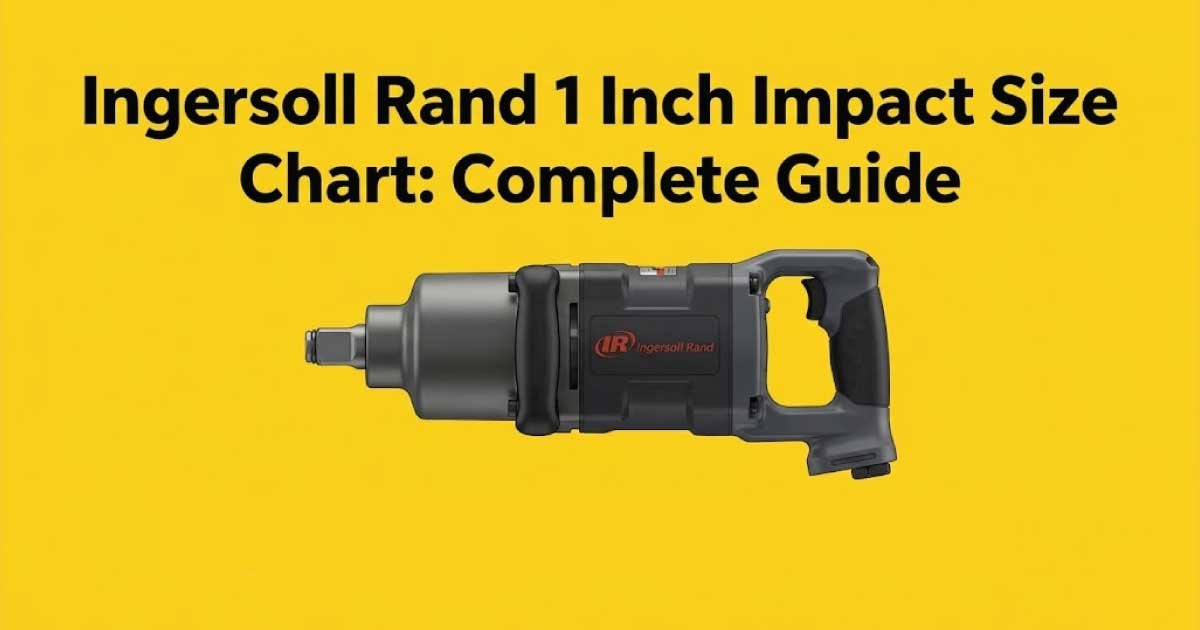
When working with heavy-duty trucks, industrial machinery, construction equipment, or large mechanical assemblies, having the right impact wrench can make a huge difference. Among professional mechanics and industrial technicians, Ingersoll Rand 1-inch impact wrenches are widely recognized for their durability, power, and reliability.
However, choosing the correct socket size, drive configuration, and impact wrench model can sometimes be confusing. That’s where an Ingersoll Rand 1 Inch Impact Size Chart becomes useful.
This complete guide explains common socket sizes, torque ranges, applications, drive types, and tips for selecting the right Ingersoll Rand 1-inch impact wrench for your needs.
Why Use a Size Chart?
Using a size chart is essential for technicians because it ensures accurate selection of tools and fasteners in mechanical work. It removes guesswork and helps maintain precision in assembly and repair tasks. With proper sizing information, workers can avoid errors, improve workflow efficiency, and achieve consistent mechanical performance across different applications.
A size chart helps technicians quickly determine:
Correct socket size
Compatible bolt sizes
Torque requirements
Appropriate applications
Recommended drive accessories
Using the wrong socket size can damage fasteners, reduce efficiency, and increase safety risks.
Ingersoll Rand 1 Inch Impact Socket Size Chart
Standard SAE Socket Sizes
| Socket Size | Typical Bolt Size | Common Applications |
|---|---|---|
| 1-1/2″ | 1″ Bolt | Heavy machinery |
| 1-5/8″ | 1-1/8″ Bolt | Industrial equipment |
| 1-11/16″ | 1-3/16″ Bolt | Truck suspension |
| 1-3/4″ | 1-1/4″ Bolt | Mining machinery |
| 1-7/8″ | 1-3/8″ Bolt | Construction equipment |
| 2″ | 1-1/2″ Bolt | Large industrial assemblies |
| 2-1/8″ | 1-5/8″ Bolt | Oil and gas equipment |
| 2-1/4″ | 1-3/4″ Bolt | Heavy-duty applications |
Metric Socket Size Chart
| Socket Size (mm) | Typical Fastener Size |
|---|---|
| 36 mm | M24 |
| 41 mm | M27 |
| 46 mm | M30 |
| 50 mm | M33 |
| 55 mm | M36 |
| 60 mm | M39 |
| 65 mm | M42 |
| 70 mm | M45 |
| 75 mm | M48 |
These sizes are commonly used with 1-inch drive impact tools in industrial environments.
Popular Ingersoll Rand 1 Inch Impact Models
Ingersoll Rand offers several 1-inch impact wrench models designed for different levels of industrial and heavy-duty applications. Each model varies in torque output, durability, weight, and intended use. Choosing the right model depends on the type of work, frequency of use, and required power level in mechanical or industrial environments.
Below are some of the most popular models used by professionals:
1. Ingersoll Rand 285B
The 285B is one of the most widely used heavy-duty impact wrenches in the industry. It is known for delivering strong performance while maintaining a compact and manageable design for technicians working in tight and demanding spaces.
Key Features:
Maximum torque around 1,475 ft-lbs
Twin hammer mechanism
Durable steel hammer case
Easy maintenance
Ideal for truck service applications
2. Ingersoll Rand 295A
The 295A is built for more demanding industrial environments where higher torque and consistent performance are required. It is designed to handle tough fastening and loosening tasks in heavy machinery and large-scale operations.
Benefits include:
High breakaway torque
Rugged construction
Long service life
Excellent for mining and construction equipment
3. Ingersoll Rand 3955B2TI
The 3955B2TI is a premium-grade model designed for professionals who need maximum performance with reduced operator fatigue. It combines strength with a lightweight structure for improved handling during long working hours.
Features include:
Titanium hammer case
Lightweight design
Extremely high torque output
Reduced operator fatigue
Industrial-grade durability
Torque Output Comparison Chart
| Model | Maximum Torque |
|---|---|
| 285B | 1,475 ft-lbs |
| 295A | 1,700+ ft-lbs |
| 3955B2TI | 2,000+ ft-lbs |
| 599A1 | 2,400+ ft-lbs |
Torque specifications may vary slightly depending on air pressure and operating conditions.
Common Socket Sizes Used With 1 Inch Impacts
Professional mechanics and heavy equipment technicians rely on a few standard socket sizes when working with 1-inch impact wrenches. These sockets are designed to handle high torque loads and large fasteners commonly found in trucks, construction machines, and industrial systems. Having the right sizes readily available improves efficiency, reduces downtime, and prevents damage to fasteners.
1. 1-1/2 Inch Socket
This is one of the most frequently used socket sizes in heavy-duty mechanical work. It is commonly applied in vehicle and equipment servicing where large wheel nuts and structural bolts are involved.
Frequently used for:
- Heavy truck wheels
- Agricultural machinery
- Construction equipment
2. 1-5/8 Inch Socket
This socket size is commonly used in medium-to-heavy industrial assemblies where stronger fastening systems are required. It is often seen in maintenance work involving trailers and large mechanical systems.
Common in:
- Trailer suspension systems
- Large industrial assemblies
- Equipment maintenance
3. 1-3/4 Inch Socket
The 1-3/4 inch socket is used in high-load environments where larger bolts are necessary to secure heavy machinery components. It is especially common in mining and excavation equipment.
Used for:
- Mining equipment
- Excavators
- Industrial machinery
4. 2 Inch Socket
This is one of the largest commonly used socket sizes in industrial applications. It is required for extremely heavy-duty fastening tasks involving structural and oilfield equipment.
Typically required for:
- Large structural bolts
- Oilfield equipment
- Heavy manufacturing systems
Keeping these sizes readily available helps improve productivity and reduce downtime.
Impact Socket Length Options
Socket length plays an important role in accessibility and torque application. Choosing the right length ensures better performance, safer operation, and easier access to fasteners in different working conditions.
1. Standard Length Sockets
Standard sockets are designed for strength and direct torque transfer. They are ideal for general applications where fasteners are easily accessible.
Advantages:
- Stronger construction
- Less flexing
- Better torque transfer
- Ideal for accessible fasteners
2. Deep Impact Sockets
Deep sockets are designed for reaching recessed or hard-to-access fasteners. They are commonly used in truck repair and complex mechanical assemblies.
Advantages:
- Reach recessed nuts
- Access longer studs
- Better versatility
- Common in truck repair
Many technicians keep both styles in their toolbox for maximum flexibility.
Drive Accessories for 1 Inch Impact Wrenches
Several drive accessories are used with 1-inch impact wrenches to improve reach, flexibility, and overall efficiency in heavy-duty mechanical work. These accessories help technicians access tight or awkward spaces, reduce disassembly time, and make challenging fastening tasks easier and safer.
1. Impact Extensions
Impact extensions are used to reach fasteners that are located in deep, narrow, or hard-to-access areas. They are especially useful in truck, construction, and industrial maintenance work where space is limited.
Common lengths:
- 5 inches
- 8 inches
- 10 inches
- 12 inches
2. Universal Joints
Universal joints allow the socket to flex at an angle, making it easier to reach fasteners that are not in a straight line with the tool. They are essential for working in cramped or obstructed environments.
Benefits include:
- Improved accessibility
- Reduced disassembly time
- Greater flexibility
3. Reducers and Adapters
Reducers and adapters allow technicians to use sockets with different drive sizes, increasing compatibility between tools and sockets. They are highly useful in workshops where multiple drive systems are used.
Examples:
- 1″ to 3/4″
- 1″ to 1/2″
- 1″ to 1-1/2″
Always ensure adapters are impact-rated to handle high torque safely and prevent breakage during use.
Air Requirements for Ingersoll Rand 1 Inch Impacts
Proper air supply is essential for getting the best performance from Ingersoll Rand 1-inch impact wrenches. These tools depend heavily on consistent airflow to deliver maximum torque output and smooth operation. If the air supply is weak or restricted, the tool will lose power and become less efficient, especially in heavy-duty applications.
Recommended Air Requirements
To ensure optimal performance, the following air conditions are generally recommended for 1-inch impact wrenches:
- Air pressure: 90 PSI
- Large air hose diameter
- High-flow fittings
- Clean, dry air
Why Air Supply Matters
Adequate airflow directly affects the torque and speed of the impact wrench. When the air pressure drops or the hose is too small, the tool cannot perform at its rated capacity. This can lead to slower operation, incomplete loosening of fasteners, and increased wear on internal components. Maintaining proper air supply ensures efficiency, durability, and consistent performance in demanding environments.
Recommended Hose Sizes
| Tool Type | Hose Size |
|---|---|
| 1 Inch Impact | 1/2″ Minimum |
| High Torque Models | 3/4″ Preferred |
Using undersized air hoses often causes power loss.
Read Our Detailed Guide:
Applications of Ingersoll Rand 1 Inch Impact Wrenches
Ingersoll Rand 1-inch impact wrenches are designed for extreme-duty applications where high torque and reliability are essential. These tools are widely used across industries that involve large machinery, heavy fasteners, and continuous maintenance work. Their strong performance makes them a standard choice for professional mechanics and industrial technicians.
1. Heavy Truck Maintenance
These tools are commonly used in truck workshops and fleet maintenance operations where large fasteners require high torque for removal and tightening.
Used for:
- Wheel lug nuts
- Suspension components
- Axle repairs
- Brake assemblies
2. Construction Equipment Repair
In construction environments, heavy machinery requires frequent servicing, and 1-inch impact wrenches provide the necessary power for fast and efficient repairs.
Ideal for servicing:
- Bulldozers
- Excavators
- Loaders
- Backhoes
3. Mining Industry
Mining operations involve extremely large and tightly secured components. These impact wrenches are essential for maintaining heavy-duty mining equipment under tough conditions.
Used extensively on:
- Haul trucks
- Crushers
- Drilling equipment
- Processing machinery
4. Industrial Manufacturing
In industrial plants, these tools are used for assembly, installation, and maintenance of large-scale equipment and production systems.
Common applications include:
- Structural assembly
- Equipment installation
- Production line maintenance
- Plant shutdown work
Read Our Detailed Guide:
Maintenance Tips
Proper maintenance is essential for keeping an Ingersoll Rand 1-inch impact wrench in top working condition. Regular care not only improves performance but also extends the overall lifespan of the tool. Neglecting maintenance can lead to reduced torque output, internal wear, and costly repairs over time.
1. Lubricate Regularly
Regular lubrication ensures smooth internal movement and reduces friction between moving parts. Air tool oil should be applied as recommended by the manufacturer to maintain consistent performance.
Benefits include:
- Reduced wear
- Improved performance
- Longer service life
2. Keep Air Clean
Clean, dry air is critical for protecting internal components from damage caused by moisture, dust, and debris. Poor air quality can significantly reduce tool efficiency and cause internal corrosion.
Install:
- Air filters
- Moisture separators
- Regulators
3. Store Properly
Proper storage helps prevent rust, contamination, and accidental damage. After use, the tool should always be stored in a controlled environment where it is protected from moisture and dust.
Store the impact wrench in a clean, dry environment to prevent corrosion and contamination.
Conclusion
An Ingersoll Rand 1 Inch Impact Wrench is one of the most valuable tools for heavy-duty mechanical work. Whether you’re maintaining trucks, repairing construction equipment, servicing mining machinery, or working in industrial manufacturing, selecting the correct socket size and impact model is essential for safe and efficient operation.
Using the Ingersoll Rand 1 Inch Impact Size Chart allows technicians to quickly identify compatible sockets, choose the proper fastener size, and maximize productivity on the job. By understanding torque requirements, air supply needs, socket configurations, and safety practices, you can get the best performance from your impact wrench while extending its service life.
Read Our Detailed Guide:
FAQs:
What is an Ingersoll Rand 1-inch impact wrench used for?
An Ingersoll Rand 1-inch impact wrench is used for heavy-duty applications like truck repair, mining equipment maintenance, and construction machinery servicing. It delivers extremely high torque to loosen or tighten large bolts and nuts that standard tools cannot handle. It is commonly used in industrial environments where strength, reliability, and durability are required for continuous operation.
Why is a size chart important for 1-inch impact wrenches?
A size chart is important because it helps technicians quickly identify the correct socket and bolt sizes for different jobs. It removes guesswork, improves accuracy, and prevents fastener damage. Using a proper chart also ensures better torque transfer, reduces tool wear, and increases safety during heavy-duty mechanical and industrial operations.
What socket sizes are commonly used with 1-inch impact tools?
Common socket sizes include 1-1/2″, 1-5/8″, 1-3/4″, and up to 2″ in SAE, while metric sizes include 36 mm to 75 mm. These sockets are designed for large fasteners used in trucks, mining equipment, and construction machinery. Having a full range improves efficiency and reduces downtime during repairs.
What type of sockets should be used with 1-inch impact wrenches?
Only impact-rated sockets made from chrome molybdenum steel should be used with 1-inch impact wrenches. Standard chrome sockets are unsafe because they can crack under high torque. Impact sockets are designed to absorb heavy force, ensuring durability, safety, and reliable performance during demanding industrial and mechanical applications.
How do I choose the right Ingersoll Rand 1-inch impact model?
Choosing the right model depends on torque needs, work frequency, and application type. For general truck work, mid-range models are suitable. For mining or construction, high-torque models are better. Weight, air supply, and duty cycle should also be considered to ensure comfort, efficiency, and long-term performance in demanding environments.
What air pressure is required for 1-inch impact wrenches?
Most Ingersoll Rand 1-inch impact wrenches require around 90 PSI with high airflow for maximum performance. A large-diameter air hose is also recommended to prevent power loss. Clean, dry air is important to avoid internal damage and ensure smooth operation. Insufficient air supply can significantly reduce torque output and efficiency.
What safety precautions should be followed when using this tool?
Always wear safety glasses and use impact-rated sockets to prevent accidents. Inspect tools regularly for cracks or damage, and avoid over-tightening fasteners. Proper torque control is important to prevent equipment failure. Following safety guidelines reduces injury risk, protects tools, and ensures smooth and reliable operation in heavy-duty environments.
How should I maintain an Ingersoll Rand 1-inch impact wrench?
Regular maintenance includes lubricating the tool, using clean dry air, and storing it in a moisture-free environment. Air filters and moisture traps should be used to protect internal parts. Inspecting hoses, fittings, and sockets also improves performance. Proper maintenance increases tool life, ensures consistent torque output, and prevents costly breakdowns.