
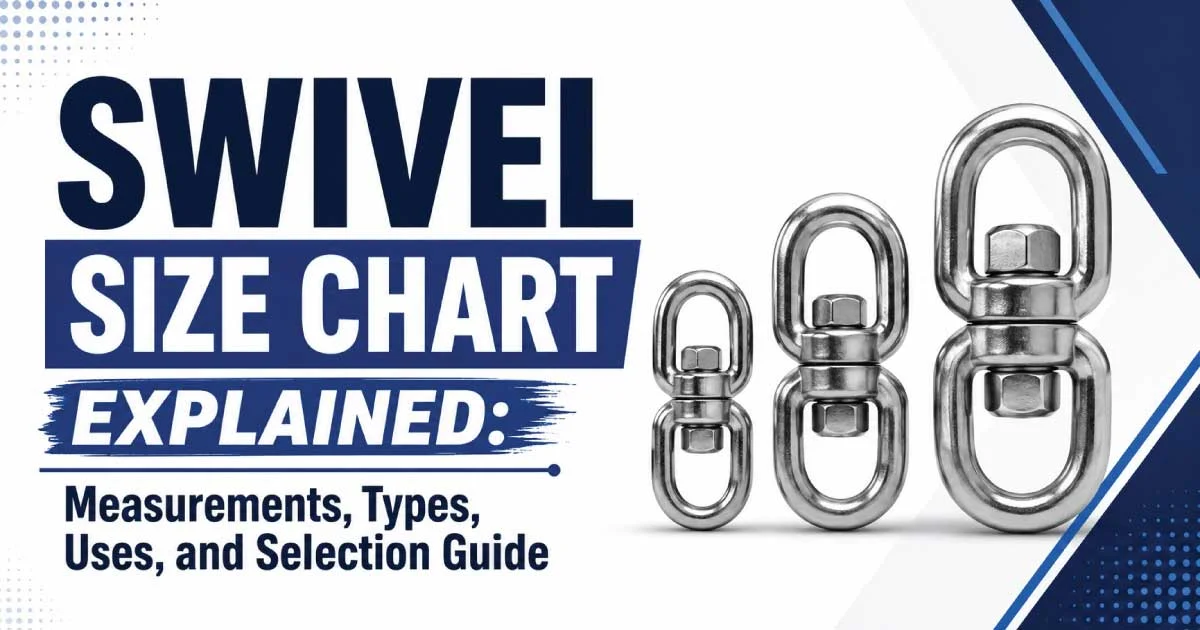
Swivels are important mechanical connectors designed to allow free rotation between two connected parts while maintaining a secure attachment. They are widely used in fishing equipment, lifting systems, marine hardware, towing applications, industrial machinery, and rigging assemblies. Choosing the correct swivel size is essential because the wrong size can reduce strength, limit rotation, and create safety risks.
A swivel size chart helps users identify the correct dimensions based on connection size, working load capacity, eye diameter, thread size, and application type. This complete guide explains swivel sizes, types, measurements, materials, and how to select the right swivel for different uses.
What Is a Swivel?
A swivel is a rotating connector that allows attached components to move freely without twisting or damaging connected ropes, chains, cables, or hardware. It contains a rotating mechanism that reduces stress and improves movement efficiency.
Swivels are designed to handle different levels of force and are available in various materials and designs. Some are made for lightweight applications, while others are engineered for heavy lifting and industrial operations.
Common swivel applications include:
- Fishing lines and hooks
- Boat and marine equipment
- Crane lifting systems
- Towing assemblies
- Chain connections
- Safety equipment
- Industrial machinery
Swivel Size Chart
Swivel sizes are generally determined by the connection diameter, overall dimensions, and load capacity. The correct size depends on the amount of force applied and the environment where the swivel will operate.
| Swivel Size | Connection Diameter | Working Load Capacity | Common Applications |
|---|---|---|---|
| Small Swivel | 3 mm – 6 mm | Light loads | Fishing, small hardware |
| Medium Swivel | 8 mm – 12 mm | Medium loads | Marine, towing, general use |
| Large Swivel | 16 mm – 25 mm | Heavy loads | Industrial equipment |
| Heavy Duty Swivel | 30 mm+ | High load applications | Cranes, lifting systems |
The exact dimensions may vary depending on the manufacturer, swivel design, and industry requirements.
Types of Swivels and Their Size Chart
Different applications require different swivel designs. The correct type depends on the load, movement requirements, and connection method.
Eye Swivel Size Chart
Eye swivels have circular openings that allow ropes, cables, chains, or hooks to be connected easily.
| Eye Swivel Size | Eye Diameter | Common Uses |
|---|---|---|
| Small Eye Swivel | 3 mm – 5 mm | Fishing and light hardware |
| Medium Eye Swivel | 6 mm – 12 mm | Marine and general applications |
| Large Eye Swivel | 15 mm – 25 mm | Industrial connections |
| Heavy Eye Swivel | 30 mm+ | Heavy-duty rigging |
The eye diameter should match the attached component to provide proper movement and load distribution.
Fishing Swivel Size Chart
Fishing swivels prevent fishing lines from twisting and allow hooks or lures to rotate freely. Fishing swivel sizes are usually identified by numbers.
| Fishing Swivel Size | Strength Level | Common Applications |
|---|---|---|
| Size 10 – 14 | Light Duty | Small fishing setups |
| Size 6 – 8 | Medium Duty | General fishing |
| Size 1 – 4 | Heavy Duty | Large fish species |
| 1/0 and Above | Extra Heavy Duty | Saltwater and big game fishing |
In fishing applications, smaller numbered swivels are usually larger in physical size.
Rigging Swivel Size Chart
Rigging swivels are designed for lifting and heavy-load applications. They are selected according to their working load limit rather than only physical dimensions.
| Working Load Capacity | Swivel Size Category | Applications |
|---|---|---|
| 0.5 – 2 Tons | Small Rigging Swivel | Light lifting |
| 3 – 10 Tons | Medium Rigging Swivel | Industrial work |
| 15 – 50 Tons | Large Rigging Swivel | Heavy machinery |
| 50+ Tons | Custom Heavy Duty | Crane operations |
Always select a rigging swivel based on its rated load capacity.
Also Read: Lathe Tool Bit Size Chart: Complete Guide 2026 with Pdf
How to Measure a Swivel Size
Accurate measurement is important when replacing or selecting a swivel. Several dimensions should be checked before purchase.
Measure Connection Diameter
The connection diameter determines whether the swivel will properly fit with hooks, ropes, chains, or cables.
Important measurements include:
- Eye opening diameter
- Pin diameter
- Thread size
- Connection width
A proper connection prevents excessive movement and improves safety.
Measure Overall Swivel Length
The overall length is measured from one end of the swivel to the other. This measurement is important when installation space is limited.
Longer swivels may provide additional clearance, while compact swivels are useful in smaller assemblies.
Check Working Load Limit
The working load limit (WLL) indicates the maximum safe load a swivel can handle during normal operation.
Always choose a swivel with a load rating above the expected working force to provide a safety margin.
Also Read: Cable Clamp Size Chart: Complete Guide + PDF
Swivel Materials and Applications
Swivels are manufactured from different materials depending on strength requirements and environmental conditions.
Stainless Steel Swivels
Stainless steel swivels are commonly used where corrosion resistance is required.
Advantages include:
- Excellent rust resistance
- Long service life
- Suitable for marine environments
- Low maintenance requirements
Common applications include boats, fishing equipment, and outdoor hardware.
Galvanized Steel Swivels
Galvanized steel swivels provide high strength and improved corrosion protection.
Benefits include:
- Strong construction
- Affordable cost
- Suitable for outdoor applications
- Good wear resistance
They are commonly used in towing, lifting, and industrial systems.
Aluminum Swivels
Aluminum swivels are lightweight and useful where reducing overall weight is important.
Common uses include:
- Sports equipment
- Lightweight hardware
- Portable systems
Types of Swivel Rotation Mechanisms
Different swivel designs provide different levels of smoothness and load handling.
Ball Bearing Swivels
Ball bearing swivels use internal bearings to provide smooth rotation under load.
Advantages include:
- Reduced friction
- Smooth movement
- Better performance under tension
They are commonly used in fishing, marine equipment, and precision applications.
Standard Swivels
Standard swivels use a basic rotating connection design and are suitable for general-purpose applications.
Common uses include:
- Small hardware connections
- Light-duty equipment
- Basic rotation needs
Heavy Duty Swivels
Heavy-duty swivels are designed for demanding applications where high strength is required.
They are commonly used in:
- Cranes
- Industrial lifting equipment
- Heavy machinery
Also Read:
Common Swivel Problems
Using the wrong swivel size or failing to maintain the component can lead to performance issues.
Overloading: Exceeding the rated capacity can cause bending, cracking, or complete swivel failure.
Corrosion Damage: Exposure to moisture, saltwater, or chemicals can weaken swivel materials over time.
Restricted Rotation: Dirt, rust, or lack of lubrication can prevent smooth rotation.
Incorrect Size Selection: A swivel that is too small may fail under load, while an oversized swivel may increase cost and weight unnecessarily.
How to Choose the Right Swivel Size
Selecting the correct swivel requires understanding the application requirements.
Consider these factors:
- Required load capacity
- Connection dimensions
- Rotation requirements
- Material compatibility
- Environmental conditions
- Frequency of use
For light applications, small stainless steel swivels are often suitable. Heavy lifting applications require properly rated industrial swivels designed for specific loads.
Swivel Installation and Maintenance Tips
Proper installation and regular inspection improve swivel performance and safety.
Follow these tips:
- Check the load rating before use.
- Ensure all connections fit correctly.
- Inspect for cracks, rust, or deformation.
- Lubricate moving parts when required.
- Replace damaged swivels immediately.
Regular maintenance is especially important for lifting and safety-related applications.
Final Thoughts on Swivel Size Guide
A swivel size chart helps users select the correct swivel for different mechanical and industrial applications. Understanding swivel dimensions, load capacity, materials, and rotation types ensures better performance and reliability.
Whether used in fishing, marine systems, towing equipment, or industrial machinery, choosing the correct swivel size improves safety, reduces wear, and provides smooth rotational movement. Always check manufacturer specifications and working load limits before installation to ensure the best results.