
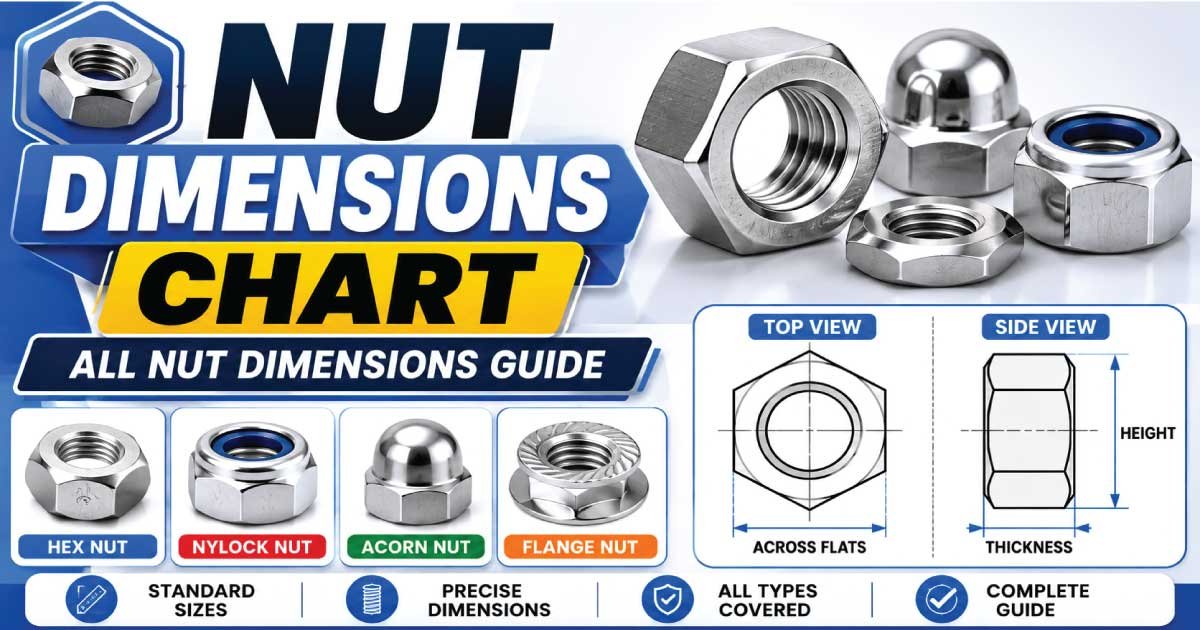
A nut dimensions chart is an essential reference for identifying and selecting the correct nut for a bolt, screw, stud, or threaded rod. Nuts are available in many sizes, shapes, materials, thicknesses, and standards. Although the basic purpose of a nut is simple, its dimensions can vary significantly depending on the nut type and specification.
The most important nut dimensions include nominal thread diameter, thread pitch, width across flats, width across corners, nut thickness, and internal thread dimensions. Understanding these measurements makes it easier to select replacement nuts, choose the correct wrench or socket, identify unknown fasteners, and compare metric and standard nut sizes.
This complete guide covers metric nut dimensions, standard nut dimensions, hex nut sizes, wrench sizes, nut thickness, thread pitch, nut standards, heavy hex nuts, thin nuts, lock nuts, flange nuts, and methods for measuring nuts accurately.
What Are Nut Dimensions?
Nut dimensions describe the physical and threaded characteristics of a nut. These dimensions determine whether the nut will fit a particular bolt and whether it can be properly installed using the appropriate tool.
The most commonly referenced nut dimensions include:
- Nominal thread diameter
- Thread pitch
- Width across flats
- Width across corners
- Nut thickness
- Internal thread diameter
- Chamfer dimensions
- Bearing surface dimensions
- Overall nut height
Different types of nuts use different dimensional standards. A standard hex nut, heavy hex nut, thin nut, flange nut, and lock nut can all have different outside dimensions even when they are designed for the same nominal thread size.
For this reason, a nut dimensions chart should be used as a reference rather than assuming that every nut of the same thread size has identical outside measurements.
Metric Nut Dimensions Chart
The following chart provides common dimensions for standard metric hex nuts. Exact dimensions may vary depending on the applicable standard, nut series, and manufacturer.
| Nut Size | Nominal Thread Diameter | Typical Width Across Flats | Typical Thickness |
|---|---|---|---|
| M3 | 3 mm | 5.5 mm | 2.4 mm |
| M4 | 4 mm | 7 mm | 3.2 mm |
| M5 | 5 mm | 8 mm | 4 mm |
| M6 | 6 mm | 10 mm | 5 mm |
| M8 | 8 mm | 13 mm | 6.5 mm |
| M10 | 10 mm | 16 mm | 8 mm |
| M12 | 12 mm | 18 mm | 10 mm |
| M14 | 14 mm | 21 mm | 12 mm |
| M16 | 16 mm | 24 mm | 13 mm |
| M18 | 18 mm | 27 mm | 15 mm |
| M20 | 20 mm | 30 mm | 16 mm |
| M22 | 22 mm | 34 mm | 18 mm |
| M24 | 24 mm | 36 mm | 19 mm |
| M27 | 27 mm | 41 mm | 22 mm |
| M30 | 30 mm | 46 mm | 24 mm |
| M33 | 33 mm | 50 mm | 26 mm |
| M36 | 36 mm | 55 mm | 29 mm |
| M39 | 39 mm | 60 mm | 31 mm |
| M42 | 42 mm | 65 mm | 34 mm |
| M45 | 45 mm | 70 mm | 36 mm |
| M48 | 48 mm | 75 mm | 38 mm |
These measurements are intended as a general reference for common metric hex nuts. Always verify the applicable standard when exact dimensions are required.
What Does Nut Size Mean?
Nut size normally refers to the nominal diameter of the internal thread rather than the outside width of the nut.
For example, an M10 nut is designed around a nominal 10 mm metric thread diameter. It does not mean that the nut is 10 mm wide across the flats.
Similarly:
- M6 refers to a nominal 6 mm thread diameter.
- M8 refers to a nominal 8 mm thread diameter.
- M12 refers to a nominal 12 mm thread diameter.
- M16 refers to a nominal 16 mm thread diameter.
- M20 refers to a nominal 20 mm thread diameter.
The wrench size is a separate dimension.
This distinction is particularly important when searching for replacement nuts because a user may know the wrench size but not the actual thread size.
Nut Dimensions Explained
Understanding the terminology used in nut dimension charts makes fastener identification much easier.
Nominal Thread Diameter
The nominal thread diameter identifies the general size of the threaded connection.
For metric nuts, it is expressed in millimeters and preceded by M.
For example, M12 means the nut is designed for a bolt with a nominal thread diameter of approximately 12 mm.
Width Across Flats
Width across flats, often abbreviated as AF, is the distance between two opposite flat sides of the nut.
This measurement determines the approximate wrench or socket size required.
Width Across Corners
Width across corners is measured from one corner of the hexagonal nut to the opposite corner.
It is larger than the across-flats measurement.
This dimension can be important when checking whether a nut will fit inside a recessed area or through a limited opening.
Nut Thickness
Nut thickness is the distance from the bearing surface to the top of the nut.
Standard, thin, and heavy nuts have different thicknesses.
Thread Pitch
Thread pitch is the distance between adjacent threads in metric fasteners.
For example, a 1.5 mm pitch means the distance from one thread crest to the corresponding next crest is 1.5 mm.
Metric Nut Size and Thread Pitch Chart
Metric nuts can have coarse, fine, and extra-fine thread pitches. The following chart shows common coarse pitches.
| Nut Size | Nominal Diameter | Common Coarse Pitch |
|---|---|---|
| M3 | 3 mm | 0.5 mm |
| M4 | 4 mm | 0.7 mm |
| M5 | 5 mm | 0.8 mm |
| M6 | 6 mm | 1.0 mm |
| M8 | 8 mm | 1.25 mm |
| M10 | 10 mm | 1.5 mm |
| M12 | 12 mm | 1.75 mm |
| M14 | 14 mm | 2.0 mm |
| M16 | 16 mm | 2.0 mm |
| M18 | 18 mm | 2.5 mm |
| M20 | 20 mm | 2.5 mm |
| M22 | 22 mm | 2.5 mm |
| M24 | 24 mm | 3.0 mm |
| M27 | 27 mm | 3.0 mm |
| M30 | 30 mm | 3.5 mm |
| M36 | 36 mm | 4.0 mm |
| M42 | 42 mm | 4.5 mm |
| M48 | 48 mm | 5.0 mm |
The pitch must match the bolt. An M10 × 1.5 nut is not interchangeable with an M10 × 1.25 nut.
Metric Nut Wrench Size Chart
One of the most useful dimensions when working with nuts is the width across flats because it determines which wrench or socket is needed.
| Nut Size | Typical Across Flats | Typical Wrench Size |
|---|---|---|
| M3 | 5.5 mm | 5.5 mm |
| M4 | 7 mm | 7 mm |
| M5 | 8 mm | 8 mm |
| M6 | 10 mm | 10 mm |
| M8 | 13 mm | 13 mm |
| M10 | 16 mm | 16 mm |
| M12 | 18 mm | 18 mm |
| M14 | 21 mm | 21 mm |
| M16 | 24 mm | 24 mm |
| M18 | 27 mm | 27 mm |
| M20 | 30 mm | 30 mm |
| M22 | 34 mm | 34 mm |
| M24 | 36 mm | 36 mm |
| M27 | 41 mm | 41 mm |
| M30 | 46 mm | 46 mm |
| M36 | 55 mm | 55 mm |
| M42 | 65 mm | 65 mm |
| M48 | 75 mm | 75 mm |
The exact across-flats dimension depends on the nut standard and style. Heavy hex nuts and other specialized nut types can have different wrench dimensions.
Standard Nut Dimensions Chart
Inch-based fasteners are widely used in the United States and in equipment manufactured using Unified thread standards.
| Nominal Nut Size | Typical Wrench Size | Common Thread Series |
|---|---|---|
| 1/4 in | 7/16 in | UNC / UNF |
| 5/16 in | 1/2 in | UNC / UNF |
| 3/8 in | 9/16 in | UNC / UNF |
| 7/16 in | 5/8 in | UNC / UNF |
| 1/2 in | 3/4 in | UNC / UNF |
| 9/16 in | 7/8 in | UNC / UNF |
| 5/8 in | 15/16 in | UNC / UNF |
| 3/4 in | 1-1/8 in | UNC / UNF |
| 7/8 in | 1-5/16 in | UNC / UNF |
| 1 in | 1-1/2 in | UNC / UNF |
| 1-1/8 in | 1-11/16 in | UNC / UNF |
| 1-1/4 in | 1-7/8 in | UNC / UNF |
| 1-3/8 in | 2-1/16 in | UNC / UNF |
| 1-1/2 in | 2-1/4 in | UNC / UNF |
These are general reference values. Exact dimensions depend on the applicable nut standard and series.
UNC and UNF Nut Dimensions
In inch-based fastening systems, thread pitch is usually expressed as threads per inch, or TPI.
UNC Nuts
UNC stands for Unified National Coarse.
Coarse threads have a lower number of threads per inch compared with fine threads of the same nominal diameter.
UNC nuts are commonly used for general mechanical and construction applications.
UNF Nuts
UNF stands for Unified National Fine.
UNF threads have more threads per inch than UNC threads for the same nominal diameter.
Fine-thread nuts can be useful in applications requiring finer thread engagement or adjustment.
A UNC nut and UNF nut of the same nominal diameter are not interchangeable because their thread pitch differs.
Also Read: Understand Shoulder Bolt Measurements and Specifications
Nut Thickness Chart
Nut thickness is an important part of overall nut dimensions.
A standard nut is designed with a particular height based on its nominal thread diameter and applicable standard. Thin nuts have reduced height, while heavy nuts have increased dimensions.
Typical standard metric hex nut thicknesses include:
| Nut Size | Typical Thickness |
|---|---|
| M3 | 2.4 mm |
| M4 | 3.2 mm |
| M5 | 4 mm |
| M6 | 5 mm |
| M8 | 6.5 mm |
| M10 | 8 mm |
| M12 | 10 mm |
| M14 | 12 mm |
| M16 | 13 mm |
| M18 | 15 mm |
| M20 | 16 mm |
| M22 | 18 mm |
| M24 | 19 mm |
| M27 | 22 mm |
| M30 | 24 mm |
| M36 | 29 mm |
Thickness is particularly important when determining available thread engagement.
Why Nut Thickness Matters
Nut thickness influences how much of the bolt thread engages with the nut.
A standard nut provides a specific amount of internal thread engagement. A thin nut provides less engagement and is generally intended for applications where its reduced height is acceptable.
Using a thin nut in an application designed for a standard or heavy nut can change the load-bearing characteristics of the connection.
Nut thickness also matters when space is limited. For example, a thin nut may be useful where a standard nut would interfere with another component.
Heavy Hex Nut Dimensions
Heavy hex nuts are larger and thicker than standard hex nuts for the same nominal thread size.
They are commonly associated with heavy-duty fastening systems and structural applications.
Important heavy hex nut dimensions include:
- Nominal thread diameter
- Width across flats
- Width across corners
- Nut thickness
- Thread pitch
- Bearing surface diameter
- Chamfer dimensions
Heavy hex nuts should be matched with compatible bolts and specified according to the required engineering standard.
A heavy hex nut is not simply a standard nut that has been made larger. Its dimensions and mechanical requirements are defined by applicable standards.
Thin Nut Dimensions
Thin nuts are designed with reduced thickness compared with standard nuts.
They are commonly used as:
- Jam nuts
- Locking arrangements
- Space-saving fasteners
- Adjustment nuts
- Secondary nuts
Thin nuts can be useful when there is insufficient space for a standard nut.
However, reduced thickness means there may be less thread engagement. Therefore, the nut should be used only where its design and strength are appropriate.
Lock Nut Dimensions
Lock nuts are designed to resist loosening from vibration, movement, or repeated loading.
Different locking nut designs have different dimensions.
Common examples include:
Nylon Insert Lock Nut
A nylon insert creates additional resistance against rotation.
All-Metal Lock Nut
An all-metal design uses deformation or other mechanical features to create prevailing torque.
Serrated Flange Nut
A serrated underside helps resist rotation when tightened against a suitable surface.
Jam Locking Arrangement
A thin nut can be tightened against another nut to create a locking arrangement.
Because locking features can affect the nut’s height and shape, their dimensions may differ from standard hex nuts.
Also Read: Complete Lathe Chuck Size Guide for Turning and Machining
Flange Nut Dimensions
A flange nut combines a hexagonal body with an integrated flange.
The flange increases the bearing surface underneath the nut.
Important flange nut dimensions include:
- Thread diameter
- Thread pitch
- Across flats
- Overall height
- Flange diameter
- Flange thickness
Flange diameter is especially important because it determines how much surface area the nut covers.
Some flange nuts have smooth bearing surfaces, while others feature serrations designed to improve resistance to loosening.
How to Measure Nut Dimensions
You can measure an unknown nut with a digital caliper, ruler, thread pitch gauge, and suitable measuring tools.
Measure the Width Across Flats
Place the caliper across two opposite flat surfaces.
The resulting measurement gives the across-flats dimension.
Measure the Thickness
Place the caliper between the bottom bearing surface and the top surface of the nut.
Measure the Thread Diameter
The internal thread is difficult to measure directly with ordinary tools. If a matching bolt is available, measuring the bolt’s outside thread diameter provides a practical way to estimate the nut’s nominal size.
Measure Thread Pitch
Use a metric thread pitch gauge for metric nuts or a thread gauge designed for inch threads.
Measure the Flange
For a flange nut, measure the outside diameter of the flange separately from the hexagonal body.
How to Identify an Unknown Nut
When you find an unidentified nut, start with the easiest measurements.
First, measure the width across flats. Then measure its approximate thickness. Next, determine whether the nut uses metric or inch threads.
If you have the bolt that belongs with the nut, measure the bolt’s nominal diameter and determine its thread pitch.
For metric fasteners, compare the measurements with common sizes such as M6, M8, M10, M12, M16, and M20.
For inch fasteners, compare them with common sizes such as 1/4 inch, 5/16 inch, 3/8 inch, 1/2 inch, 5/8 inch, and 3/4 inch.
Do not identify a nut solely by the wrench size because multiple thread sizes and nut standards can potentially have similar external dimensions.
How to Match Nut Dimensions With Bolt Dimensions
A nut must match the bolt’s threaded characteristics.
The following specifications should be compatible:
- Nominal diameter
- Thread pitch
- Thread series
- Thread form
- Material and grade
- Applicable standard
For example, an M12 × 1.75 nut should be matched with an M12 × 1.75 bolt.
Similarly, a 1/2-inch UNC nut should be paired with a compatible 1/2-inch UNC bolt rather than a 1/2-inch UNF bolt.
The outside diameter may appear similar, but the different thread pitch can prevent proper engagement.
Also Read: Complete M Set Screw Size Guide with Metric Dimensions
Metric vs Standard Nut Dimensions
Metric and standard nut dimensions use different measurement systems.
Metric nuts are identified with millimeter-based designations such as M8, M10, M12, and M16.
Standard or inch nuts are commonly identified using fractional sizes such as 1/4 inch, 3/8 inch, 1/2 inch, and 3/4 inch.
Some metric and inch sizes are close in physical diameter, but this does not make them interchangeable.
For example, an M10 nut and a 3/8-inch nut are relatively close in nominal diameter, but their thread specifications can differ.
The safest approach is always to identify the complete thread specification.
Nut Standards and Specifications
Different standards define the dimensions and performance requirements of nuts.
ISO Standards
ISO standards are widely used for metric fasteners and define dimensions, tolerances, and other requirements for different nut types.
DIN Standards
DIN standards are German standards widely encountered in industrial and mechanical applications. Many DIN fastener specifications are familiar to engineers, mechanics, and manufacturers worldwide.
ASME Standards
ASME standards are widely used for mechanical and industrial fasteners, particularly in North American applications.
ASTM Specifications
ASTM specifications often define material, mechanical properties, testing, and performance requirements for fasteners.
When selecting nuts for critical applications, it is important to identify the exact standard instead of relying solely on nominal size.
Nut Material and Dimensions
Nut material can affect strength, corrosion resistance, and suitability for a particular environment.
Carbon Steel Nuts
Carbon steel nuts are widely used in general mechanical applications.
Stainless Steel Nuts
Stainless steel nuts are frequently selected for applications where corrosion resistance is important.
Brass Nuts
Brass nuts are useful in applications requiring specific electrical, corrosion-resistant, or aesthetic characteristics.
Alloy Steel Nuts
Alloy steel nuts can be manufactured for demanding mechanical applications where higher strength characteristics are required.
Material selection should always be considered alongside the bolt grade and application requirements.
Nut Surface Finish
The surface finish of a nut can affect corrosion resistance and appearance.
Common finishes include:
- Zinc plated
- Galvanized
- Black oxide
- Zinc flake
- Nickel plated
- Plain steel
- Stainless steel finish
For outdoor applications, corrosion-resistant finishes may provide advantages over untreated carbon steel.
Common Nut Sizes for General Applications
Some nut sizes are particularly common in everyday mechanical work.
M6 Nut
M6 nuts are commonly used for smaller machinery, brackets, equipment, furniture, and general-purpose hardware.
M8 Nut
M8 nuts are frequently found in machinery, automotive components, mounting systems, and equipment.
M10 Nut
M10 nuts are widely used in mechanical assemblies, automotive applications, brackets, machinery, and general construction.
M12 Nut
M12 nuts are common in heavier mechanical assemblies where greater clamping capacity is required.
M16 Nut
M16 nuts are often used in heavier machinery, equipment, construction, and structural applications.
M20 and Larger Nuts
M20, M24, M27, M30, and larger nuts are typically used for larger machinery, heavy equipment, structural assemblies, and demanding mechanical connections.
Nut Dimensions and Wrench Selection
The wrench or socket must match the nut’s across-flats dimension.
For example, if a nut has an across-flats dimension of 18 mm, an 18 mm wrench or socket is generally required.
The nut’s nominal thread size does not necessarily equal the wrench size.
This is why a nut dimensions chart can be more useful than a simple thread-size chart. It provides information about both the threaded connection and the physical dimensions of the nut.
Common Nut Dimension Mistakes
Several mistakes can occur when selecting nuts.
Mistake 1: Matching Only the Diameter
Two nuts can have similar nominal diameters but different thread pitches.
Mistake 2: Assuming Nut Size Equals Wrench Size
An M10 nut does not mean a 10 mm wrench is required.
Mistake 3: Mixing Metric and Inch Threads
Metric and inch threads should not be mixed simply because their diameters appear close.
Mistake 4: Ignoring Nut Thickness
A thin nut and standard nut can have very different mechanical characteristics.
Mistake 5: Ignoring the Standard
Two nuts with the same nominal thread size may have different external dimensions because they follow different standards.
Mistake 6: Using the Wrong Strength Grade
A nut should be appropriate for the bolt and load requirements of the assembly.
Nut Dimensions Chart for Quick Reference
For quick identification, the following table summarizes common metric nut dimensions.
| Size | Diameter | Across Flats | Thickness |
|---|---|---|---|
| M5 | 5 mm | 8 mm | 4 mm |
| M6 | 6 mm | 10 mm | 5 mm |
| M8 | 8 mm | 13 mm | 6.5 mm |
| M10 | 10 mm | 16 mm | 8 mm |
| M12 | 12 mm | 18 mm | 10 mm |
| M14 | 14 mm | 21 mm | 12 mm |
| M16 | 16 mm | 24 mm | 13 mm |
| M18 | 18 mm | 27 mm | 15 mm |
| M20 | 20 mm | 30 mm | 16 mm |
| M22 | 22 mm | 34 mm | 18 mm |
| M24 | 24 mm | 36 mm | 19 mm |
| M27 | 27 mm | 41 mm | 22 mm |
| M30 | 30 mm | 46 mm | 24 mm |
| M36 | 36 mm | 55 mm | 29 mm |
| M42 | 42 mm | 65 mm | 34 mm |
| M48 | 48 mm | 75 mm | 38 mm |
These values provide a convenient general reference for common metric hex nuts.
Frequently Asked Questions About Nut Dimensions
What are the main dimensions of a nut?
The main nut dimensions are nominal thread diameter, thread pitch, width across flats, width across corners, and thickness. Specialized nuts may also have flange diameter, flange thickness, or other dimensional characteristics.
How is a nut size measured?
Nut size is generally identified by its nominal thread diameter. The external dimensions are measured separately using across-flats, across-corners, and thickness measurements.
What does M10 mean on a nut?
M10 indicates a metric nut designed around a nominal 10 mm thread diameter. It does not indicate the wrench size.
What size wrench fits an M8 nut?
A common M8 hex nut uses a 13 mm wrench under many current metric standards.
What size wrench fits an M10 nut?
A common M10 hex nut uses a 16 mm wrench under many current metric standards.
What size wrench fits an M12 nut?
A common M12 hex nut uses an 18 mm wrench under many current metric standards.
Is thread pitch important when selecting a nut?
Yes. The nut’s thread pitch must match the bolt’s thread pitch. Matching only the nominal diameter is not sufficient.
Are metric and standard nuts interchangeable?
Generally, no. Metric and inch-threaded fasteners use different thread specifications. Some sizes are physically close but should not be treated as interchangeable.
What is across flats on a nut?
Across flats is the distance between two opposite flat surfaces of a hex nut. It determines the wrench or socket size.
What is across corners on a nut?
Across corners is the distance between opposite corners of a hexagonal nut. It is larger than the across-flats dimension.
What is a heavy hex nut?
A heavy hex nut is a larger and generally thicker nut designed according to specific standards for applications requiring its particular dimensions and mechanical properties.
What is a thin nut?
A thin nut has reduced thickness compared with a standard nut. It is commonly used as a jam nut or where installation space is limited.
Why are some nuts the same thread size but different dimensions?
Different nut styles and standards can specify different widths, thicknesses, flange sizes, and other dimensions even when the internal thread specification is the same.
Final Thoughts on Nut Dimensions
A detailed nut dimensions chart makes it much easier to identify and select the right fastener. The most important measurements to understand are the nominal thread diameter, thread pitch, width across flats, width across corners, and nut thickness.
For metric nuts, common sizes include M5, M6, M8, M10, M12, M14, M16, M20, M24, M30, M36, and M48. However, the nominal M-size does not tell you the complete physical dimensions of the nut.
When selecting a nut, always verify the thread diameter and pitch first. Then check the nut’s width across flats, thickness, style, material, strength grade, and applicable standard. If the nut is being used with a specific bolt, both fasteners should be compatible in thread specification and appropriate for the expected load.
For general maintenance and DIY projects, a nut size chart can provide a quick and practical reference. For structural, safety-critical, or heavily loaded applications, exact manufacturer and standard specifications should always take priority over generalized chart values.
Understanding nut dimensions, metric nut sizes, standard nut sizes, hex nut dimensions, nut thickness, wrench sizes, thread pitch, heavy hex nuts, thin nuts, flange nuts, and lock nut dimensions will help you identify fasteners accurately and choose the correct nut for a wide range of mechanical and construction applications.