
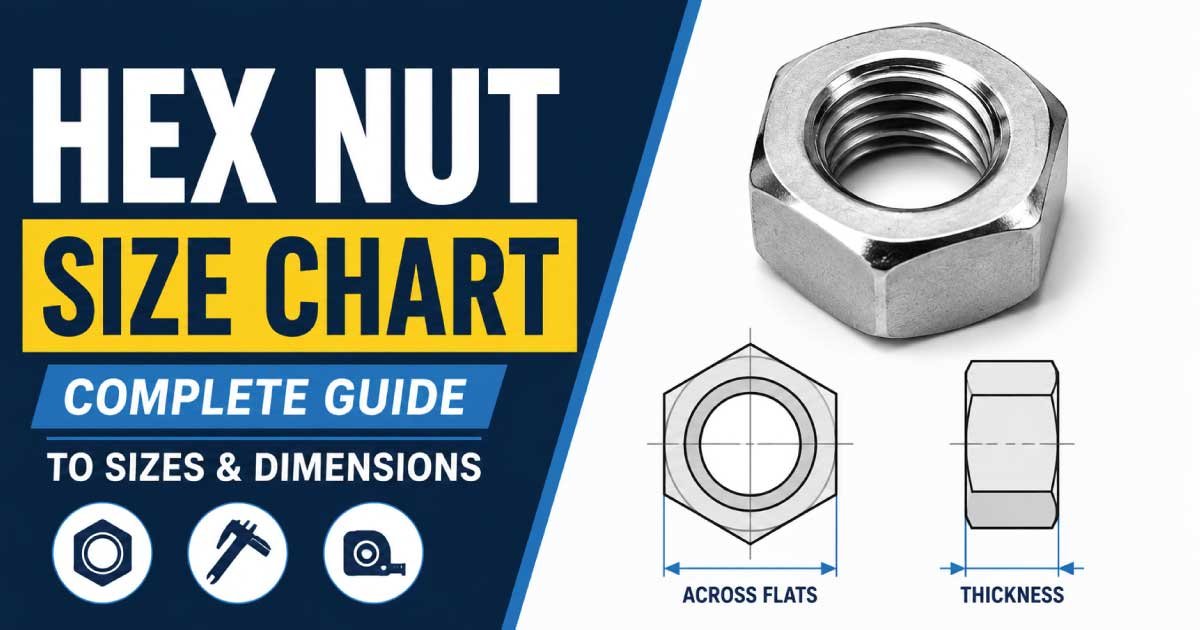
Hex nuts are among the most widely used fasteners in mechanical, construction, automotive, plumbing, manufacturing, and DIY applications. A hex nut size chart makes it easier to identify the correct nut by thread diameter, thread pitch, width across flats, thickness, and applicable standard. Because hex nuts are available in both metric and inch sizes, understanding their dimensions is important when selecting a replacement or matching a nut with a bolt.
This complete guide explains common hex nut sizes, metric and standard measurements, thread specifications, wrench sizes, nut thickness, and the differences between common nut standards. Use the charts below as a practical reference when identifying or selecting hex nuts for your project.
What Is a Hex Nut?
A hex nut is a threaded fastener with six flat sides that allow it to be tightened or loosened with a wrench or socket. The internal threads of the nut match the external threads of a bolt, screw, or threaded rod.
The six-sided design provides multiple contact points for a wrench, making hex nuts easy to install and remove. They are manufactured in many sizes, materials, grades, and finishes to meet different mechanical and environmental requirements.
Common hex nut applications include:
- Machinery assembly
- Automotive repairs
- Structural projects
- Construction equipment
- Electrical installations
- Plumbing systems
- Manufacturing
- Furniture assembly
- General maintenance
- DIY projects
Choosing the correct hex nut requires more than simply measuring the outside of the nut. The thread diameter and pitch must match the bolt, while the nut’s width and thickness determine the required wrench or socket.
Hex Nut Size Chart
The following metric hex nut size chart provides common nominal thread sizes and typical dimensions. Dimensions can vary depending on the applicable standard, such as ISO 4032, DIN 934, or other specifications.
| Metric Nut Size | Nominal Thread Diameter | Typical Width Across Flats | Typical Nut Thickness |
|---|---|---|---|
| M3 | 3 mm | 5.5 mm | 2.4 mm |
| M4 | 4 mm | 7 mm | 3.2 mm |
| M5 | 5 mm | 8 mm | 4 mm |
| M6 | 6 mm | 10 mm | 5 mm |
| M8 | 8 mm | 13 mm | 6.5 mm |
| M10 | 10 mm | 16 mm | 8 mm |
| M12 | 12 mm | 18 mm | 10 mm |
| M14 | 14 mm | 21 mm | 12 mm |
| M16 | 16 mm | 24 mm | 13 mm |
| M18 | 18 mm | 27 mm | 15 mm |
| M20 | 20 mm | 30 mm | 16 mm |
| M22 | 22 mm | 34 mm | 18 mm |
| M24 | 24 mm | 36 mm | 19 mm |
| M27 | 27 mm | 41 mm | 22 mm |
| M30 | 30 mm | 46 mm | 24 mm |
| M33 | 33 mm | 50 mm | 26 mm |
| M36 | 36 mm | 55 mm | 29 mm |
| M39 | 39 mm | 60 mm | 31 mm |
| M42 | 42 mm | 65 mm | 34 mm |
| M45 | 45 mm | 70 mm | 36 mm |
| M48 | 48 mm | 75 mm | 38 mm |
These dimensions are useful for general identification, but exact dimensions should always be checked against the manufacturer’s specification and the applicable standard.
Understanding Hex Nut Measurements
Understanding how hex nuts are measured helps prevent mistakes when selecting fasteners. A nut has several important dimensions, but three measurements are particularly useful: nominal thread diameter, width across flats, and thickness.
1. Nominal Thread Diameter
The nominal thread diameter is the approximate outside diameter of the bolt thread that the nut is designed to fit.
For example, an M10 nut is designed for a bolt with a nominal thread diameter of approximately 10 mm. The internal diameter of the nut is smaller than 10 mm because the nut contains internal threads.
Common metric nominal diameters include:
- M3
- M4
- M5
- M6
- M8
- M10
- M12
- M14
- M16
- M18
- M20
- M24
- M30
- M36
2. Width Across Flats
Width across flats, commonly abbreviated as AF, is the distance between two opposite flat sides of the hex nut.
This measurement determines the size of wrench or socket required to tighten the nut.
For example, a common M10 hex nut has a width across flats of approximately 16 mm under many current metric standards.
3. Nut Thickness
Nut thickness is measured from the top surface to the bottom bearing surface of the nut.
Standard hex nuts generally have a thickness related to their nominal diameter. Thin nuts are intentionally manufactured with less thickness, while heavy hex nuts are thicker and have larger overall dimensions.
Also Read: Complete Concrete Block Guide 2026: Sizes and Selection
Metric Hex Nut Sizes
Metric hex nuts are identified using the letter M followed by the nominal thread diameter in millimeters.
For example:
- M6 = 6 mm nominal thread diameter
- M8 = 8 mm nominal thread diameter
- M10 = 10 mm nominal thread diameter
- M12 = 12 mm nominal thread diameter
- M16 = 16 mm nominal thread diameter
- M20 = 20 mm nominal thread diameter
The designation does not directly tell you the wrench size. For example, an M12 nut does not necessarily require a 12 mm wrench. Its wrench size depends on the applicable nut standard.
Metric Hex Nut Thread Pitch
Thread pitch is another critical measurement when selecting a hex nut.
For metric fasteners, pitch is measured as the distance between adjacent thread peaks in millimeters. Metric nuts can have coarse, fine, or extra-fine threads.
For example, common coarse-pitch combinations include:
| Nut Size | Common Coarse Pitch |
|---|---|
| M4 | 0.7 mm |
| M5 | 0.8 mm |
| M6 | 1.0 mm |
| M8 | 1.25 mm |
| M10 | 1.5 mm |
| M12 | 1.75 mm |
| M14 | 2.0 mm |
| M16 | 2.0 mm |
| M18 | 2.5 mm |
| M20 | 2.5 mm |
| M22 | 2.5 mm |
| M24 | 3.0 mm |
| M27 | 3.0 mm |
| M30 | 3.5 mm |
A nut and bolt must have compatible thread diameter, pitch, and thread form. An M10 × 1.5 nut, for example, should not be forced onto an M10 × 1.25 bolt.
Standard Hex Nut Size Chart
In the United States and other regions using inch-based fasteners, hex nuts are commonly identified by nominal thread size rather than an M designation.
Common sizes include:
| Nominal Size | Typical Wrench Size | Common Thread Types |
|---|---|---|
| 1/4 in | 7/16 in | UNC / UNF |
| 5/16 in | 1/2 in | UNC / UNF |
| 3/8 in | 9/16 in | UNC / UNF |
| 7/16 in | 5/8 in | UNC / UNF |
| 1/2 in | 3/4 in | UNC / UNF |
| 9/16 in | 7/8 in | UNC / UNF |
| 5/8 in | 15/16 in | UNC / UNF |
| 3/4 in | 1-1/8 in | UNC / UNF |
| 7/8 in | 1-5/16 in | UNC / UNF |
| 1 in | 1-1/2 in | UNC / UNF |
| 1-1/8 in | 1-11/16 in | UNC / UNF |
| 1-1/4 in | 1-7/8 in | UNC / UNF |
| 1-3/8 in | 2-1/16 in | UNC / UNF |
| 1-1/2 in | 2-1/4 in | UNC / UNF |
Exact wrench dimensions can differ according to the nut series and applicable standard, so this chart should be treated as a general reference.
Also Read: Brick Size Guide: Complete Chart and Standards
What Is the Difference Between Metric and Standard Hex Nuts?
The biggest difference between metric and standard hex nuts is the measurement system and thread specification.
Metric nuts use millimeters and are designated with sizes such as M8, M10, and M12. Standard or inch nuts use fractional or nominal inch sizes such as 1/4 inch, 3/8 inch, and 1/2 inch.
The two systems should not normally be mixed. Even when two nuts appear similar in diameter, their thread pitch may be different.
For example, an M10 metric bolt and a 3/8-inch bolt are relatively close in diameter, but their threads are not interchangeable.
Hex Nut Wrench Size Chart
The wrench size is one of the most useful measurements when working with hex nuts.
For common metric hex nuts, approximate wrench sizes include:
| Nut Thread | Common Wrench Size |
|---|---|
| M3 | 5.5 mm |
| M4 | 7 mm |
| M5 | 8 mm |
| M6 | 10 mm |
| M8 | 13 mm |
| M10 | 16 mm |
| M12 | 18 mm |
| M14 | 21 mm |
| M16 | 24 mm |
| M18 | 27 mm |
| M20 | 30 mm |
| M22 | 34 mm |
| M24 | 36 mm |
| M27 | 41 mm |
| M30 | 46 mm |
| M36 | 55 mm |
Always verify the wrench size before purchasing a socket or wrench because different nut standards can use different across-flat dimensions.
Also Read: Linear Bearing Size Guide: Complete Chart
Hex Nut Standards
Hex nuts are manufactured according to different standards that specify dimensions, tolerances, materials, mechanical properties, and other requirements.
Some commonly encountered standards include:
ISO 4032
ISO 4032 is widely used for standard hexagon nuts. It specifies dimensional requirements for metric hex nuts across various nominal thread sizes.
DIN 934
DIN 934 is a well-known German standard historically associated with hexagon nuts. DIN and ISO specifications have evolved over time, so older DIN 934 nuts should not automatically be assumed to have exactly the same dimensions as current ISO-standard nuts.
ASME and ASTM Standards
In inch-based applications, ASME and ASTM standards are commonly encountered. These standards can specify dimensional, material, strength, and performance requirements for different fastener types.
When selecting a nut for an engineering application, the standard should be considered along with the thread size and material grade.
How to Measure a Hex Nut
If you have an unidentified hex nut, you can determine its approximate size with a caliper, ruler, thread gauge, or wrench.
Step 1: Measure the Width Across Flats
Measure directly from one flat side to the opposite flat side. This gives you the width across flats.
Step 2: Measure the Nut Thickness
Measure from the bottom bearing surface to the top surface.
Step 3: Identify the Thread Diameter
If possible, measure the matching bolt or the outside diameter of the nut’s internal thread area using an appropriate method.
Step 4: Determine Thread Pitch
For metric fasteners, use a metric thread pitch gauge or measure the distance between several thread peaks.
Step 5: Identify the Thread Standard
Determine whether the nut uses a metric thread, UNC, UNF, or another thread system.
These measurements together provide a much more reliable identification than looking only at the outside width of the nut.
Common Hex Nut Types
Although the standard hex nut is the most common design, several other nut styles are used for specialized applications.
Standard Hex Nut
The standard hex nut is the general-purpose option used with compatible bolts, screws, and threaded rods.
Heavy Hex Nut
Heavy hex nuts are larger and thicker than standard hex nuts. They are often used in structural and heavy-duty applications where greater bearing area and strength are required.
Thin Hex Nut
Thin nuts have reduced thickness and are often used as jam nuts. They can be useful where space is limited or where a second nut is needed for locking.
Lock Nut
Lock nuts are designed to resist loosening caused by vibration or movement. Different locking mechanisms include nylon inserts, all-metal locking features, and specialized thread designs.
Flange Nut
A flange nut includes an integrated flange that increases the bearing surface beneath the nut. Some flange nuts also have serrated surfaces to improve resistance to rotation.
How to Choose the Correct Hex Nut
Selecting the correct hex nut involves matching several specifications rather than choosing a nut based only on appearance.
Consider the following factors:
- Nominal thread diameter
- Thread pitch
- Thread type
- Nut thickness
- Width across flats
- Nut standard
- Material
- Strength grade
- Corrosion resistance
- Operating temperature
- Application requirements
For general applications, the nut should have compatible threads with the bolt. For critical mechanical or structural applications, the nut’s grade and material should also be matched appropriately to the bolt and engineering requirements.
Hex Nut Material and Finish
Hex nuts are manufactured from a variety of materials.
Carbon steel is commonly used for general-purpose fasteners because it provides a balance of strength, availability, and cost.
Stainless steel hex nuts are useful where corrosion resistance is important, including outdoor, marine, food-processing, and other demanding environments.
Brass nuts are commonly selected for applications where corrosion resistance, electrical properties, or appearance are important.
Common surface finishes include zinc plating, zinc flake coatings, black oxide, and plain finishes. The correct finish depends on the environment and performance requirements.
Why Hex Nut Size Matters
Using the wrong hex nut can create several problems. An incorrect thread pitch may cause cross-threading, while an incorrectly sized nut may fail to provide the required clamping force.
A nut that is too thin may not provide sufficient thread engagement for a particular application. Likewise, using the wrong material or strength grade can create a safety concern in highly loaded assemblies.
Correct sizing helps ensure:
- Proper thread engagement
- Reliable clamping
- Correct wrench fit
- Better load distribution
- Reduced risk of thread damage
- Easier installation and removal
- Improved fastener performance
For critical applications, never rely solely on a general-purpose size chart. Always confirm the required standard and engineering specification.
Hex Nut Size Chart: Quick Reference
For quick identification, the most frequently used metric hex nut sizes include M6, M8, M10, M12, M16, M20, and M24.
Among these, M8 and M10 are extremely common in machinery, automotive components, equipment, brackets, and general mechanical work. M12 and larger sizes are frequently used where greater clamping capacity is required.
Remember that the nut size refers primarily to the nominal thread diameter, not the wrench size. For example, an M10 nut can require a 16 mm wrench under a common current metric standard.
FAQs About Hex Nut Sizes
What is the most common hex nut size?
There is no single universal most common size because applications vary. In general mechanical and maintenance work, metric sizes such as M6, M8, M10, and M12 are widely encountered.
How do I know what size hex nut I need?
Identify the bolt’s nominal diameter and thread pitch first. Then select a nut with the same compatible thread specification. Finally, verify the nut’s standard, wrench size, thickness, and material requirements.
Is an M10 nut the same as a 10 mm nut?
M10 describes a metric nut designed around a nominal 10 mm thread diameter. It does not mean that the nut requires a 10 mm wrench.
What wrench fits an M8 hex nut?
A common M8 hex nut uses a 13 mm wrench under many current metric dimensional standards. However, the exact across-flat dimension can vary with the nut standard.
Can metric nuts fit standard bolts?
Metric and inch-threaded fasteners are generally not interchangeable. Even when their nominal diameters appear similar, their thread pitch and geometry may differ.
What does M12 × 1.75 mean?
M12 identifies the nominal metric thread diameter, while 1.75 represents the thread pitch in millimeters. Therefore, an M12 × 1.75 nut is designed for a compatible M12 × 1.75 bolt.
Final Thoughts on Hex Nut Sizes
A reliable hex nut size chart is an important reference for anyone working with mechanical fasteners. The correct nut must match the bolt’s nominal diameter, thread pitch, and thread system. Its width across flats and thickness are also important because they determine wrench compatibility and overall fit.
Metric hex nuts are commonly identified as M3, M4, M5, M6, M8, M10, M12, M16, M20, M24, and larger sizes, while inch-based fasteners use fractional or nominal inch designations. Different standards can produce variations in dimensions, so always verify the applicable specification before using a nut in a critical application.
Whether you are working on machinery, automotive components, construction projects, industrial equipment, or a DIY repair, understanding hex nut dimensions, metric nut sizes, standard nut sizes, thread pitch, wrench sizes, and nut standards makes fastener selection much easier and helps ensure a secure and reliable connection.