
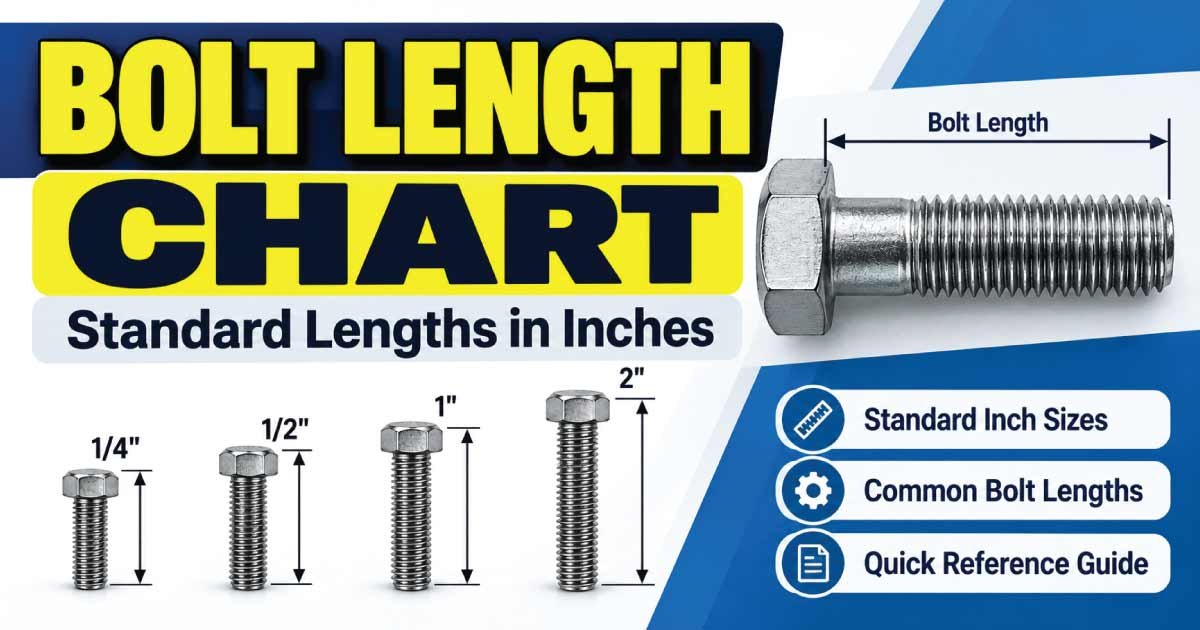
Bolts are available in many different lengths, and choosing the correct one is essential for getting a secure, properly fitted connection. A bolt that is too short may not provide enough thread engagement, while one that is too long can interfere with surrounding components or leave unnecessary thread exposed.
This bolt length chart in inches provides a practical reference for common nominal bolt lengths, from short fasteners to longer construction and machinery bolts. It also explains how bolt length is measured, how fractional and decimal inch measurements relate, how much thread engagement is appropriate, and how to select the correct length for a particular application.
Because bolt availability varies by diameter, thread type, head style, manufacturer, and applicable standard, the chart should be used as a starting point rather than a guarantee that every length exists for every bolt size.
Bolt Length Chart in Inches
Bolt length is normally specified in inches for many U.S. customary fasteners. Common nominal lengths are often available in fractional-inch increments for shorter bolts and larger increments as bolts become longer.
The following chart shows commonly encountered nominal lengths. It is a length reference only and does not indicate that every length is available for every diameter or bolt grade.
| Bolt Length (in.) | Equivalent Fraction | Equivalent Decimal (in.) | Typical Use |
|---|---|---|---|
| 1/2 | 1/2 | 0.500 | Short assemblies |
| 5/8 | 5/8 | 0.625 | Light-duty assemblies |
| 3/4 | 3/4 | 0.750 | General fastening |
| 7/8 | 7/8 | 0.875 | General fastening |
| 1 | 1 | 1.000 | General-purpose |
| 1-1/4 | 1 1/4 | 1.250 | Medium assemblies |
| 1-1/2 | 1 1/2 | 1.500 | Medium assemblies |
| 1-3/4 | 1 3/4 | 1.750 | Thicker materials |
| 2 | 2 | 2.000 | Structural/mechanical |
| 2-1/4 | 2 1/4 | 2.250 | Thicker assemblies |
| 2-1/2 | 2 1/2 | 2.500 | Mechanical applications |
| 2-3/4 | 2 3/4 | 2.750 | Extended assemblies |
| 3 | 3 | 3.000 | Long assemblies |
| 3-1/2 | 3 1/2 | 3.500 | Heavy assemblies |
| 4 | 4 | 4.000 | Long fastening |
| 4-1/2 | 4 1/2 | 4.500 | Extended fastening |
| 5 | 5 | 5.000 | Long applications |
| 6 | 6 | 6.000 | Very thick assemblies |
The actual standard length series depends on the bolt type and standard being used. For example, a particular hex bolt, socket head cap screw, carriage bolt, or structural fastener may not be manufactured in every length shown above.
What Is Bolt Length?
Bolt length is the nominal distance used to describe how long a bolt is along its axis. For most conventional bolts with a head that sits against the surface, length is measured from the bearing surface under the head to the end of the bolt.
This is an important distinction because the bolt head is generally not included in the stated length.
For example, if a conventional hex bolt is specified as 3 inches long, the 3-inch dimension normally represents the distance from the underside of the hexagonal head to the threaded end.
Bolt length is only one part of a fastener’s specification. A complete bolt description may also include:
- Nominal diameter
- Thread pitch or threads per inch
- Thread type
- Thread length
- Bolt grade or property class
- Head style
- Material
- Finish or coating
A correct length alone does not guarantee that a bolt is suitable for an application.
How Is Bolt Length Measured?
Measuring a bolt correctly is straightforward when the bolt has a conventional head.
1. Measure From Under the Head
For a typical hex bolt, socket head cap screw, or similar non-countersunk bolt, place the starting point of the ruler or caliper against the bearing surface directly beneath the head.
Measure in a straight line to the end of the bolt.
Do not include the height of the bolt head in the measurement.
For example:
Head → 3-inch shank/threaded section → bolt end
The nominal bolt length is therefore 3 inches.
2. Countersunk Bolts Are Different
Countersunk fasteners are a notable exception. Their heads are designed to sit flush with the material surface, so the overall fastener length is generally measured from the top of the head to the end.
This means you should not automatically apply the underside-of-head measurement method to every fastener.
3. Measure With the Right Tool
A ruler can be sufficient for a quick measurement, but a caliper provides better accuracy when determining an existing bolt’s dimensions.
When identifying a bolt, measure:
- Overall applicable length
- Outside thread diameter
- Thread pitch or threads per inch
- Head dimensions if identification is required
If the bolt is being replaced, comparing it with the manufacturer’s specifications or the original fastener documentation is preferable to relying on length alone.
Bolt Length Inches to Decimal Conversion
Some applications specify bolt lengths as fractions, while technical drawings, measuring tools, and digital systems may use decimal inches.
Understanding the conversion makes it easier to compare measurements.
| Fractional Length | Decimal Inches | Millimeters (Approx.) |
|---|---|---|
| 1/4 in. | 0.250 | 6.35 mm |
| 3/8 in. | 0.375 | 9.53 mm |
| 1/2 in. | 0.500 | 12.70 mm |
| 5/8 in. | 0.625 | 15.88 mm |
| 3/4 in. | 0.750 | 19.05 mm |
| 7/8 in. | 0.875 | 22.23 mm |
| 1 in. | 1.000 | 25.40 mm |
| 1-1/4 in. | 1.250 | 31.75 mm |
| 1-1/2 in. | 1.500 | 38.10 mm |
| 1-3/4 in. | 1.750 | 44.45 mm |
| 2 in. | 2.000 | 50.80 mm |
| 2-1/2 in. | 2.500 | 63.50 mm |
| 3 in. | 3.000 | 76.20 mm |
| 4 in. | 4.000 | 101.60 mm |
| 5 in. | 5.000 | 127.00 mm |
| 6 in. | 6.000 | 152.40 mm |
These metric values are mathematical conversions from inch measurements. They should not be interpreted as proof that a particular inch bolt and metric bolt are interchangeable.
Common Bolt Lengths and When They Are Used
Different applications require different bolt lengths. The correct choice depends primarily on the combined thickness of the materials being joined, washers, nuts, spacers, and other components.
Short Bolts: 1/2 to 1 Inch
Bolts around 1/2 to 1 inch are useful where the total clamped material thickness is relatively small.
They may be found in:
- Machinery components
- Brackets
- Small assemblies
- Hardware fixtures
- Thin mounting applications
The exact suitability depends on the bolt diameter, thread engagement, and joint design.
Medium Bolts: 1-1/4 to 2-1/2 Inches
Lengths from approximately 1-1/4 to 2-1/2 inches cover a large range of general mechanical fastening applications.
They may be appropriate for assemblies involving:
- Multiple plates
- Brackets
- Flanges
- Mounting hardware
- Machinery frames
- Wood-to-metal or metal-to-metal assemblies
The bolt should be selected according to the actual stack-up rather than simply choosing a commonly used length.
Long Bolts: 3 to 6 Inches
Longer bolts are used when the joint contains thick components, spacers, washers, structural members, or other hardware.
Common examples include:
- Heavy machinery
- Structural assemblies
- Large brackets
- Thick mounting plates
- Fabricated equipment
Long bolts may require additional attention to thread length and the amount of unthreaded shank.
How to Choose the Correct Bolt Length
Selecting bolt length should begin with the total thickness of the joint, not the bolt diameter.
Step 1: Measure the Material Stack
Determine the combined thickness of everything the bolt must pass through.
Include components such as:
- First material
- Second material
- Brackets
- Washers
- Spacers
- Plates
- Other components compressed by the joint
Step 2: Account for the Nut and Washer
If a nut is being used, the bolt must extend sufficiently through the nut for the intended connection.
A washer also adds thickness to the assembly, so it needs to be included in the stack-up.
Step 3: Check Thread Engagement
The bolt must provide appropriate thread engagement for the nut or internally threaded component.
There is no single universal engagement length that applies to every bolt, material, diameter, and application. Joint design, material strength, thread form, loading, and applicable engineering requirements all matter.
For critical connections, follow the relevant engineering specification or manufacturer’s guidance.
Step 4: Avoid Excessive Length
A bolt should not automatically be made as long as possible.
Excessive protrusion can:
- Interfere with nearby components
- Reduce available clearance
- Create snagging hazards
- Complicate installation
- Affect the appearance of an assembly
The goal is the appropriate length, not simply the longest available bolt.
Also Read:
Bolt Length vs. Thread Length
Bolt length and thread length are not the same measurement.
Bolt length describes the overall nominal length of the fastener according to its measurement convention. Thread length describes how much of that bolt is threaded.
A 3-inch bolt can therefore have different thread configurations depending on its type and specification.
This distinction becomes particularly important when selecting bolts for applications that require:
- A specific unthreaded grip length
- Full or partial threading
- Shear loading
- Spacers
- Thick plates
- Precision assemblies
Two bolts can have the same nominal length but different threaded and unthreaded portions.
For that reason, replacing a bolt based only on its length can sometimes produce an unsuitable result.
Fractional Inch Bolt Lengths Explained
U.S. customary bolt lengths are frequently expressed as fractions.
Common fractions include:
- 1/4 inch
- 3/8 inch
- 1/2 inch
- 5/8 inch
- 3/4 inch
- 7/8 inch
- 1 inch
- 1-1/4 inches
- 1-1/2 inches
- 1-3/4 inches
- 2 inches
After 1 inch, mixed numbers are common. For example, 1-1/2 inches means one whole inch plus one-half inch.
When reading a fastener package or technical drawing, pay attention to the difference between:
1-1/4 inches and 1/4 inch
The first is 1.25 inches, while the second is only 0.25 inches.
A small reading error can result in ordering a bolt that is dramatically different from the required length.
Also Read:
How Much Longer Should a Bolt Be?
A common mistake is choosing bolt length based only on the thickness of the material.
The required bolt length generally needs to accommodate the entire assembly, including the nut and washers where applicable, while still providing suitable thread engagement.
A simplified way to think about the calculation is:
Required bolt length ≈ joint thickness + washer thickness + required nut/thread engagement
This is a planning concept rather than a universal engineering formula. The final selection depends on the fastener system and application.
For example, suppose an assembly contains:
- Two plates
- One washer
- One nut
The bolt must be long enough to pass through the plates and washer and engage the nut appropriately. Simply selecting a bolt that matches the thickness of the two plates would likely be insufficient.
For safety-critical or heavily loaded connections, use the applicable engineering requirements rather than relying on a basic rule of thumb.
Also Read:
Common Bolt Length Selection Mistakes
Choosing the wrong bolt length can create installation and performance problems. Several mistakes occur frequently.
1. Measuring the Head
For most conventional bolts, the head is not included in the nominal length.
Always verify the measurement convention for the specific fastener.
2. Ignoring Washers
A washer increases the total thickness of the assembly. If you select a bolt based only on the material thickness, the resulting bolt may be too short.
3. Confusing Length With Thread Length
A bolt may be fully threaded or partially threaded. The threaded portion does not necessarily equal the overall bolt length.
4. Assuming Every Length Is Available
Manufacturers do not necessarily produce every diameter in every possible length.
If a particular nominal length is unavailable, select an appropriate alternative based on the application rather than assuming another size is identical.
5. Ignoring Bolt Diameter
Length alone does not identify a bolt. A 1/2-inch-long bolt could have a completely different diameter and thread specification from another 1/2-inch-long bolt.
6. Mixing Inch and Metric Fasteners
A metric bolt and an inch bolt can appear similar in some cases but have different thread dimensions.
Do not assume that a close-looking measurement means the fasteners are interchangeable.
Inch Bolt Length Chart for Quick Reference
For quick selection, the following condensed chart groups common lengths by approximate size range.
| Length Range | Common Inch Sizes | General Description |
|---|---|---|
| Short | 1/2–1 in. | Compact assemblies |
| Medium-short | 1-1/4–1-1/2 in. | Moderate joint thickness |
| Medium | 1-3/4–2-1/2 in. | General mechanical assemblies |
| Long | 2-3/4–4 in. | Thick assemblies |
| Extra-long | 4-1/2–6 in. | Very thick or extended assemblies |
This grouping is only a convenient reference. There is no universal rule that defines a particular bolt length as “short,” “medium,” or “long.”
Bolt Length and Diameter Are Different Specifications
One of the most important points when reading a bolt size is that diameter and length describe different dimensions.
For example, a bolt specification might look like:
1/2-13 × 2 in.
In a typical inch fastener designation:
- 1/2 = nominal diameter
- 13 = threads per inch
- 2 in. = nominal bolt length
The designation tells you substantially more than the length alone.
A correct replacement therefore needs to match the required diameter, thread specification, length, and fastener type.
If you only know that the original bolt was 2 inches long, you have not yet identified the correct replacement.
When to Use a Bolt Length Chart
A bolt length chart is particularly useful when:
- Ordering replacement fasteners
- Comparing bolts in a hardware inventory
- Reading mechanical drawings
- Converting fractional measurements to decimals
- Checking an existing bolt
- Planning an assembly
- Comparing available fastener lengths
- Preparing a parts list
Charts are excellent for quickly identifying the nominal length, but they should be combined with the bolt’s diameter, thread specification, material, grade, and head style when selecting an actual fastener.
Frequently Asked Questions About Bolt Length
How is standard bolt length measured?
For most conventional non-countersunk bolts, length is measured from the bearing surface beneath the head to the end of the bolt. Countersunk fasteners use a different measurement convention because the head is designed to sit flush.
Is bolt length measured including the head?
Usually, no. For common hex bolts and similar fasteners, the nominal length excludes the head height. The measurement starts at the underside of the head.
What is the most common bolt length?
There is no single universal most common bolt length. Fastener length depends on bolt diameter, joint thickness, application, and fastener type. Lengths around 1 to 3 inches are commonly encountered in many general fastening situations, but this does not make them appropriate for every application.
How do I convert bolt length from inches to millimeters?
Multiply the inch measurement by 25.4.
For example:
2 inches × 25.4 = 50.8 mm
Therefore, 2 inches equals 50.8 millimeters mathematically.
Does a longer bolt provide a stronger connection?
Not necessarily. A longer bolt is not automatically stronger or safer. Connection performance depends on bolt diameter, material, grade, thread engagement, joint design, preload, loading, and other factors.
Can I use a slightly longer bolt if the exact length is unavailable?
Sometimes a slightly longer bolt can be suitable, provided there is adequate clearance and the resulting thread engagement and assembly meet the requirements of the application. Do not make this substitution automatically in critical connections.
Does bolt length include the nut?
No. Bolt length describes the bolt itself. The nut, washer, spacer, and joined materials are separate components and should be considered when determining the required fastener length.
Are inch and metric bolt lengths interchangeable?
Not automatically. Even when lengths are numerically close, the thread diameter and pitch can differ. The complete fastener specification must be checked before substitution.
Final Takeaway
A reliable bolt length chart in inches is useful for identifying common nominal lengths and planning fastener requirements, but length is only one part of proper bolt selection.
For most conventional bolts, measure from the underside of the head to the bolt end. Then consider the total joint thickness, washers, nut engagement, thread length, diameter, thread specification, and application requirements.
Use the inch chart as a quick reference, but verify the complete fastener specification before ordering or installing a replacement. When the connection is safety-critical or highly loaded, follow the applicable engineering standard, drawing, or manufacturer’s documentation rather than relying on a general sizing rule.