
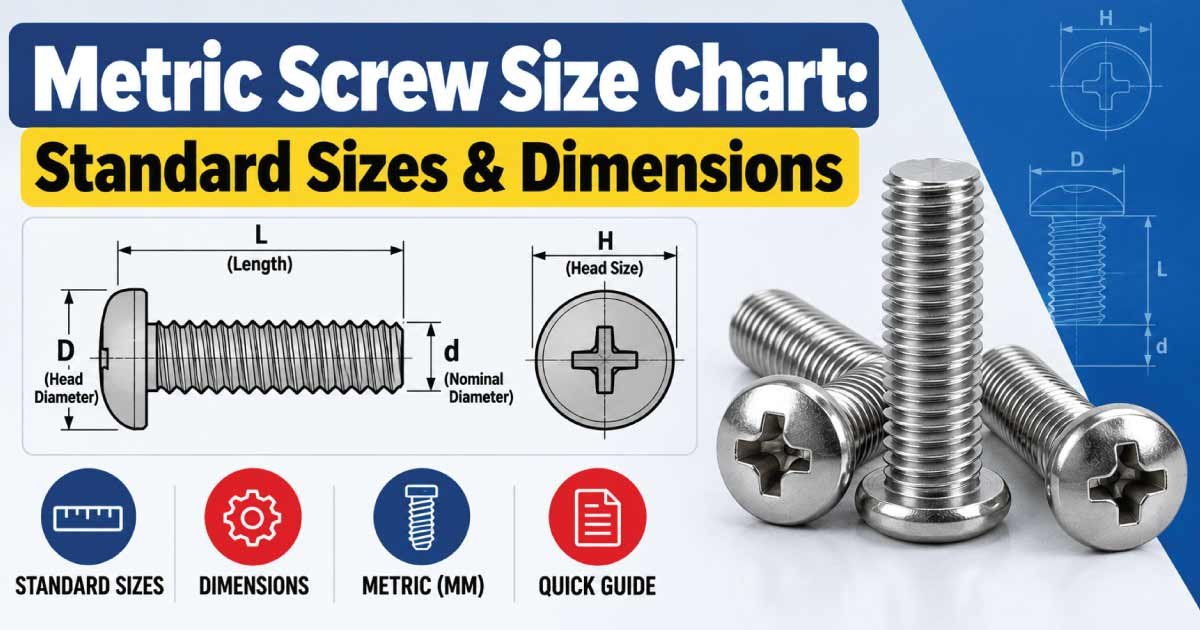
Choosing the correct screw becomes much easier when you understand metric screw sizing. A designation such as M6 × 30 mm tells you important information about the fastener: the nominal thread diameter is 6 mm and the screw length is 30 mm. However, diameter and length are only part of the specification. Thread pitch, head style, drive type, material, and applicable standard can also affect whether a screw is suitable for a particular application.
This metric screw size chart provides a practical reference for common metric screw diameters and standard coarse thread pitches, from small M2 fasteners through larger M20 sizes. It also explains how metric screws are measured, how thread pitch works, how to identify an unknown screw, and how to choose the right size for an application.
Because screw head dimensions vary according to the screw type and standard, there is no single head-size specification for every screw with the same thread diameter. Always verify the applicable product standard or manufacturer’s drawing when exact dimensions are critical.
Metric Screw Size Chart
The table below shows common metric screw sizes, their nominal outside thread diameter, and commonly used coarse thread pitches. These are useful starting points for general-purpose metric fastener selection.
| Metric Size | Nominal Diameter (mm) | Coarse Pitch (mm) | Approx. Threads per 25.4 mm | Typical Use |
|---|---|---|---|---|
| M2 | 2.0 | 0.40 | 63.5 | Small electronics and precision assemblies |
| M2.5 | 2.5 | 0.45 | 56.4 | Small equipment and instruments |
| M3 | 3.0 | 0.50 | 50.8 | Electronics, panels, light assemblies |
| M4 | 4.0 | 0.70 | 36.3 | General light-duty fastening |
| M5 | 5.0 | 0.80 | 31.8 | Equipment, brackets, machinery |
| M6 | 6.0 | 1.00 | 25.4 | General machinery and automotive work |
| M8 | 8.0 | 1.25 | 20.3 | Machinery, frames, automotive components |
| M10 | 10.0 | 1.50 | 16.9 | Structural and heavy-duty assemblies |
| M12 | 12.0 | 1.75 | 14.5 | Machinery, vehicles, structural connections |
| M14 | 14.0 | 2.00 | 12.7 | Heavy equipment and mechanical assemblies |
| M16 | 16.0 | 2.00 | 12.7 | Heavy machinery and structural applications |
| M18 | 18.0 | 2.50 | 10.2 | Large mechanical assemblies |
| M20 | 20.0 | 2.50 | 10.2 | Heavy machinery and structural fastening |
The nominal diameter is the approximate major diameter of the external thread. The coarse pitch is the standard pitch commonly associated with that nominal diameter, but many metric screw sizes are also available with fine or extra-fine pitches.
For example, an M10 screw is not automatically an M10 × 1.50 screw. M10 screws can be manufactured with different pitches, so the pitch should be confirmed before replacing a fastener.
What Does a Metric Screw Size Mean?
Metric screws generally use the letter M followed by a number representing the nominal thread diameter in millimeters.
For example:
M8 × 40 mm
means:
- M = metric thread designation
- 8 = approximately 8 mm nominal thread diameter
- 40 mm = screw length
If the pitch is included, the designation becomes more specific:
M8 × 1.25 × 40 mm
Here, 1.25 mm is the thread pitch and 40 mm is the nominal screw length.
When a metric screw is described only as M8, the coarse pitch is often implied in general fastener contexts. However, relying on the diameter alone can cause problems when fine-pitch versions are available.
Metric Screw Size vs. Screw Dimensions
The term “screw size” can refer to several different measurements. These should not be confused.
The important dimensions can include:
- Nominal thread diameter
- Thread pitch
- Screw length
- Head diameter
- Head height
- Drive size
- Shank diameter
- Threaded length
- Washer or flange diameter, if applicable
The exact head and drive dimensions depend on the screw design. An M6 socket head cap screw, M6 pan head screw, and M6 countersunk screw can have different head dimensions even though their thread diameter is the same.
Metric Screw Diameter Chart
The nominal diameter is one of the easiest ways to classify metric screws. It refers to the approximate major diameter of the external thread rather than the smaller diameter measured at the thread valleys.
| Metric Size | Nominal Diameter (mm) | Diameter in Inches (Approx.) |
|---|---|---|
| M2 | 2.0 | 0.079 in |
| M2.5 | 2.5 | 0.098 in |
| M3 | 3.0 | 0.118 in |
| M4 | 4.0 | 0.157 in |
| M5 | 5.0 | 0.197 in |
| M6 | 6.0 | 0.236 in |
| M8 | 8.0 | 0.315 in |
| M10 | 10.0 | 0.394 in |
| M12 | 12.0 | 0.472 in |
| M14 | 14.0 | 0.551 in |
| M16 | 16.0 | 0.630 in |
| M18 | 18.0 | 0.709 in |
| M20 | 20.0 | 0.787 in |
The inch values are simple dimensional conversions and should not be treated as equivalent inch screw sizes. For example, an M6 screw is approximately 0.236 inches in nominal diameter, but that does not mean a 1/4-inch screw is automatically an interchangeable replacement.
Understanding Metric Thread Pitch
Thread pitch is the distance from one thread crest to the corresponding point on the next thread, measured parallel to the screw’s axis. It is expressed in millimeters per thread.
For example, an M10 × 1.5 screw has a pitch of 1.5 mm. This means adjacent thread crests are separated by 1.5 mm.
Pitch is particularly important when identifying or replacing a screw because two screws can have the same diameter but different pitches.
Coarse vs. Fine Metric Threads
Metric screws may be available in coarse, fine, and sometimes extra-fine thread pitches.
Coarse threads generally have a larger pitch and fewer threads per unit length. They are widely used for general-purpose fastening.
Fine threads have a smaller pitch and more threads over the same length. They can be useful in applications where thread engagement, adjustment, or other design considerations call for a finer pitch.
For example, M10 coarse thread commonly uses a 1.50 mm pitch, while an M10 fine-thread fastener may use a smaller pitch.
Never substitute a fine-thread screw for a coarse-thread screw simply because the diameter is the same. The mating nut or threaded hole must have the corresponding thread pitch.
Metric Screw Length Chart
Screw length is normally measured from the bearing surface under the head to the end of the screw. However, countersunk screws are an important exception: their length is generally measured from the top of the head because the entire head is intended to sit within the countersunk hole.
A general selection reference looks like this:
| Screw Size | Common Length Examples (mm) |
|---|---|
| M2 | 4, 5, 6, 8, 10, 12, 16 |
| M3 | 5, 6, 8, 10, 12, 16, 20, 25 |
| M4 | 6, 8, 10, 12, 16, 20, 25, 30 |
| M5 | 8, 10, 12, 16, 20, 25, 30, 40 |
| M6 | 10, 12, 16, 20, 25, 30, 40, 50 |
| M8 | 12, 16, 20, 25, 30, 40, 50, 60 |
| M10 | 16, 20, 25, 30, 40, 50, 60, 80 |
| M12 | 20, 25, 30, 40, 50, 60, 80, 100 |
| M16 | 25, 30, 40, 50, 60, 80, 100, 120 |
| M20 | 30, 40, 50, 60, 80, 100, 120, 150 |
These are common length examples, not universal standard length ranges. Availability depends on screw type, manufacturer, standard, material, and application.
How to Measure a Metric Screw
If you have an unidentified screw and need to determine its size, measure the diameter, pitch, and length separately.
1. Measure the Thread Diameter
Use a vernier or digital caliper to measure across the outside of the threads.
A measurement close to:
- 3 mm suggests M3
- 4 mm suggests M4
- 5 mm suggests M5
- 6 mm suggests M6
- 8 mm suggests M8
- 10 mm suggests M10
- 12 mm suggests M12
Because thread peaks, wear, coatings, and measurement technique can affect the reading, do not identify the thread from diameter alone.
2. Measure the Thread Pitch
A metric thread pitch gauge is one of the easiest tools for determining pitch. Select the gauge blade that fits cleanly into the screw threads.
Alternatively, measure a known number of thread intervals with a caliper. For example, if ten pitch intervals measure 15 mm, the pitch is approximately 1.5 mm.
Pitch must be measured carefully because choosing the wrong pitch can result in cross-threading or an improperly fitting fastener.
3. Measure the Screw Length
For most screws, measure from the underside of the head to the tip.
For a countersunk screw, measure from the top of the head to the tip.
This distinction matters because the same nominal length can represent different physical dimensions depending on the head style.
Metric Screw Head Types and Dimensions
The thread size alone does not identify the complete screw. Metric screws are manufactured with many different head configurations.
Pan Head Screws
Pan head screws have a rounded or slightly domed top and are commonly used where a protruding head is acceptable.
Flat or Countersunk Head Screws
Countersunk screws have a tapered underside designed to sit flush with a countersunk hole. They are useful when the screw head should be approximately level with the surrounding surface.
Socket Head Cap Screws
Socket head cap screws have a cylindrical head with an internal hexagonal drive. They are common in machinery and assemblies where a compact but strong fastening solution is needed.
Button Head Screws
Button head screws have a lower-profile rounded head and are frequently selected for appearance or clearance considerations.
Hex Head Screws
Hex head screws use an external hexagonal head and are installed with a wrench or socket. Their head dimensions are governed by the relevant screw or bolt standard rather than by the M-size alone.
Metric Screw Drive Sizes
The required driver or wrench cannot be determined from the thread diameter alone.
For example, several different screw designs can use an M6 thread, but their drive requirements may be completely different:
- Phillips or similar cross-recess
- Slotted drive
- Internal hex socket
- Torx-style internal drive
- External hex head
- Other proprietary or specialized drives
This is why a complete fastener description should identify both the thread specification and head/drive type when ordering a replacement.
For exact drive dimensions, refer to the screw’s applicable standard or manufacturer’s product drawing.
How to Choose the Correct Metric Screw Size
Selecting a screw is more than choosing the largest diameter that fits the hole. The fastener must match the threaded component and provide suitable engagement without causing interference.
Check the Thread Diameter
First determine the required nominal diameter, such as M4, M5, M6, M8, or M10.
If replacing an existing screw, measure it rather than assuming the size from appearance.
Confirm the Pitch
Make sure the pitch matches the mating nut or threaded hole.
This is especially important when working with:
- Fine-thread fasteners
- Automotive components
- Machinery
- Specialized equipment
- Existing tapped holes
Select the Correct Length
The screw should provide appropriate thread engagement while avoiding excessive protrusion or interference.
The ideal length depends on the thickness of the materials being joined, washers or spacers used, thread engagement requirements, and the design of the mating component.
Choose the Appropriate Head Style
Consider whether the head needs to:
- Sit flush
- Fit into a restricted space
- Provide a large bearing surface
- Accept a socket or hex key
- Remain accessible after assembly
Check Material and Grade
Metric screws are available in materials such as carbon steel, alloy steel, stainless steel, brass, and others.
Strength, corrosion resistance, temperature exposure, electrical requirements, and environmental conditions can influence material selection. For load-bearing applications, use the specified strength class or material requirement rather than choosing based solely on size.
Discover More:
Metric Screw Size and Thread Standards
Metric screw threads are commonly associated with ISO metric screw threads, but the complete specification can involve several standards and product-specific requirements.
A designation such as M8 does not tell you everything about the fastener.
The complete specification may include:
- Thread diameter
- Pitch
- Tolerance class
- Thread length
- Screw length
- Head style
- Drive type
- Material
- Property class
- Surface finish
- Applicable product standard
For example, a drawing may specify a particular ISO metric thread tolerance, while a screw standard specifies the head shape and dimensional requirements.
For critical engineering work, always use the applicable standard, engineering drawing, or manufacturer’s documentation rather than relying on a generic screw size chart.
Metric Screw Sizes vs. Imperial Screw Sizes
Metric and imperial fasteners use different sizing systems. Metric threads are identified primarily by nominal diameter in millimeters and pitch in millimeters, while inch-based fasteners may use nominal diameter in inches together with threads per inch.
A metric and imperial screw can appear similar in size without being interchangeable.
For example, an M6 screw and a nearby inch-based fastener may have similar outside diameters, but their thread forms and pitches can differ. Attempting to force one into the mating thread can damage both components.
Do Not Match by Diameter Alone
When identifying an unknown fastener, compare:
- Thread diameter
- Thread pitch
- Thread form
- Length
- Head style
- Drive type
If the screw is going into an existing threaded hole, thread compatibility is more important than visual similarity.
Discover More:
Common Metric Screw Sizes and Applications
Different metric sizes tend to appear in different types of assemblies, although actual selection should always be based on engineering requirements.
| Size | Common Applications |
|---|---|
| M2–M2.5 | Electronics, instruments, precision components |
| M3 | Small equipment, brackets, panels, electronics |
| M4 | Light machinery, enclosures, general assemblies |
| M5 | Equipment, brackets, machine components |
| M6 | Machinery, automotive components, general fastening |
| M8 | Frames, machinery, automotive and equipment assemblies |
| M10 | Heavy equipment and mechanical assemblies |
| M12 | Machinery, vehicles, structural mechanical connections |
| M14–M16 | Heavy machinery and larger assemblies |
| M18–M20 | Large mechanical and structural applications |
These application examples are general. A screw’s suitability depends on loading, joint design, material, grade, installation method, and applicable engineering requirements.
Common Mistakes When Selecting Metric Screws
Even experienced users can encounter problems when a replacement screw is selected by appearance alone.
Mistake 1: Assuming the M Number Is the Length
In M8 × 40, the M8 describes the nominal thread diameter. The 40 mm describes the screw length.
The M number does not indicate length.
Mistake 2: Ignoring Thread Pitch
Two M8 screws can have different pitches. If the pitch does not match the mating thread, the screw may not fit correctly.
Mistake 3: Measuring the Wrong Part of the Screw
The head diameter should not be confused with thread diameter. Measure across the external threads to determine nominal diameter.
Mistake 4: Treating Metric and Inch Screws as Interchangeable
Similar-looking fasteners can have incompatible threads. Always identify the thread system before installation.
Mistake 5: Assuming All M6 Screws Have the Same Head Dimensions
M6 describes the thread diameter, not the complete head design. Pan head, socket head, countersunk, button head, and hex head screws can have different dimensions.
Mistake 6: Choosing Length Without Considering the Joint
A longer screw is not automatically better. Excess length can interfere with moving components, bottom out in a blind hole, or create other assembly problems.
Discover More:
Metric Screw Size Chart Quick Reference
For a fast reference, the most commonly encountered coarse metric sizes are summarized below.
| Size | Diameter (mm) | Coarse Pitch (mm) | Example Designation |
|---|---|---|---|
| M3 | 3.0 | 0.50 | M3 × 10 |
| M4 | 4.0 | 0.70 | M4 × 16 |
| M5 | 5.0 | 0.80 | M5 × 20 |
| M6 | 6.0 | 1.00 | M6 × 25 |
| M8 | 8.0 | 1.25 | M8 × 30 |
| M10 | 10.0 | 1.50 | M10 × 40 |
| M12 | 12.0 | 1.75 | M12 × 50 |
| M16 | 16.0 | 2.00 | M16 × 60 |
| M20 | 20.0 | 2.50 | M20 × 80 |
The examples in the final column show the common notation diameter × length. They are examples of designation format rather than a statement that those lengths are required for every application.
Frequently Asked Questions About Metric Screw Sizes
What does M6 mean on a screw?
M6 indicates a metric screw with a nominal thread diameter of approximately 6 mm. It does not specify the screw’s length, head type, material, or exact pitch unless those details are separately stated.
What is the standard pitch for an M8 screw?
The commonly used coarse pitch for M8 is 1.25 mm. However, M8 screws can also be produced with finer pitches, so verify the actual fastener specification when pitch matters.
Is M10 the same as 10 mm?
M10 means the screw has a nominal metric thread diameter of approximately 10 mm. It does not mean every dimension of the screw is 10 mm.
How do I know what size metric screw I have?
Measure the screw’s external thread diameter with a caliper, identify the thread pitch using a metric thread gauge, and measure the length correctly for its head style. Compare all three measurements with a metric screw chart.
Are metric screws measured in millimeters?
Yes. Metric screw thread diameter and pitch are specified using millimeters. Screw length is also normally specified in millimeters.
Can I use an M8 screw in an M10 hole?
No. An M8 screw has a smaller nominal thread diameter than an M10 screw and will not correctly match an M10 threaded hole. The mating thread must have the corresponding diameter and pitch.
Does M8 × 40 mean 40 mm diameter?
No. M8 × 40 means approximately 8 mm nominal thread diameter and 40 mm screw length. The 40 mm measurement is the length, not the diameter.
Are all metric screw sizes interchangeable if the diameter is the same?
No. Screws with the same nominal diameter can have different pitches, lengths, head styles, materials, strength classes, and standards. The complete specification should be checked before substitution.
Final Tips for Using a Metric Screw Size Chart
A metric screw size chart is an excellent starting point, but it should be used together with the actual requirements of the fastener and joint.
When selecting or identifying a screw, check these specifications in order:
- Nominal diameter
- Thread pitch
- Screw length
- Head style
- Drive type
- Material
- Strength or property class
- Surface finish
- Applicable standard
- Manufacturer’s specifications when exact dimensions matter
For a basic replacement, matching diameter, pitch, length, and head style may be enough. For machinery, structural connections, pressure equipment, automotive systems, or other critical applications, the required fastener grade and engineering specification should also be confirmed.
The most important point is that the M designation identifies the nominal metric thread diameter, not the complete screw. Understanding pitch, length, head dimensions, and fastener standards allows you to move from a basic size identification to a correct and reliable fastener selection.
Conclusion
A metric screw size chart makes it easier to compare common sizes such as M3, M4, M5, M6, M8, M10, M12, M16, and M20. The key measurements are nominal diameter, thread pitch, and length, while head style, drive type, material, and strength class determine the rest of the screw specification.
For accurate replacement, never rely on diameter or appearance alone. Measure the existing screw, confirm its pitch and length, identify the head style, and check the relevant standard or manufacturer’s documentation when exact specifications are important. With these measurements, selecting the correct metric screw becomes much more straightforward.