
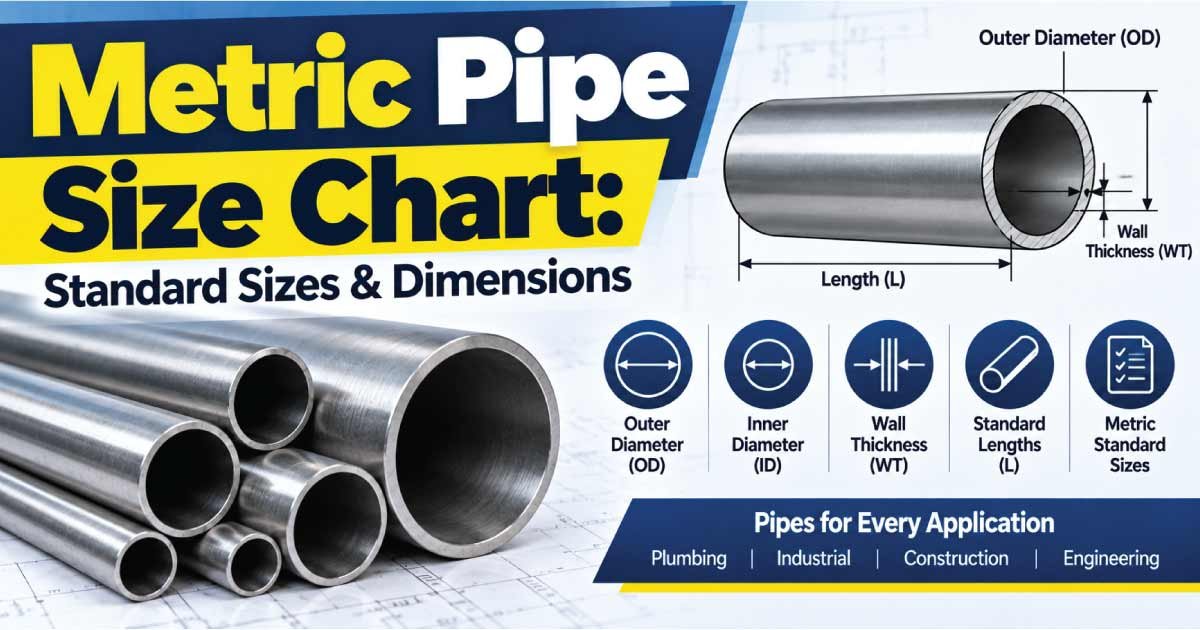
Choosing the correct pipe size is easier when you understand how DN, outside diameter (OD), inside diameter (ID), and wall thickness relate to one another. A metric pipe size chart helps engineers, contractors, fabricators, maintenance professionals, and buyers identify the nominal size of a pipe and compare it with its actual dimensions.
One important point is that metric pipe size does not always mean the pipe’s actual outside diameter in millimeters. In many industrial systems, metric pipe sizing uses the DN (nominal diameter) designation. DN numbers provide a standardized way to identify pipe size, while the actual outside diameter depends on the applicable dimensional standard.
This guide provides a practical metric pipe size chart, explains common DN sizes, shows approximate NPS equivalents, and explains how wall thickness affects the finished inside diameter. It also covers how to measure pipe, how DN compares with NPS, and how to select the right pipe for a particular application.
What Is a Metric Pipe Size?
A metric pipe size is commonly identified using DN, which stands for diamètre nominal or nominal diameter. DN is used extensively in international and European piping systems to designate pipe sizes.
For example, a pipe may be identified as DN 50. The DN number is a nominal designation rather than a precise measurement of the pipe’s actual outside or inside diameter.
This distinction matters when ordering pipe, fittings, valves, flanges, and other components. Two pipes with similar nominal designations can have different wall thicknesses while retaining the same nominal size and outside diameter.
DN Does Not Always Equal Actual Diameter
A common mistake is assuming that DN 50 means the pipe has an outside diameter of exactly 50 mm. It does not.
Depending on the dimensional standard, a DN 50 pipe commonly has an outside diameter around 60.3 mm. The actual internal diameter will then depend on the pipe wall thickness.
The basic relationship is:
Inside Diameter = Outside Diameter − (2 × Wall Thickness)
Therefore, a DN designation should be treated as a nominal size identifier, while actual dimensions should be taken from the applicable pipe standard and product specification.
Metric Pipe Size Chart
The following chart provides commonly encountered DN sizes and representative outside diameters used for standard steel pipe dimensions. The NPS column provides a commonly associated nominal inch designation for comparison.
| DN Nominal Size | Approx. NPS | Outside Diameter (mm) | Outside Diameter (in.) |
|---|---|---|---|
| DN 6 | 1/8 | 10.2 | 0.405 |
| DN 8 | 1/4 | 13.5 | 0.531 |
| DN 10 | 3/8 | 17.2 | 0.675 |
| DN 15 | 1/2 | 21.3 | 0.840 |
| DN 20 | 3/4 | 26.9 | 1.050 |
| DN 25 | 1 | 33.7 | 1.325 |
| DN 32 | 1 1/4 | 42.4 | 1.660 |
| DN 40 | 1 1/2 | 48.3 | 1.900 |
| DN 50 | 2 | 60.3 | 2.375 |
| DN 65 | 2 1/2 | 76.1 | 3.000 |
| DN 80 | 3 | 88.9 | 3.500 |
| DN 100 | 4 | 114.3 | 4.500 |
| DN 125 | 5 | 139.7 | 5.500 |
| DN 150 | 6 | 168.3 | 6.625 |
| DN 200 | 8 | 219.1 | 8.625 |
| DN 250 | 10 | 273.0 | 10.750 |
| DN 300 | 12 | 323.9 | 12.750 |
| DN 350 | 14 | 355.6 | 14.000 |
| DN 400 | 16 | 406.4 | 16.000 |
| DN 450 | 18 | 457.0 | 18.000 |
| DN 500 | 20 | 508.0 | 20.000 |
| DN 600 | 24 | 610.0 | 24.000 |
The values above are useful for identification and comparison, but wall thickness and exact dimensional requirements must be confirmed against the pipe’s governing standard and manufacturer documentation.
Understanding DN Pipe Sizes
DN is particularly useful because it provides a common language for specifying piping components. A DN 100 valve, for example, is intended for a piping system based around the DN 100 nominal size.
Common Small Metric Pipe Sizes
Smaller pipe sizes are frequently encountered in instrumentation, plumbing, compressed-air systems, process piping, and utility services.
Common designations include:
- DN 6
- DN 8
- DN 10
- DN 15
- DN 20
- DN 25
- DN 32
- DN 40
- DN 50
At these sizes, it is particularly important not to assume that the DN value represents the measured outside diameter.
Common Medium Pipe Sizes
Medium-diameter piping is widely used for industrial services, water distribution, heating systems, process lines, and mechanical installations.
Typical sizes include:
- DN 65
- DN 80
- DN 100
- DN 125
- DN 150
- DN 200
These sizes are often available with several wall thickness options, allowing the same nominal pipe size to be used for different pressure, temperature, and mechanical requirements.
Common Large Pipe Sizes
Large-diameter pipe is used for high-flow applications such as water transmission, industrial process systems, cooling systems, and large utility networks.
Examples include:
- DN 250
- DN 300
- DN 350
- DN 400
- DN 450
- DN 500
- DN 600
For larger piping, outside diameter, wall thickness, material grade, joining method, and pressure requirements become especially important during specification.
Metric Pipe Size vs. NPS Pipe Size
One of the most confusing parts of pipe sizing is the difference between DN and NPS.
NPS, or Nominal Pipe Size, is the traditional North American nominal sizing system. It uses inch-based designations such as 1/2, 1, 2, 4, 6, and 12.
DN is an international nominal designation generally expressed as a dimensionless number associated with millimeter-based sizing conventions.
They are related, but they are not direct mathematical conversions.
For example:
| DN Size | Common NPS Equivalent | Typical OD (mm) |
|---|---|---|
| DN 15 | 1/2 | 21.3 |
| DN 20 | 3/4 | 26.9 |
| DN 25 | 1 | 33.7 |
| DN 40 | 1 1/2 | 48.3 |
| DN 50 | 2 | 60.3 |
| DN 80 | 3 | 88.9 |
| DN 100 | 4 | 114.3 |
| DN 150 | 6 | 168.3 |
| DN 200 | 8 | 219.1 |
| DN 250 | 10 | 273.0 |
| DN 300 | 12 | 323.9 |
| DN 400 | 16 | 406.4 |
| DN 500 | 20 | 508.0 |
| DN 600 | 24 | 610.0 |
The comparison is useful when working with international equipment or converting between project documentation systems. However, do not select fittings based only on a nominal DN-to-NPS conversion. Verify actual dimensional compatibility.
Outside Diameter, Inside Diameter, and Wall Thickness
Three dimensions are particularly important when evaluating pipe:
- Outside diameter (OD)
- Inside diameter (ID)
- Wall thickness
The outside diameter is measured from one outside edge of the pipe to the opposite outside edge.
The inside diameter is the clear opening through the pipe.
Wall thickness is the distance from the outside surface to the inside surface.
The relationship can be expressed as:
ID = OD − 2t
where t is the wall thickness.
Why Wall Thickness Matters
A DN 100 pipe can have the same nominal size and outside diameter while being manufactured with different wall thicknesses.
Increasing the wall thickness reduces the internal diameter.
For example, if a pipe has an OD of 114.3 mm and a wall thickness of 6 mm:
ID = 114.3 − (2 × 6)
ID = 102.3 mm
This demonstrates why the nominal pipe size alone cannot tell you the actual flow opening.
Wall thickness can affect:
- Pressure capacity
- Flow area
- Pipe weight
- Corrosion allowance
- Mechanical strength
- Welding requirements
- Connection compatibility
- Overall project cost
Pipe Wall Thickness and Schedule
For many steel pipe systems, wall thickness is specified using pipe schedules, such as Schedule 10, Schedule 40, Schedule 80, or other applicable schedules.
A schedule designation should not be treated as a universal wall thickness across every pipe size. The actual wall thickness changes with nominal pipe size and the governing standard.
For that reason, a statement such as “Schedule 40 always has the same thickness” would be incorrect.
When selecting pipe, check the dimensional table for the specific:
- Nominal size
- Pipe schedule
- Material
- Manufacturing standard
- Outside diameter
- Wall thickness
For metric or European projects, wall thickness may instead be specified directly in millimeters or according to a particular dimensional series.
Discover More:
Metric Pipe Dimensions by Measurement
If you already have a physical pipe and need to identify its size, measuring the outside diameter is often a useful first step.
How to Measure Pipe Outside Diameter
Use a vernier caliper for small pipe where possible. For larger pipe, a suitable tape measure can be used to determine circumference, which can then be converted to diameter.
The mathematical relationship is:
Diameter = Circumference ÷ π
For example, if a pipe’s measured circumference is approximately 190 mm:
190 ÷ 3.1416 ≈ 60.5 mm
That measurement is close to the standard 60.3 mm OD associated with many DN 50 / NPS 2 steel pipes.
However, measurement alone should not be used to identify a pipe’s exact pressure rating, schedule, material, or standard.
Measure Wall Thickness When Necessary
If you need to determine the internal diameter, wall thickness must also be known.
A pipe wall can be measured using:
- Vernier calipers, where the geometry permits
- Ultrasonic thickness gauges
- A suitable thickness gauge
- Manufacturer markings or documentation
For used piping, ultrasonic measurement can be useful because corrosion and wear may have reduced the original wall thickness.
Discover More:
How to Choose the Correct Metric Pipe Size
Selecting pipe size is more than matching a DN number to an outside diameter. The correct choice depends on the complete operating requirements.
1. Determine the Required Flow
The pipe must provide sufficient internal flow area for the required fluid volume.
A larger internal diameter generally provides greater flow capacity and can reduce velocity for a given flow rate. However, increasing pipe size also affects material, fittings, supports, installation space, and cost.
2. Check Operating Pressure
The pipe must be suitable for the system’s operating pressure.
Consider:
- Normal operating pressure
- Maximum pressure
- Pressure surges
- Design pressure
- Temperature
- Material properties
- Applicable design code
The pipe size chart alone cannot determine whether a pipe is safe for a particular pressure.
3. Consider Operating Temperature
Temperature can affect material strength, dimensional stability, and allowable working pressure.
A pipe suitable for a cold-water service may not automatically be suitable for a high-temperature process.
4. Select the Material
Metric-size piping is available in many materials, including:
- Carbon steel
- Stainless steel
- Ductile iron
- Copper
- PVC
- CPVC
- Polyethylene
- Other specialized alloys and plastics
The material should be selected according to fluid compatibility, temperature, pressure, corrosion conditions, mechanical requirements, and applicable standards.
5. Verify Fittings and Valves
The pipe, fittings, valves, flanges, gaskets, and other components must form a compatible system.
A DN 100 designation is useful for matching nominal components, but the actual connection dimensions and pressure class must be verified.
Discover More:
Where Metric Pipe Sizes Are Used
Metric nominal pipe sizing is common in international engineering and industrial applications.
Typical uses include:
- Water distribution
- Industrial process piping
- Chemical processing
- Oil and gas facilities
- HVAC systems
- Fire protection systems
- Compressed air
- Steam systems
- Cooling-water circuits
- Manufacturing plants
- Mechanical equipment connections
- Municipal infrastructure
The exact dimensional standard can vary according to the country, industry, material, and project specifications.
Metric Pipe Size Standards
Several standards and specifications may be encountered when working with metric or internationally specified pipe.
For steel pipe dimensions, standards such as EN 10220 are used in European contexts to define outside diameters and mass-related dimensions for steel tubes.
Other specifications may govern:
- Manufacturing requirements
- Chemical composition
- Mechanical properties
- Testing
- Pressure service
- Threading
- Flanges
- Welding
- Corrosion resistance
This is why a pipe’s nominal size should never be considered a complete specification.
A proper purchasing or engineering specification may need to identify the DN size, outside diameter, wall thickness or schedule, material grade, manufacturing standard, length, end preparation, and applicable pressure or design requirements.
Common Metric Pipe Sizing Mistakes
Even experienced installers can encounter problems when nominal and actual dimensions are confused.
Mistake 1: Assuming DN Equals OD
DN 50 does not mean the pipe has a 50 mm outside diameter. A common steel pipe OD associated with DN 50 is 60.3 mm.
Mistake 2: Ignoring Wall Thickness
The same nominal size can have different wall thicknesses. Always check the specific dimensional table.
Mistake 3: Treating DN and NPS as Exact Conversions
DN and NPS are related nominal systems, but their designations are not simply interchangeable mathematical measurements.
Mistake 4: Choosing Pipe by Diameter Alone
Pressure, temperature, material compatibility, corrosion, flow, joining method, and applicable codes can all affect the correct selection.
Mistake 5: Mixing Standards Without Verification
A pipe from one dimensional system may not connect directly to a fitting designed to another standard, even if the nominal sizes appear similar.
Metric Pipe Size Conversion Tips
When converting between metric and inch-based pipe specifications, start with the nominal designation and then verify the actual dimensions.
A useful workflow is:
- Identify the DN or NPS designation.
- Determine the applicable pipe standard.
- Check the actual outside diameter.
- Confirm wall thickness or schedule.
- Calculate or verify the inside diameter.
- Check fitting and valve dimensions.
- Confirm pressure and temperature requirements.
- Verify material and application compatibility.
This approach is much more reliable than converting a number from millimeters to inches and assuming the resulting value is the pipe’s nominal size.
Metric Pipe Size Chart: Quick Reference
For quick identification, the following table summarizes some of the most frequently encountered sizes.
| DN | NPS | OD (mm) | Common Identification |
|---|---|---|---|
| DN 15 | 1/2 | 21.3 | Small utility pipe |
| DN 20 | 3/4 | 26.9 | Small service line |
| DN 25 | 1 | 33.7 | General utility piping |
| DN 32 | 1 1/4 | 42.4 | Small process piping |
| DN 40 | 1 1/2 | 48.3 | Utility and mechanical piping |
| DN 50 | 2 | 60.3 | Common industrial size |
| DN 65 | 2 1/2 | 76.1 | Medium service piping |
| DN 80 | 3 | 88.9 | General process piping |
| DN 100 | 4 | 114.3 | Common industrial size |
| DN 125 | 5 | 139.7 | Medium-large piping |
| DN 150 | 6 | 168.3 | Process and utility systems |
| DN 200 | 8 | 219.1 | Large process piping |
| DN 250 | 10 | 273.0 | Large-flow applications |
| DN 300 | 12 | 323.9 | Large industrial piping |
| DN 400 | 16 | 406.4 | High-flow systems |
| DN 500 | 20 | 508.0 | Large transmission piping |
| DN 600 | 24 | 610.0 | Very large piping |
The application descriptions are general examples rather than requirements. Actual pipe selection should always be based on the system design and relevant specification.
Frequently Asked Questions About Metric Pipe Sizes
Is DN the same as millimeters?
No. DN is a nominal diameter designation, not necessarily the measured diameter in millimeters. DN 50, for example, is commonly associated with a 60.3 mm OD steel pipe.
What is DN 50 pipe in inches?
DN 50 is commonly associated with NPS 2. For many standard steel pipe dimensions, the outside diameter is 60.3 mm.
What is DN 100 pipe in inches?
DN 100 is commonly associated with NPS 4, with a representative steel pipe outside diameter of 114.3 mm.
How do I calculate pipe inside diameter?
Use the outside diameter and wall thickness:
ID = OD − 2 × wall thickness
For example, an OD of 60.3 mm with a 3.9 mm wall gives an approximate ID of 52.5 mm.
Does a thicker pipe have a smaller inside diameter?
Yes, when the outside diameter remains the same. Increasing wall thickness reduces the available internal diameter.
Can I use DN to buy pipe fittings?
DN is an important starting point, but it is not enough by itself. Confirm the applicable standard, connection type, pressure class, dimensions, and material before purchasing.
Is metric pipe actually measured in metric units?
Many pipe specifications use millimeters for dimensional measurements, but nominal pipe sizing can use standardized designations such as DN rather than the actual measured diameter.
Final Takeaway
A metric pipe size chart is most useful when you understand the difference between nominal size and actual dimensions. DN identifies the nominal pipe size, while the outside diameter, wall thickness, and inside diameter provide the physical dimensions needed for engineering and installation.
For common steel pipe, DN 50 corresponds to an outside diameter of about 60.3 mm, DN 100 to about 114.3 mm, and DN 200 to about 219.1 mm. These values help with identification, but they should not replace the applicable dimensional standard.
When selecting pipe, always verify DN or NPS, outside diameter, wall thickness or schedule, material, pressure, temperature, connection dimensions, and governing standards. This prevents costly compatibility problems and helps ensure the piping system performs as intended.
The most important rule is simple: use the nominal size to identify the pipe, but use the actual dimensional and engineering specification to select it.