
The American Wire Gauge (AWG) system is one of the most common ways to identify electrical conductor sizes. An AWG wire size chart makes it easier to compare wire diameter, cross-sectional area, resistance, and typical current-carrying capacity.
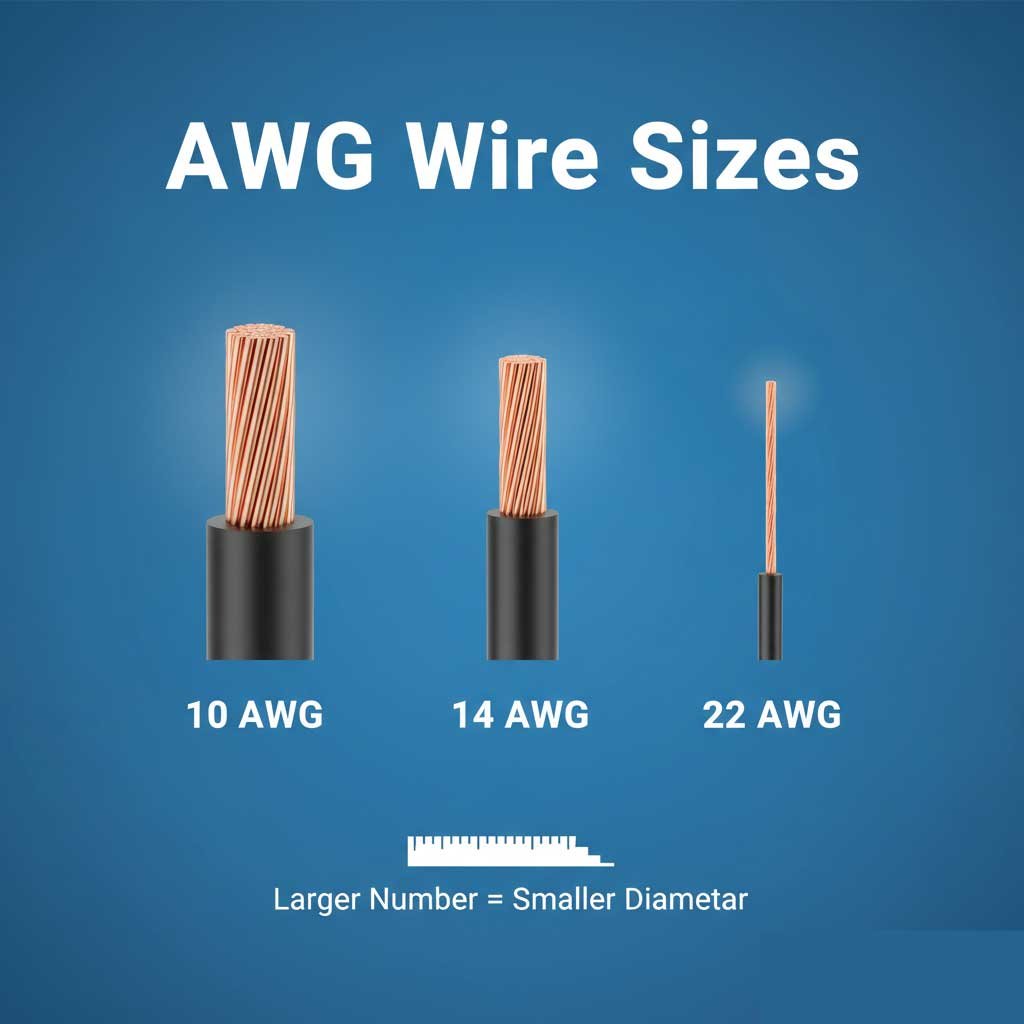
One important point to remember is that AWG numbering works in reverse. A smaller AWG number means a larger wire, while a larger AWG number means a smaller conductor. For example, 10 AWG wire is larger than 14 AWG wire, and 4 AWG is larger than 10 AWG.
Wire size affects electrical performance, heat generation, voltage drop, and the amount of current a conductor can safely carry under specified conditions. However, selecting wire should never be based on gauge alone. Conductor material, insulation rating, installation conditions, circuit length, overcurrent protection, and applicable electrical codes also matter.
This guide provides a practical AWG wire size chart, explains common gauge sizes, compares AWG with metric sizes, and shows how to select the appropriate wire for an electrical application.
What Does AWG Mean?
AWG stands for American Wire Gauge. It is a standardized system used primarily in North America to describe the diameter of electrical conductors.
The AWG system uses a numerical scale:
- Higher AWG number = smaller conductor
- Lower AWG number = larger conductor
- 14 AWG is smaller than 12 AWG
- 12 AWG is smaller than 10 AWG
- 10 AWG is smaller than 8 AWG
- Sizes larger than 1 AWG are commonly identified as 1/0, 2/0, 3/0, and 4/0
The gauge number describes the conductor size, not the total outside diameter of an insulated wire or cable. Insulation, shielding, jacketing, and the number of conductors can make the complete cable considerably larger.
AWG Wire Size Chart
The following chart lists common AWG conductor sizes along with their approximate diameter and cross-sectional area.
| AWG Size | Diameter (mm) | Diameter (in.) | Area (mm²) |
|---|---|---|---|
| 24 AWG | 0.511 mm | 0.0201 in | 0.205 mm² |
| 22 AWG | 0.644 mm | 0.0253 in | 0.326 mm² |
| 20 AWG | 0.812 mm | 0.0320 in | 0.519 mm² |
| 18 AWG | 1.024 mm | 0.0403 in | 0.823 mm² |
| 16 AWG | 1.291 mm | 0.0508 in | 1.31 mm² |
| 14 AWG | 1.628 mm | 0.0641 in | 2.08 mm² |
| 12 AWG | 2.053 mm | 0.0808 in | 3.31 mm² |
| 10 AWG | 2.588 mm | 0.1019 in | 5.26 mm² |
| 8 AWG | 3.264 mm | 0.1285 in | 8.37 mm² |
| 6 AWG | 4.115 mm | 0.1620 in | 13.3 mm² |
| 4 AWG | 5.189 mm | 0.2043 in | 21.2 mm² |
| 2 AWG | 6.544 mm | 0.2576 in | 33.6 mm² |
| 1 AWG | 7.348 mm | 0.2893 in | 42.4 mm² |
| 1/0 AWG | 8.251 mm | 0.3249 in | 53.5 mm² |
| 2/0 AWG | 9.266 mm | 0.3648 in | 67.4 mm² |
| 3/0 AWG | 10.40 mm | 0.4096 in | 85.0 mm² |
| 4/0 AWG | 11.68 mm | 0.4600 in | 107.2 mm² |
These values describe the conductor itself. The outside diameter of an insulated wire or cable will be larger.
AWG Size Chart PDF
Understanding wire sizes is essential for safe and efficient electrical work. The American Wire Gauge (AWG) system helps you determine the right wire thickness for your project. This AWG Size Chart provides an easy reference for wire diameter, ampacity, and common applications, making it simple for both DIY enthusiasts and professionals to choose the correct wire safely and effectively.
AWG_Size_Chart PDF
AWG Wire Size and Current Capacity
AWG size is closely related to a conductor’s ability to carry electrical current, but gauge alone does not determine ampacity.
Ampacity is the maximum current a conductor can carry continuously under specified conditions without exceeding its permitted temperature.
For copper conductors, common reference ampacities can be summarized as follows:
| Copper AWG | 60°C Reference Ampacity | 75°C Reference Ampacity |
|---|---|---|
| 14 AWG | 15 A | 20 A |
| 12 AWG | 20 A | 25 A |
| 10 AWG | 30 A | 35 A |
| 8 AWG | 40 A | 50 A |
| 6 AWG | 55 A | 65 A |
| 4 AWG | 70 A | 85 A |
| 3 AWG | 85 A | 100 A |
| 2 AWG | 95 A | 115 A |
| 1 AWG | 110 A | 130 A |
| 1/0 AWG | 125 A | 150 A |
| 2/0 AWG | 145 A | 175 A |
| 3/0 AWG | 165 A | 200 A |
| 4/0 AWG | 195 A | 230 A |
These are reference values under specified conditions, not universal circuit-breaker ratings. The actual allowable ampacity can be affected by conductor insulation, ambient temperature, number of current-carrying conductors, installation method, equipment terminals, and applicable electrical requirements.
Why Smaller AWG Numbers Mean Larger Wires
The AWG system was designed so that gauge numbers decrease as conductor diameter increases.
This can seem confusing at first because many other sizing systems work in the opposite direction.
For example:
14 AWG < 12 AWG < 10 AWG < 8 AWG < 6 AWG
When moving through this sequence, the physical conductor becomes larger.
A 6 AWG conductor therefore has substantially more cross-sectional area than a 14 AWG conductor.
Larger conductors generally have lower electrical resistance. Lower resistance can reduce heat generation and voltage drop for a given current and conductor length.
Common AWG Wire Sizes and Their Applications
Different AWG sizes are commonly encountered in different types of electrical work.
24 AWG
24 AWG is a relatively small conductor. It is commonly found in low-current electronic, communication, signal, and data-related wiring.
It is not normally selected for high-power electrical circuits.
22 AWG
22 AWG is also commonly used for low-current applications such as control, signal, electronics, and communication wiring.
20 AWG
20 AWG is used in various low-power electronic, control, instrumentation, and signal applications.
18 AWG
18 AWG is widely used for low-power equipment wiring, control circuits, electronics, and certain flexible cords.
16 AWG
16 AWG is larger than 18 AWG and is commonly found in equipment wiring, power cords, lighting-related applications, and other moderate-load uses depending on the product and installation.
14 AWG
14 AWG is commonly associated with 15-amp branch circuits in installations where permitted by the applicable electrical code.
12 AWG
12 AWG is commonly used for 20-amp branch circuits and other applications requiring a larger conductor than 14 AWG.
10 AWG
10 AWG is commonly associated with higher-load circuits, including many applications using 30-amp overcurrent protection when permitted by the applicable requirements.
8 AWG and Larger
8 AWG, 6 AWG, 4 AWG, and larger conductors are generally encountered in higher-current equipment, feeders, larger electrical systems, and other applications requiring greater conductor capacity.
The actual use always depends on the complete electrical design.
AWG to Metric Wire Size Chart
Outside North America, electrical wire is often identified by its cross-sectional area in square millimeters.
AWG and metric sizes do not always have exact one-to-one equivalents. The closest metric size should not automatically be treated as a direct replacement.
| AWG Size | Conductor Area | Approximate Metric Comparison |
|---|---|---|
| 24 AWG | 0.205 mm² | 0.2 mm² |
| 22 AWG | 0.326 mm² | 0.35 mm² |
| 20 AWG | 0.519 mm² | 0.5 mm² |
| 18 AWG | 0.823 mm² | 0.75–1.0 mm² |
| 16 AWG | 1.31 mm² | 1.5 mm² |
| 14 AWG | 2.08 mm² | 2.0–2.5 mm² |
| 12 AWG | 3.31 mm² | 3.0–4.0 mm² |
| 10 AWG | 5.26 mm² | 6 mm² |
| 8 AWG | 8.37 mm² | 10 mm² |
| 6 AWG | 13.3 mm² | 16 mm² |
| 4 AWG | 21.2 mm² | 25 mm² |
| 2 AWG | 33.6 mm² | 35 mm² |
| 1/0 AWG | 53.5 mm² | 50–70 mm² |
| 2/0 AWG | 67.4 mm² | 70 mm² |
| 4/0 AWG | 107.2 mm² | 95–120 mm² |
Metric comparisons are approximate because AWG and metric sizing systems use different standardized increments.
AWG Wire Resistance
Wire resistance is another important factor when selecting a conductor.
For a given conductor material, a smaller wire generally has greater resistance per unit length than a larger wire. Resistance also increases as the wire becomes longer.
Copper conductor resistance at approximately 20°C can be represented by the following approximate values:
| AWG Size | Approx. Copper Resistance per 1000 ft |
|---|---|
| 18 AWG | 6.39 Ω |
| 16 AWG | 4.02 Ω |
| 14 AWG | 2.53 Ω |
| 12 AWG | 1.59 Ω |
| 10 AWG | 0.999 Ω |
| 8 AWG | 0.628 Ω |
| 6 AWG | 0.395 Ω |
| 4 AWG | 0.249 Ω |
| 2 AWG | 0.156 Ω |
| 1/0 AWG | 0.0983 Ω |
| 2/0 AWG | 0.0779 Ω |
| 4/0 AWG | 0.0490 Ω |
Actual resistance changes with conductor temperature and material. These values should therefore be treated as reference figures rather than exact operating values.
How Wire Length Affects AWG Selection
Wire length can become particularly important when a circuit carries substantial current over a long distance.
As the conductor gets longer, its total resistance increases. This can cause a greater voltage drop between the power source and the load.
For example, a short run may perform adequately with a particular wire size, while a much longer run carrying the same current may require a larger conductor.
When evaluating a long circuit, consider:
- Load current
- Supply voltage
- One-way conductor length
- Total circuit length
- Conductor material
- Wire gauge
- Acceptable voltage drop
- Starting current for motors or similar equipment
A larger conductor can reduce resistance and voltage drop, but it must still be compatible with the circuit protection and installation requirements.
Also Read:
Copper vs. Aluminum AWG Wire
AWG identifies conductor size, but it does not tell you whether the conductor is copper or aluminum.
Copper and aluminum have different electrical properties.
Copper has higher conductivity and is widely used for branch-circuit wiring and equipment connections. Aluminum is lighter and is commonly used in larger conductors and feeder applications.
| Characteristic | Copper | Aluminum |
|---|---|---|
| Conductivity | Higher | Lower |
| Weight | Higher | Lower |
| Common applications | Branch circuits, equipment | Larger feeders and conductors |
| Equivalent conductor considerations | Generally smaller | Often requires larger conductor area |
| Connection requirements | Must use approved terminals | Must use equipment approved for aluminum |
A copper and aluminum conductor with the same AWG designation should not automatically be assumed to have identical ampacity for a particular application.
Solid vs. Stranded AWG Wire
AWG can describe both solid and stranded conductors.
Solid Wire
Solid wire consists of a single conductor.
It is often used in fixed installations where the wire does not need to flex frequently.
Advantages include:
- Simple construction
- Easy termination in many applications
- Stable mechanical form
- Common use in building wiring
Stranded Wire
Stranded wire consists of multiple smaller wires twisted or grouped together.
It is more flexible and is commonly used where wiring needs to bend or move.
Common applications include:
- Equipment wiring
- Control panels
- Flexible cords
- Automotive wiring
- Electronics
- Connections to equipment that may vibrate
The AWG designation of stranded wire refers to its equivalent conductor area, but its physical outside diameter can differ from that of a solid conductor.
Also Read:
How to Choose the Right AWG Wire Size
Selecting the correct AWG size requires more than matching a gauge to an amp rating.
Step 1: Determine the Load
Identify the equipment’s power or current requirements.
For a simple single-phase load, current can be estimated using:
Current = Power ÷ Voltage
For example, a 1,200-watt load operating at 120 volts draws approximately 10 amps under ideal conditions.
Step 2: Check the Circuit Protection
Determine the required fuse or circuit-breaker rating.
The conductor must be appropriately protected against excessive current.
Step 3: Check Wire Material
Confirm whether the conductor is copper or aluminum.
Do not use an ampacity assumption for copper when the actual conductor is aluminum.
Step 4: Check Installation Conditions
Consider:
- Ambient temperature
- Number of current-carrying conductors
- Raceway or cable installation
- Insulation temperature rating
- Connection points
- Available space
These conditions can affect the allowable ampacity.
Step 5: Consider Voltage Drop
For longer runs, calculate voltage drop rather than relying only on ampacity.
A larger AWG conductor may be appropriate if the voltage drop is excessive.
Step 6: Verify the Applicable Code
Electrical requirements vary by location and application. Always verify the final wire size against the electrical code and equipment manufacturer’s requirements that apply to the installation.
Also Read:
Common AWG Wire Size Mistakes
Several mistakes repeatedly cause confusion when people use an AWG wire size chart.
Choosing a Larger AWG Number for More Current
This is the opposite of how AWG works. A lower number represents a larger conductor.
Ignoring Wire Length
A wire can have adequate basic ampacity but still experience excessive voltage drop over a long distance.
Confusing Conductor Size With Cable Size
12 AWG describes a conductor. A cable containing several 12 AWG conductors can have a much larger overall diameter.
Ignoring Conductor Material
Copper and aluminum should not be treated as identical simply because they have the same AWG number.
Using Ampacity Without Considering Installation Conditions
Ampacity values depend on specified conditions. Temperature, conductor count, insulation, and installation method can all affect the allowable value.
Automatically Increasing Breaker Size
Installing a larger breaker because you installed larger wire is not automatically acceptable. Circuit protection must be selected as part of the complete electrical design.
Quick AWG Wire Size Reference
For quick comparison, the following chart summarizes several common sizes.
| AWG | Diameter | Area | General Size Category |
|---|---|---|---|
| 24 | 0.511 mm | 0.205 mm² | Very small |
| 22 | 0.644 mm | 0.326 mm² | Small |
| 20 | 0.812 mm | 0.519 mm² | Small |
| 18 | 1.024 mm | 0.823 mm² | Small |
| 16 | 1.291 mm | 1.31 mm² | Medium-small |
| 14 | 1.628 mm | 2.08 mm² | Medium |
| 12 | 2.053 mm | 3.31 mm² | Medium |
| 10 | 2.588 mm | 5.26 mm² | Medium-large |
| 8 | 3.264 mm | 8.37 mm² | Large |
| 6 | 4.115 mm | 13.3 mm² | Large |
| 4 | 5.189 mm | 21.2 mm² | Very large |
| 2 | 6.544 mm | 33.6 mm² | Very large |
| 1/0 | 8.251 mm | 53.5 mm² | Extra large |
| 4/0 | 11.68 mm | 107.2 mm² | Extra large |
Frequently Asked Questions
What does AWG stand for?
AWG stands for American Wire Gauge. It is a standardized system for identifying electrical conductor sizes.
Is 12 AWG bigger than 14 AWG?
Yes. 12 AWG has a larger diameter and greater cross-sectional area than 14 AWG.
Is 10 AWG bigger than 12 AWG?
Yes. A 10 AWG conductor is larger than a 12 AWG conductor.
What is the smallest AWG number?
The AWG system includes very large conductors beyond 4/0 using larger standardized sizes, so there is not simply one universal smallest number for every application. Common electrical charts typically extend from small gauges through 4/0 and beyond.
What is the largest common AWG wire size?
4/0 AWG is one of the largest commonly encountered sizes in general electrical wiring charts. Larger conductors can be identified using larger circular-mil or other conductor-sizing systems depending on the application.
Does a lower AWG number mean thicker wire?
Yes. A lower AWG number means a larger conductor diameter. For example, 8 AWG is thicker than 12 AWG.
Can AWG wire size be converted directly to mm²?
AWG can be mathematically converted to conductor cross-sectional area, but AWG and metric wire sizes do not always have exact matching standard sizes. A listed metric comparison should therefore be treated as approximate.
Does stranded wire have the same AWG size as solid wire?
AWG can describe both solid and stranded conductors based on conductor area. However, stranded wire may have a different physical outside diameter because it consists of multiple individual strands.
Does thicker wire always carry more current?
A larger conductor generally has greater current-carrying capability under comparable conditions, but ampacity depends on much more than physical size. Material, insulation, temperature, installation method, and electrical code requirements must also be considered.
Conclusion
The AWG wire size chart provides a quick way to compare electrical conductor sizes, from small 24 AWG wires used for low-current applications to large 4/0 AWG conductors used for much higher-current applications.
The key rule is simple: the smaller the AWG number, the larger the conductor. Wire diameter and cross-sectional area increase as the gauge number decreases.
For a proper wire selection, however, do not rely on gauge alone. Consider current, circuit protection, conductor material, insulation temperature, installation conditions, circuit length, voltage drop, and applicable electrical requirements.
Understanding AWG makes it much easier to compare wire sizes, but the final conductor should always be selected according to the actual electrical application and the standards that govern it.