
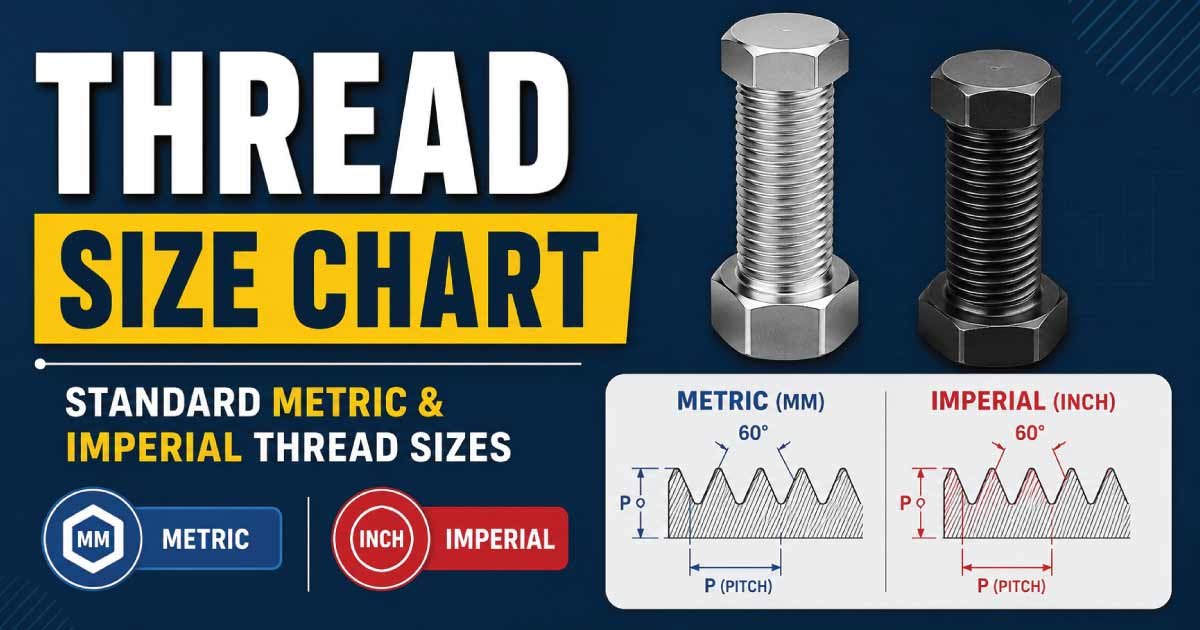
Understanding thread sizes is essential when selecting bolts, nuts, screws, threaded rods, taps, dies, fittings, and other threaded components. A thread that looks similar may have a different diameter, pitch, thread angle, or measurement system, making it incompatible with the mating part.
Thread specifications are commonly divided into metric and imperial systems. Metric threads are generally identified by diameter and pitch in millimeters, while U.S. customary threads are commonly identified by nominal diameter and threads per inch (TPI).
This complete guide explains thread size, diameter, pitch, TPI, metric and imperial thread charts, thread identification, common thread sizes, and the differences between coarse and fine threads.
What Is Thread Size?
Thread size is a standardized way of describing the dimensions and characteristics of a threaded fastener or threaded hole.
A complete thread specification can include:
- Nominal diameter
- Thread pitch
- Threads per inch
- Thread series
- Thread angle
- Thread direction
- Thread tolerance
- Thread form
For example, M10 × 1.5 identifies a metric thread with a nominal diameter of 10 mm and a pitch of 1.5 mm.
An imperial specification such as 1/2-13 UNC identifies a nominal diameter of 1/2 inch, 13 threads per inch, and a Unified National Coarse thread.
Thread size is therefore more than simply the outside diameter of a bolt.
Metric Thread Size Chart
Metric threads are generally identified using the letter M, followed by the nominal diameter and, when necessary, the thread pitch.
| Metric Thread | Nominal Diameter | Common Coarse Pitch |
|---|---|---|
| M3 | 3 mm | 0.50 mm |
| M4 | 4 mm | 0.70 mm |
| M5 | 5 mm | 0.80 mm |
| M6 | 6 mm | 1.00 mm |
| M8 | 8 mm | 1.25 mm |
| M10 | 10 mm | 1.50 mm |
| M12 | 12 mm | 1.75 mm |
| M14 | 14 mm | 2.00 mm |
| M16 | 16 mm | 2.00 mm |
| M18 | 18 mm | 2.50 mm |
| M20 | 20 mm | 2.50 mm |
| M22 | 22 mm | 2.50 mm |
| M24 | 24 mm | 3.00 mm |
| M27 | 27 mm | 3.00 mm |
| M30 | 30 mm | 3.50 mm |
| M33 | 33 mm | 3.50 mm |
| M36 | 36 mm | 4.00 mm |
| M39 | 39 mm | 4.00 mm |
| M42 | 42 mm | 4.50 mm |
| M45 | 45 mm | 4.50 mm |
| M48 | 48 mm | 5.00 mm |
These are common coarse-pitch values. Metric standards also provide fine and extra-fine pitches for many diameters.
Imperial Thread Size Chart
Imperial threads are commonly identified by nominal diameter and threads per inch.
| Nominal Size | Decimal Diameter | Common Coarse TPI |
|---|---|---|
| 1/4 in | 0.250 in | 20 TPI |
| 5/16 in | 0.3125 in | 18 TPI |
| 3/8 in | 0.375 in | 16 TPI |
| 7/16 in | 0.4375 in | 14 TPI |
| 1/2 in | 0.500 in | 13 TPI |
| 9/16 in | 0.5625 in | 12 TPI |
| 5/8 in | 0.625 in | 11 TPI |
| 3/4 in | 0.750 in | 10 TPI |
| 7/8 in | 0.875 in | 9 TPI |
| 1 in | 1.000 in | 8 TPI |
| 1-1/8 in | 1.125 in | 7 TPI |
| 1-1/4 in | 1.250 in | 7 TPI |
| 1-3/8 in | 1.375 in | 6 TPI |
| 1-1/2 in | 1.500 in | 6 TPI |
| 1-3/4 in | 1.750 in | 5 TPI |
| 2 in | 2.000 in | 4.5 TPI |
These values are common Unified thread sizes, but actual thread specifications can vary according to thread series and standard.
What Does M10 × 1.5 Mean?
A designation such as M10 × 1.5 contains two primary pieces of information.
M10 means the nominal thread diameter is 10 mm.
1.5 means the thread pitch is 1.5 mm.
Thread pitch is the distance from one thread crest to the corresponding point on the next thread, measured parallel to the thread axis.
Therefore, an M10 × 1.5 thread advances 1.5 mm for each complete turn in a single-start thread.
If the pitch is omitted in a metric designation, the coarse pitch is often implied according to the relevant standard and context, but specifying the pitch removes ambiguity.
What Does 1/2-13 Mean?
A designation such as 1/2-13 is commonly used for an imperial threaded fastener.
The 1/2 represents the nominal diameter in inches.
The 13 represents 13 threads per inch.
This means that the threaded portion contains 13 thread intervals per inch of axial length.
Imperial thread specifications may also include a series designation such as UNC for Unified National Coarse or UNF for Unified National Fine.
For example:
1/2-13 UNC
means a 1/2-inch nominal diameter Unified National Coarse thread with 13 TPI.
Thread Pitch vs. Threads Per Inch
Thread pitch and threads per inch describe similar characteristics but are used differently in metric and imperial systems.
Metric Thread Pitch
Metric thread pitch is measured in millimeters.
For example:
M8 × 1.25
has a 1.25 mm pitch.
A smaller pitch indicates that the threads are closer together.
Imperial Threads Per Inch
Imperial threads use TPI.
For example:
3/8-16
has 16 threads per inch.
A higher TPI means the threads are more closely spaced.
The two systems can be related mathematically:
Pitch in millimeters = 25.4 ÷ TPI
For example, 20 TPI corresponds to a pitch of approximately 1.27 mm.
However, mathematical similarity does not mean two thread systems are interchangeable.
Coarse Thread vs. Fine Thread
Threads are commonly classified as coarse or fine.
Coarse Threads
Coarse threads have a larger pitch or fewer threads per unit length.
Common advantages include:
- Faster assembly
- Better tolerance of minor contamination
- Less sensitivity to thread damage
- Good general-purpose performance
- Easier starting during assembly
Coarse threads are widely used in general mechanical applications.
Fine Threads
Fine threads have a smaller pitch or more threads per unit length.
Potential advantages include:
- Greater adjustment precision
- Smaller pitch
- Greater resistance to loosening in some applications when properly designed
- More threads engaged over a given length
Fine threads can be useful where dimensional adjustment, material thickness, or other application requirements make them appropriate.
Neither coarse nor fine threads are universally better. The correct choice depends on the application and applicable specification.
Metric Fine Thread Size Chart
Many metric diameters are available with multiple pitches.
| Thread Diameter | Common Coarse Pitch | Example Fine Pitches |
|---|---|---|
| M6 | 1.00 mm | 0.75 mm |
| M8 | 1.25 mm | 1.00 mm |
| M10 | 1.50 mm | 1.25 mm |
| M12 | 1.75 mm | 1.50 mm |
| M14 | 2.00 mm | 1.50 mm |
| M16 | 2.00 mm | 1.50 mm |
| M18 | 2.50 mm | 2.00 mm |
| M20 | 2.50 mm | 2.00 mm, 1.50 mm |
| M22 | 2.50 mm | 2.00 mm, 1.50 mm |
| M24 | 3.00 mm | 2.00 mm |
| M30 | 3.50 mm | 3.00 mm, 2.00 mm |
Fine-pitch availability depends on the diameter and applicable standard.
UNC and UNF Thread Sizes
Imperial Unified threads are commonly divided into two major series.
UNC Threads
UNC stands for Unified National Coarse.
UNC threads use relatively coarse thread spacing and are widely used for general-purpose fastening.
Examples include:
- 1/4-20 UNC
- 5/16-18 UNC
- 3/8-16 UNC
- 7/16-14 UNC
- 1/2-13 UNC
- 5/8-11 UNC
- 3/4-10 UNC
UNF Threads
UNF stands for Unified National Fine.
UNF threads use more threads per inch than their corresponding UNC sizes.
Examples include:
- 1/4-28 UNF
- 5/16-24 UNF
- 3/8-24 UNF
- 7/16-20 UNF
- 1/2-20 UNF
- 5/8-18 UNF
- 3/4-16 UNF
The nut and bolt must use compatible thread specifications.
Metric and Imperial Thread Comparison
Metric and imperial threads can sometimes appear very similar in physical size, but they are not automatically interchangeable.
For example:
- M6 = 6.00 mm
- 1/4 inch = 6.35 mm
- M8 = 8.00 mm
- 5/16 inch = 7.94 mm
- M10 = 10.00 mm
- 3/8 inch = 9.53 mm
- M12 = 12.00 mm
- 1/2 inch = 12.70 mm
Some of these dimensions are close enough to cause confusion.
However, diameter is only one part of the thread specification. Pitch, thread angle, tolerance, and thread form also affect compatibility.
Never force a nut onto a bolt simply because the diameters appear close.
Also Read:
How to Measure Thread Size
Identifying an unknown thread requires more than measuring its diameter.
Step 1: Measure the Major Diameter
For an external thread, use a caliper to measure across the thread crests.
Compare the measurement with standard metric or imperial nominal sizes.
Step 2: Measure the Pitch
For metric threads, determine the distance between adjacent thread crests.
For imperial threads, determine the number of threads per inch.
A thread pitch gauge makes this process much easier.
Step 3: Determine the Thread System
Once the diameter and pitch have been measured, determine whether the fastener is metric or imperial.
Step 4: Check the Thread Series
For imperial threads, determine whether the thread is UNC, UNF, or another applicable series.
Step 5: Check the Application
If the fastener came from a vehicle, machine, pipe fitting, or engineered assembly, compare your measurements with the manufacturer’s specification.
Major Diameter, Minor Diameter, and Pitch Diameter
Thread terminology includes several important diameter measurements.
Major Diameter
The major diameter is the largest diameter of an external thread, measured approximately across the thread crests.
For a standard bolt, this is close to the nominal diameter.
Minor Diameter
The minor diameter is measured near the roots of the threads.
It is smaller than the major diameter because the thread profile removes material from the original cylindrical surface.
Pitch Diameter
Pitch diameter is a theoretical or functional diameter associated with the thread profile and is important for determining how mating threads engage.
For ordinary fastener identification, major diameter and pitch are generally the most practical measurements.
Thread Size and Tap Drill Size
When creating an internal threaded hole, a tap drill is used to create the hole before tapping.
The required drill size depends on the thread diameter and pitch.
For a simple approximation for many metric threads:
Tap drill size ≈ major diameter − pitch
For example:
M10 × 1.5
10 − 1.5 = approximately 8.5 mm
This is a useful approximation for many standard applications, but actual tap drill recommendations can depend on the required thread percentage, material, tapping method, and engineering standard.
For critical work, use the recommended tap-drill size from the applicable tooling or thread standard.
Common Metric Thread Sizes
Several metric thread sizes appear frequently in mechanical work.
M4 Thread
M4 threads are used for small components, electronics, equipment, brackets, and light assemblies.
M5 Thread
M5 is common in machinery, equipment panels, brackets, and general hardware.
M6 Thread
M6 is one of the most commonly encountered small-to-medium metric thread sizes.
M8 Thread
M8 is widely used in machinery, automotive components, mounting systems, brackets, and fabrication.
M10 Thread
M10 provides a larger fastening diameter and is common in mechanical equipment, vehicles, machinery, and structural components.
M12 Thread
M12 is frequently used for applications requiring greater clamping capacity and mechanical strength.
M16 and Larger
M16, M20, M24, and larger threads are common in heavy machinery, industrial equipment, structural assemblies, and other applications requiring larger fasteners.
Also Read:
Common Imperial Thread Sizes
Common imperial thread sizes include:
- 1/4-20
- 5/16-18
- 3/8-16
- 7/16-14
- 1/2-13
- 9/16-12
- 5/8-11
- 3/4-10
- 7/8-9
- 1-8
These examples generally represent common coarse Unified thread combinations.
Fine-thread versions are also available for many diameters.
Thread Size and Thread Engagement
Thread engagement is the amount of mating thread contact between a bolt and nut or between an external thread and an internally threaded hole.
Adequate engagement is important because insufficient engagement can reduce the load-carrying capability of the joint.
The required engagement depends on:
- Thread diameter
- Material strength
- Thread pitch
- Fastener grade
- Internal thread material
- Joint loading
- Thread standard
- Application requirements
A general-purpose rule should not replace engineering calculations for safety-critical applications.
Right-Hand and Left-Hand Threads
Most common fasteners use right-hand threads.
A right-hand thread tightens when turned clockwise and loosens when turned counterclockwise when viewed from the appropriate end.
Left-hand threads operate in the opposite direction.
Left-hand threads are used in specific applications where normal rotation could otherwise loosen a conventional right-hand threaded fastener.
When replacing a specialized fastener, verify the thread direction before installation.
Single-Start and Multi-Start Threads
Most standard bolts use single-start threads.
A single-start thread advances by one pitch for each full revolution.
Multi-start threads have multiple thread starts and can advance farther per revolution.
Multi-start threads are commonly associated with specialized mechanisms requiring rapid linear movement or particular motion characteristics.
They are different from simply using a coarse thread.
Thread Angle and Thread Form
Thread compatibility also depends on thread form.
Common thread forms have specific profiles and angles.
For example, Unified and metric ISO threads use a 60-degree thread angle, while other thread standards can use different profiles.
This is another reason why diameter and pitch alone may not be sufficient when identifying specialized threads.
Pipe threads, trapezoidal threads, acme threads, and other specialized forms should be identified according to their appropriate standards.
Thread Size Chart for Quick Reference
| Size | Nominal Diameter | Typical Coarse Specification |
|---|---|---|
| M4 | 4 mm | M4 × 0.7 |
| M5 | 5 mm | M5 × 0.8 |
| M6 | 6 mm | M6 × 1.0 |
| M8 | 8 mm | M8 × 1.25 |
| M10 | 10 mm | M10 × 1.5 |
| M12 | 12 mm | M12 × 1.75 |
| M14 | 14 mm | M14 × 2.0 |
| M16 | 16 mm | M16 × 2.0 |
| M18 | 18 mm | M18 × 2.5 |
| M20 | 20 mm | M20 × 2.5 |
| 1/4 in | 6.35 mm | 1/4-20 |
| 5/16 in | 7.94 mm | 5/16-18 |
| 3/8 in | 9.53 mm | 3/8-16 |
| 7/16 in | 11.11 mm | 7/16-14 |
| 1/2 in | 12.70 mm | 1/2-13 |
| 5/8 in | 15.88 mm | 5/8-11 |
| 3/4 in | 19.05 mm | 3/4-10 |
| 1 in | 25.40 mm | 1-8 |
This is a quick-reference table rather than a complete specification for every possible thread standard.
Also Read:
Common Thread Identification Mistakes
Measuring Only the Diameter
Diameter alone cannot identify the complete thread.
Ignoring Thread Pitch
An M10 coarse thread and an M10 fine thread have the same nominal diameter but different pitches.
Mixing Metric and Imperial Threads
Similar-looking sizes are not necessarily compatible.
Using the Wrong Nut
The nut must match the bolt’s diameter, pitch, thread series, and applicable thread standard.
Forcing an Incorrect Thread
If a nut does not start easily by hand, stop and verify the thread specification. Forcing mismatched threads can damage both components.
Assuming All Threads Are Right-Handed
Most are, but specialized applications can use left-hand threads.
How to Choose the Correct Thread Size
When selecting a replacement fastener, identify the complete thread specification rather than choosing a bolt based only on its diameter.
Check:
- Nominal diameter
- Thread pitch or TPI
- Metric or imperial system
- Thread series
- Thread direction
- Thread form
- Bolt length
- Fastener grade
- Material
- Application requirements
For an existing assembly, the original manufacturer’s specifications are the best reference whenever available.
Frequently Asked Questions About Thread Size
How do I know what thread size a bolt is?
Measure the bolt’s major diameter and determine its pitch using a thread gauge or accurate measurement. Then compare the results with the appropriate metric or imperial thread standard.
Is M10 the same as 3/8 inch?
No. M10 has a nominal diameter of 10 mm, while 3/8 inch is 9.525 mm. Their thread pitches can also differ.
What is the difference between M10 and M10 × 1.5?
M10 identifies the nominal diameter. M10 × 1.5 specifies both the 10 mm diameter and the 1.5 mm thread pitch.
What does TPI mean?
TPI means threads per inch. It is commonly used to describe imperial thread spacing.
What is the difference between UNC and UNF?
UNC means Unified National Coarse, while UNF means Unified National Fine. The two systems use different thread spacing for the same nominal diameter.
Can a metric nut fit an imperial bolt?
A similar physical diameter does not guarantee compatibility. The thread pitch, diameter, thread form, and other specifications must match.
How is metric thread pitch measured?
Metric pitch is the distance in millimeters between corresponding points on adjacent threads.
What is the most common metric thread size?
There is no single universal most common size across every industry, but sizes such as M6, M8, M10, and M12 are widely encountered in mechanical and general-purpose applications.
What is a coarse thread?
A coarse thread has greater spacing between adjacent threads than a fine thread of the same nominal diameter.
What is a fine thread?
A fine thread has smaller spacing and therefore more threads over the same length compared with a coarse thread of the same nominal diameter.
Final Thoughts on Thread Sizes
Thread size identification requires more than measuring the outside diameter of a bolt. A complete thread specification can include diameter, pitch, TPI, thread series, thread form, thread direction, tolerance, and application requirements.
Metric threads are generally identified using diameter and pitch, such as M8 × 1.25 or M12 × 1.75. Imperial threads commonly use nominal diameter and threads per inch, such as 3/8-16 UNC or 1/2-20 UNF.
When identifying an unknown fastener, start by measuring the major diameter and then determine the pitch or TPI. A thread gauge is one of the easiest tools for making an accurate identification.
Most importantly, do not force a nut or bolt together simply because the dimensions appear close. Metric and imperial threads can look surprisingly similar while being incompatible.
Using the correct thread size, pitch, diameter, and thread series ensures proper fit, reliable assembly, and reduced risk of thread damage.