
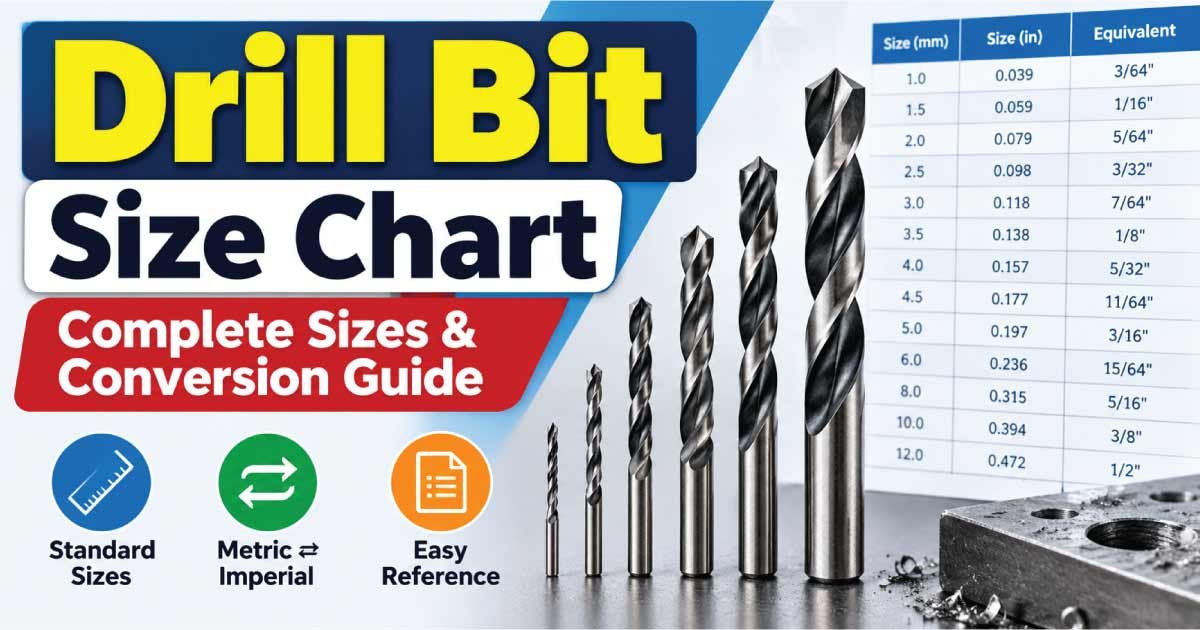
Choosing the right drill bit is easier when you understand how drill bit sizes are measured and converted. A drill bit size chart helps you compare metric, fractional-inch, number, and letter sizes so you can select the closest or exact bit for a hole.
Drill bits are commonly identified by their diameter, but manufacturers use several sizing systems. Metric bits are measured in millimeters, fractional bits in inches, while number and letter sizes are commonly used for smaller or specialized drill diameters.
This guide provides practical drill bit size charts, decimal conversions, common sizes, selection tips, and answers to frequently asked questions. Whether you’re drilling wood, metal, plastic, or preparing a hole for tapping, understanding bit sizes can help you achieve the correct hole diameter.
What Is a Drill Bit Size?
A drill bit size refers primarily to the diameter of the cutting portion of the bit. For a standard twist drill, this is the approximate diameter of the cylindrical hole the bit is designed to produce.
For example:
- A 5 mm drill bit is approximately 5 mm in diameter.
- A 1/4-inch drill bit has a diameter of 0.250 inches.
- A #10 drill bit has a nominal diameter of 0.1935 inches.
- A letter-size F drill bit has a nominal diameter of 0.257 inches.
The actual hole produced can vary slightly because of material, drill condition, runout, cutting technique, and the particular bit design.
The most important point is that bit diameter and required hole diameter are not always the same. A clearance hole, pilot hole, and tap-drill hole can each require different drill sizes for the same fastener.
Why Drill Bit Sizes Matter
Using the wrong diameter can cause several problems:
- A hole may be too small for a fastener.
- A tap may not have the correct amount of material to form threads.
- A screw may split wood or fail to seat properly.
- Excessive material removal can weaken a component.
- An oversized hole can reduce fastener engagement.
For precision work, always identify whether you need a finished hole, pilot hole, clearance hole, or tap-drill hole before choosing the bit.
Drill Bit Size Systems
Several sizing systems are used in workshops, construction, manufacturing, automotive work, and DIY projects.
Metric Drill Bit Sizes
Metric drill bits are identified by their diameter in millimeters. Common sizes include 1 mm, 2 mm, 3 mm, 4 mm, 5 mm, 6 mm, 8 mm, 10 mm, and 12 mm.
Metric sets may use different increments. A general-purpose set might contain bits in 0.5 mm increments, while specialized sets can provide finer increments.
Metric sizing is straightforward because the number directly represents the diameter.
Fractional-Inch Drill Bit Sizes
Fractional drill bits are measured in inches and commonly expressed as fractions such as:
- 1/16 inch
- 3/32 inch
- 1/8 inch
- 5/32 inch
- 3/16 inch
- 1/4 inch
- 5/16 inch
- 3/8 inch
- 7/16 inch
- 1/2 inch
The fractional designation must be converted to decimal inches or millimeters when comparing it with metric or other drill sizes.
Number Drill Bit Sizes
Number drills use numbers rather than fractions to identify the diameter. The system generally runs from #80 through #1, with the diameter increasing as the number gets smaller.
This can initially seem backward. For example, a #80 bit is much smaller than a #1 bit.
Number drills are particularly useful for small holes and machining applications.
Letter Drill Bit Sizes
Letter drill bits use letters from A through Z. Their diameters increase progressively from A toward Z.
Letter sizes occupy a useful range between many number drills and larger fractional sizes.
Because number and letter drills have standardized nominal diameters, they are often useful when a fractional or metric size is not quite suitable.
Metric Drill Bit Size Chart
The following chart shows commonly used metric drill diameters and their approximate decimal-inch equivalents.
| Metric Size (mm) | Approx. Decimal Inch | Common Use |
|---|---|---|
| 1.0 | 0.0394 | Small holes |
| 1.5 | 0.0591 | Small fasteners |
| 2.0 | 0.0787 | Pilot holes |
| 2.5 | 0.0984 | Small hardware |
| 3.0 | 0.1181 | General drilling |
| 3.5 | 0.1378 | Fastener holes |
| 4.0 | 0.1575 | General purpose |
| 5.0 | 0.1969 | Hardware holes |
| 6.0 | 0.2362 | General drilling |
| 7.0 | 0.2756 | Larger fasteners |
| 8.0 | 0.3150 | General purpose |
| 9.0 | 0.3543 | Larger holes |
| 10.0 | 0.3937 | Fasteners |
| 11.0 | 0.4331 | Larger holes |
| 12.0 | 0.4724 | General drilling |
| 13.0 | 0.5118 | Large holes |
These are diameter conversions, not recommendations for a particular fastener. The correct drill diameter depends on the application.
Fractional Drill Bit Size Chart
Fractional sizes are especially common in inch-based workshops and hardware applications.
| Fractional Size | Decimal Inch | Approx. Metric (mm) |
|---|---|---|
| 1/16 | 0.0625 | 1.59 |
| 5/64 | 0.0781 | 1.98 |
| 3/32 | 0.0938 | 2.38 |
| 7/64 | 0.1094 | 2.78 |
| 1/8 | 0.1250 | 3.18 |
| 9/64 | 0.1406 | 3.57 |
| 5/32 | 0.1563 | 3.97 |
| 11/64 | 0.1719 | 4.37 |
| 3/16 | 0.1875 | 4.76 |
| 13/64 | 0.2031 | 5.16 |
| 7/32 | 0.2188 | 5.56 |
| 15/64 | 0.2344 | 5.95 |
| 1/4 | 0.2500 | 6.35 |
| 9/32 | 0.2813 | 7.14 |
| 5/16 | 0.3125 | 7.94 |
| 11/32 | 0.3438 | 8.73 |
| 3/8 | 0.3750 | 9.53 |
| 13/32 | 0.4063 | 10.32 |
| 7/16 | 0.4375 | 11.11 |
| 15/32 | 0.4688 | 11.91 |
| 1/2 | 0.5000 | 12.70 |
The metric values are rounded conversions. A nearby metric bit is not necessarily interchangeable with a fractional bit when a precise hole diameter is required.
Common Number Drill Bit Size Chart
Number drills are frequently used for small-diameter holes.
| Number Size | Diameter (in.) | Approx. Diameter (mm) |
|---|---|---|
| #80 | 0.0135 | 0.343 |
| #70 | 0.0280 | 0.711 |
| #60 | 0.0400 | 1.016 |
| #50 | 0.0700 | 1.778 |
| #40 | 0.0980 | 2.489 |
| #30 | 0.1285 | 3.264 |
| #20 | 0.1610 | 4.089 |
| #10 | 0.1935 | 4.915 |
| #5 | 0.2055 | 5.220 |
| #1 | 0.2280 | 5.791 |
This table shows selected number sizes rather than every size in the complete #80-to-#1 range.
The numbering system is not intuitive: smaller number = larger drill diameter. When a precise number drill is required, verify the manufacturer’s stated diameter rather than estimating from the drill number.
Letter Drill Bit Size Chart
Letter drills provide another standardized series of diameters.
| Letter Size | Diameter (in.) | Approx. Diameter (mm) |
|---|---|---|
| A | 0.2340 | 5.944 |
| B | 0.2380 | 6.045 |
| C | 0.2420 | 6.147 |
| D | 0.2460 | 6.248 |
| E | 0.2500 | 6.350 |
| F | 0.2570 | 6.528 |
| G | 0.2610 | 6.629 |
| H | 0.2660 | 6.756 |
| I | 0.2720 | 6.909 |
| J | 0.2770 | 7.036 |
| K | 0.2810 | 7.137 |
| L | 0.2900 | 7.366 |
| M | 0.2950 | 7.493 |
| N | 0.3020 | 7.671 |
| O | 0.3160 | 8.026 |
| P | 0.3230 | 8.204 |
| Q | 0.3320 | 8.433 |
| R | 0.3390 | 8.611 |
| S | 0.3480 | 8.839 |
| T | 0.3580 | 9.093 |
| U | 0.3680 | 9.347 |
| V | 0.3770 | 9.576 |
| W | 0.3860 | 9.804 |
| X | 0.3970 | 10.084 |
| Y | 0.4040 | 10.262 |
| Z | 0.4130 | 10.490 |
Letter sizes are particularly useful when a design or machining specification calls for a specific letter drill rather than a convenient fractional size.
Drill Bit Size Conversion: Metric to Inches
Converting between millimeters and inches is useful when working with mixed measurement systems.
The basic formulas are:
Millimeters to inches:
inches = millimeters ÷ 25.4
Inches to millimeters:
millimeters = inches × 25.4
For example, a 6 mm drill converts to approximately:
6 ÷ 25.4 = 0.2362 inch
Likewise, a 1/4-inch drill converts to:
0.250 × 25.4 = 6.35 mm
The important distinction is between an exact mathematical conversion and the nearest commercially available drill size.
A 6 mm drill is not the same diameter as a 1/4-inch drill. The difference is small, but it can matter in precision work.
Also Read:
How to Choose the Correct Drill Bit Size
Selecting a drill bit should start with the required hole rather than the bit itself.
1. Identify the Required Hole Type
Determine whether you need:
- A pilot hole
- A clearance hole
- A tapped hole
- A countersunk or counterbored hole
- A simple through-hole
- A blind hole
Each application can require a different diameter.
2. Identify the Material
The workpiece material affects bit selection and drilling technique.
Common materials include:
- Wood
- Mild steel
- Stainless steel
- Aluminum
- Brass
- Plastic
- Masonry
- Composite materials
A standard high-speed steel twist drill may work well for many metals, while masonry and wood applications generally require purpose-designed bits.
3. Check the Fastener or Tap Specification
If drilling for a bolt, screw, or threaded hole, don’t select the diameter simply by looking at the fastener’s outside diameter.
For example, a tap-drill size is intentionally smaller than the nominal thread diameter because the tap needs material to form the threads.
For critical threaded holes, use a recognized tap-drill chart or the tap manufacturer’s recommendation.
4. Consider the Required Tolerance
For ordinary DIY work, a nearby standard size may be adequate. Precision machining requires much tighter control.
Consider:
- Required hole diameter
- Hole tolerance
- Material behavior
- Surface finish
- Drill runout
- Whether the hole will be reamed afterward
A drill is not always the final sizing tool. Reaming may be appropriate when a more controlled hole diameter and finish are required.
Also Read:
Drill Bit Size vs. Hole Size
It is tempting to assume that a 10 mm drill always creates a precisely 10.000 mm hole. In practical drilling, this is not guaranteed.
Hole size can be influenced by:
- Drill geometry
- Workpiece material
- Machine condition
- Chuck accuracy
- Tool wear
- Feed rate
- Spindle speed
- Workpiece movement
- Drilling technique
For general drilling, these variations may not be important. For precision work, measure the finished hole using suitable measuring equipment.
A caliper can provide a useful general measurement, while precision applications may require bore gauges, pin gauges, or other appropriate metrology tools.
How to Read a Drill Bit Size Marking
Drill bits may be marked in several ways.
A bit can show:
- A metric diameter such as 8 mm
- A fractional size such as 5/16 in
- A number such as #30
- A letter such as F
Some drill bits also carry information about material, coating, or manufacturer specifications.
If the marking is worn away, measuring the bit’s cutting diameter can help identify its approximate size.
For very small drills, accurate measurement is more difficult because a tiny measurement error can significantly affect the calculated size.
Also Read:
Common Drill Bit Size Mistakes
Even experienced users can choose the wrong drill size when switching between sizing systems.
Mistake 1: Confusing Metric and Fractional Sizes
A nearby metric and inch size may look interchangeable but have different diameters.
For non-critical holes, the difference may not matter. For precision applications, it can.
Mistake 2: Assuming Number Sizes Increase Numerically
With number drills, #1 is larger than #80.
The number alone does not tell you the diameter without a chart.
Mistake 3: Using the Fastener Diameter as the Drill Size
A bolt’s nominal diameter is not automatically its required hole diameter.
Clearance holes and threaded holes require different calculations.
Mistake 4: Ignoring Material
The same drill diameter can behave very differently in wood, aluminum, steel, and masonry.
The bit type, speed, feed, lubrication, and drilling method should suit the workpiece.
Mistake 5: Choosing a Close Size for Precision Work
A nearby drill may be acceptable for a rough clearance hole but unsuitable when a specific tolerance is required.
Tips for Better Drilling Results
A correct drill bit size is only part of achieving a good hole.
Use these practical techniques:
- Mark the hole location accurately before drilling.
- Use a center punch when appropriate for metal work.
- Clamp the workpiece securely.
- Select a bit designed for the material.
- Keep the drill aligned with the intended hole.
- Use suitable cutting fluid when recommended for the material and operation.
- Avoid excessive pressure that can damage the cutting edges.
- Clear chips when drilling deeper holes.
- Use reduced pressure as the bit breaks through thin material.
- Inspect worn or damaged drill bits before use.
For larger holes in metal, a pilot hole may make the operation easier and can help the larger bit engage more predictably.
Drill Bit Size Chart: Quick Reference
For everyday work, the following examples provide useful comparisons between common sizes.
| Common Size | Decimal Inch | Approx. Metric |
|---|---|---|
| 1/16 in | 0.0625 | 1.59 mm |
| 1/8 in | 0.1250 | 3.18 mm |
| 3/16 in | 0.1875 | 4.76 mm |
| 1/4 in | 0.2500 | 6.35 mm |
| 5/16 in | 0.3125 | 7.94 mm |
| 3/8 in | 0.3750 | 9.53 mm |
| 7/16 in | 0.4375 | 11.11 mm |
| 1/2 in | 0.5000 | 12.70 mm |
| 5/8 in | 0.6250 | 15.88 mm |
| 3/4 in | 0.7500 | 19.05 mm |
| 7/8 in | 0.8750 | 22.23 mm |
| 1 in | 1.0000 | 25.40 mm |
These are direct size conversions. They should not be interpreted as universal recommendations for fastener clearance, tapping, or any particular application.
When to Use Metric, Fractional, Number, or Letter Bits
The best sizing system often depends on the equipment, drawing, fastener, or specification you are working from.
Metric Bits
Choose metric sizes when:
- The drawing specifies millimeters.
- The fastener system is metric.
- You need a straightforward diameter measurement.
- Metric tooling is standard in your workshop.
Fractional Bits
Fractional sizes are useful when:
- Working from inch-based specifications.
- Drilling for imperial hardware.
- The required hole is specified as a fractional inch.
- A standard fractional set is readily available.
Number and Letter Bits
Number and letter drills are particularly useful when:
- A machining specification calls for a specific number or letter size.
- You need a diameter between common fractional sizes.
- Small-hole drilling requires finer size increments.
- A tap-drill chart specifies a number or letter drill.
The key is to follow the specified diameter or application requirement, not simply choose whichever size is closest visually.
Frequently Asked Questions About Drill Bit Sizes
What are the most common drill bit sizes?
Common general-purpose sizes vary by application and measurement system. Metric sets often include sizes from around 1 mm upward in regular increments, while fractional sets commonly include sizes from 1/16 inch through 1/2 inch and beyond.
A complete workshop may use metric, fractional, number, and letter sizes depending on the work being performed.
How do I convert a drill bit size from inches to millimeters?
Multiply the inch measurement by 25.4.
For example:
1/4 × 25.4 = 6.35 mm
Therefore, a 1/4-inch drill is exactly 6.35 mm in mathematical conversion.
Is a 6 mm drill the same as 1/4 inch?
No. A 6 mm drill is approximately 0.2362 inch, while a 1/4-inch drill is 6.35 mm. They are close, but they have different diameters.
Which drill bit is bigger, #1 or #80?
A #1 drill bit is larger. Number drill sizes become larger as the number decreases.
What is a letter-size drill bit?
A letter drill is identified by letters A through Z rather than by a fractional or metric measurement. The diameter increases as the letter progresses from A toward Z.
Should I use a metric or imperial drill bit?
Use the sizing system specified by your application whenever possible. If the required hole is specified in millimeters, use a metric bit; if it is specified in inches, an imperial-size bit may be more appropriate.
For a precision hole, select the actual required diameter rather than simply choosing the nearest size.
How do I know what drill bit size I need for a screw?
First determine whether you need a pilot hole, clearance hole, or threaded hole. Then consult the screw manufacturer’s recommendations or an appropriate engineering/fastener chart.
The correct size depends on the screw type, material, thread design, and intended connection.
Final Thoughts on Drill Bit Sizes
A reliable drill bit size chart makes it much easier to compare metric, fractional, number, and letter drill sizes. The most important measurement is the actual bit diameter, while the correct choice depends on the hole’s purpose, workpiece material, fastener, thread requirements, and desired tolerance.
For everyday drilling, a standard metric or fractional set covers many common jobs. More specialized work may require number and letter drills for finer diameter choices.
Always distinguish between a bit’s nominal diameter and the hole specification you actually need. For precision drilling, tapping, or machining, verify the required size against the relevant fastener, tap, engineering drawing, tool manufacturer, or applicable standard before drilling.