
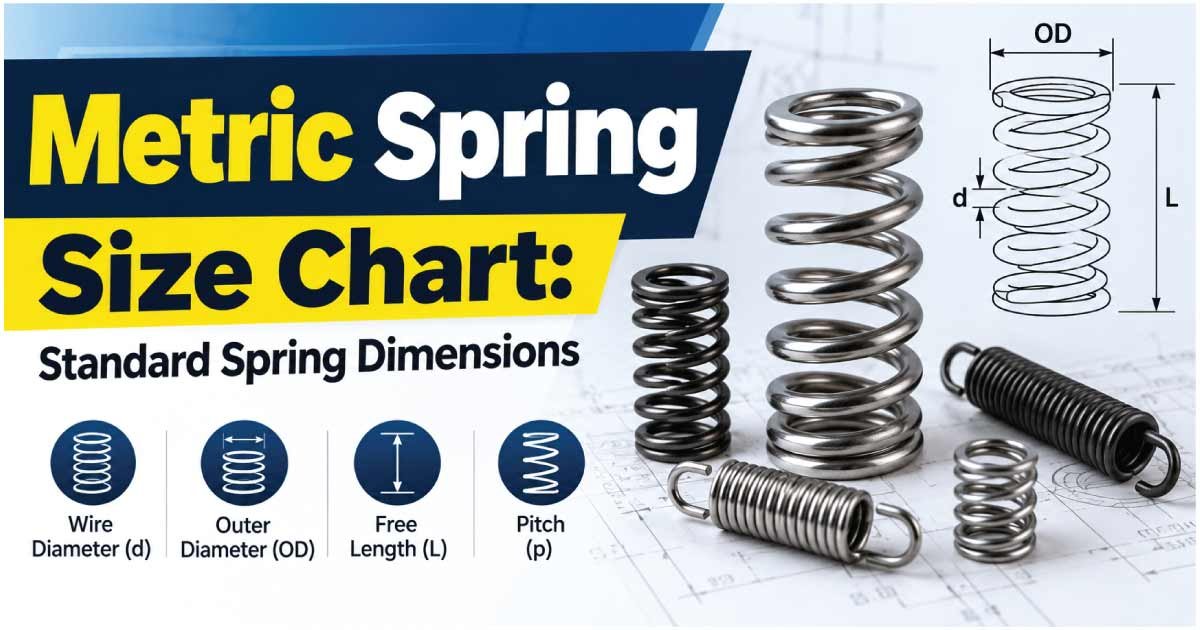
Choosing the correct spring is about much more than matching its outside diameter or overall length. A spring’s wire diameter, coil diameter, free length, active coils, spring index, end configuration, material, and spring rate all affect how it fits and performs.
This metric spring size chart guide explains the main dimensions used for compression, extension, and torsion springs, how to measure an existing spring, and how to interpret manufacturer specifications. It also explains an important point: there is no single universal metric spring size chart that applies to every spring. Dimensions depend on spring type, material, manufacturing method, load requirements, and the applicable standard.
For general spring terminology and technical documentation, ISO standards provide established terminology and representation methods, while specific standards cover particular spring types and applications. ISO 22705-1, for example, addresses measurement and test parameters for cold-formed cylindrical helical compression springs.
What Is a Metric Spring Size Chart?
A metric spring size chart organizes spring dimensions using millimeters (mm) and related engineering specifications. Instead of describing a spring only as “small” or “large,” a technical chart identifies the dimensions that determine its physical fit and operating characteristics.
For a typical cylindrical compression spring, the most important dimensions include:
- Wire diameter (d)
- Outside diameter (OD)
- Inside diameter (ID)
- Mean coil diameter (D)
- Free length (L)
- Solid height
- Total coils
- Active coils
- Spring index
- Pitch
- End configuration
- Spring rate or stiffness
A spring drawing or product specification may also identify winding direction, material, surface treatment, load, working length, and allowable tolerances.
The exact dimensions are not interchangeable. For example, two springs can have the same 20 mm outside diameter but behave very differently if one uses thicker wire, has fewer coils, or has a different free length.
Why Metric Dimensions Matter
Metric dimensions are especially important when a spring must fit into a metric bore, over a metric shaft, or into a machine designed around millimeter-based drawings.
A small dimensional difference can affect:
- Clearance inside a housing
- Clearance around a guide rod
- Available spring travel
- Installed load
- Coil stress
- Buckling behavior
- Solid height
- Fatigue performance
For this reason, spring selection should consider both physical dimensions and performance requirements.
Metric Spring Dimension Chart
The following chart shows the principal dimensions normally used when specifying a helical spring. These are dimension categories rather than universal standard sizes, because actual spring dimensions vary by design and manufacturer.
| Dimension | Symbol | Typical Unit | What It Means |
|---|---|---|---|
| Wire diameter | d | mm | Diameter of the spring wire |
| Outside diameter | OD | mm | Maximum outside diameter of the coil |
| Inside diameter | ID | mm | Open diameter inside the coil |
| Mean diameter | D | mm | Diameter measured approximately through the wire center |
| Free length | L₀ | mm | Length of the unloaded spring |
| Solid height | Ls | mm | Length when the coils are fully compressed |
| Pitch | p | mm | Axial distance between corresponding points of adjacent coils |
| Total coils | Nt | — | Total number of turns in the spring |
| Active coils | Na | — | Coils that contribute to spring deflection |
| Spring index | C | — | Mean coil diameter divided by wire diameter |
| Spring rate | k | N/mm | Force required per millimeter of deflection |
These measurements form the foundation of a metric spring dimension chart. However, they should not be interpreted as a universal list of available sizes.
Understanding the Main Spring Dimensions
Wire Diameter
Wire diameter is the thickness of the material used to manufacture the spring. It is one of the most important spring dimensions because it strongly influences spring stiffness and strength.
Measure the wire itself rather than measuring across the entire coil.
For an existing spring, a precision caliper or micrometer is preferred. Lee Spring recommends measuring wire diameter carefully and notes that greater measurement precision improves identification accuracy.
A larger wire diameter generally allows a spring to carry greater loads, but the actual result also depends on the coil diameter, number of coils, material, and design.
Outside Diameter
The outside diameter (OD) is the largest diameter across the outside of the spring coil.
OD is particularly important when the spring must fit inside a housing, sleeve, tube, or bore.
When measuring an existing spring, measure at several locations if possible. Coil diameter can vary slightly, so the largest relevant measurement may be important when checking available clearance.
Inside Diameter
The inside diameter (ID) is the open space inside the spring.
It becomes important when a spring fits over a shaft, guide rod, mandrel, or other component.
For a round-wire cylindrical spring, the basic relationship is:
ID = OD − 2d
where d is the wire diameter.
For example, if a spring has an OD of 30 mm and a wire diameter of 3 mm:
ID = 30 − (2 × 3) = 24 mm
This calculation is useful for checking geometry, but actual manufactured dimensions and tolerances should be confirmed from the spring drawing or manufacturer’s specification.
Mean Coil Diameter
Mean coil diameter, commonly represented by D, is the diameter measured approximately through the centerline of the spring wire.
For a round-wire spring:
D = OD − d
or
D = ID + d
Mean diameter is particularly important when calculating the spring index.
Free Length
Free length is the length of the spring when it is not subjected to an external load.
It is commonly identified as L₀.
Free length is not necessarily the working length. Once a compression spring is installed and compressed, its operating length becomes shorter.
When measuring a replacement spring, always measure it in its unloaded condition unless the manufacturer specifies another measurement condition.
Solid Height
Solid height is the approximate length of a compression spring when its coils are fully compressed against one another.
This dimension matters because the spring should not normally be selected simply by matching free length. The available working travel and required clearance must also be considered.
Active Coils
Active coils are the coils that contribute to the spring’s deflection.
They are not always equal to the total number of coils because the end configuration can make some coils inactive.
This distinction is important in spring calculations and specifications. Spring industry guidance treats number of coils, free length, wire diameter, spring diameter, squareness, parallelism, and bow as separate dimensional characteristics.
Spring Index and Why It Matters
The spring index (C) describes the relationship between mean coil diameter and wire diameter:
C = D / d
For example, if:
- Mean coil diameter = 24 mm
- Wire diameter = 3 mm
then:
C = 24 / 3 = 8
Spring index is useful because it provides a quick indication of the spring’s geometric proportions.
A very small spring index can make manufacturing and forming more demanding, while a very large index produces a relatively slender coil. The acceptable range depends on the spring design, manufacturing method, material, and applicable specification.
For example, ISO 11891:2012 specifies a spring-index range of 3 to 12 for the hot-formed helical compression springs within that standard’s scope. That range should not be treated as a universal requirement for every metric spring.
Metric Compression Spring Size Chart
Compression springs are probably the most common type considered when someone searches for a metric spring size chart. They are designed to resist compression and return toward their original length when the compressive load is removed.
There is no single universal list of metric compression spring sizes. Instead, manufacturers offer numerous combinations of diameter, length, wire size, coil count, material, and spring rate.
| Measurement | What to Record | Why It Matters |
|---|---|---|
| Wire diameter | mm | Affects strength and spring rate |
| Outside diameter | mm | Determines housing clearance |
| Inside diameter | mm | Determines shaft or guide clearance |
| Free length | mm | Establishes unloaded spring length |
| Solid height | mm | Determines minimum compressed length |
| Active coils | Number | Affects spring behavior |
| Total coils | Number | Identifies overall construction |
| End type | Description | Affects seating and working geometry |
| Material | Grade/type | Affects strength and environment suitability |
| Spring rate | N/mm | Defines force per unit deflection |
Commercial metric compression springs demonstrate how widely dimensions can vary. For example, a Lee Spring metric product may combine a 3 mm outside diameter with a 0.51 mm wire diameter, while another standard metric spring can have a much larger diameter and different coil arrangement.
These examples show why a single “standard size” should not be assumed from diameter alone.
Metric Extension Spring Dimensions
Extension springs are designed to resist pulling forces rather than compression.
Their dimensional requirements differ from compression springs because the ends normally include hooks, loops, or other attachment features.
Important dimensions can include:
- Wire diameter
- Outside diameter
- Body length
- Overall length
- Number of coils
- Hook or loop dimensions
- Hook orientation
- Initial tension
- Spring rate
The end geometry can be just as important as the body diameter. A spring may have the correct body dimensions but still be unsuitable if its hooks do not align with the application.
When replacing an extension spring, measure both the spring body and the attachment ends.
Metric Torsion Spring Dimensions
Torsion springs are designed primarily to produce rotational force or torque.
Their dimensions are therefore described differently from a compression spring.
Important specifications may include:
- Wire diameter
- Mean coil diameter
- Body length
- Number of coils
- Leg length
- Leg angle
- Winding direction
- Torque
- Angular deflection
The correct torsion spring cannot be selected from diameter and length alone. The required torque and angular movement are critical.
Spring industry testing guidance treats torsion spring dimensions and performance characteristics separately, including wire diameter, spring diameter, number of coils, winding direction, end relation, torque, and angular behavior.
Discover More:
How to Measure a Metric Spring
If you have an existing spring and need to identify a replacement, record as many dimensions as possible.
1. Measure the Wire Diameter
Use a micrometer or accurate caliper to measure the wire.
Avoid estimating wire diameter visually.
Record the measurement in millimeters and, if possible, take measurements at more than one location.
2. Measure the Outside Diameter
Measure across the outside of the coil.
If the spring diameter changes slightly from one location to another, record the relevant maximum dimension for fit purposes.
3. Measure the Free Length
Do not compress or stretch the spring while measuring its free length.
For a compression spring, place it in its unloaded condition and measure its overall length.
4. Measure the Inside Diameter
If the spring fits over a shaft or inside a housing, measure the internal opening.
This helps determine whether the replacement spring will maintain sufficient clearance.
5. Count the Coils
Count the total turns carefully.
Where the design requires it, distinguish active coils from inactive end coils.
Lee Spring’s measurement guidance recommends counting coils to the nearest eighth of a turn and also recording the spring’s winding direction and end type.
6. Identify the Ends
For compression springs, determine whether the ends are:
- Open
- Closed
- Ground
- Closed and ground
- Another specialized configuration
End geometry affects how the spring seats against its mating surfaces.
7. Record Material and Finish
If known, record the material and coating or surface treatment.
Material can be especially important when the spring operates in:
- High temperatures
- Corrosive environments
- Moisture
- High-cycle applications
- Chemically aggressive conditions
How to Choose the Correct Metric Spring Size
Correct spring selection requires more than finding a dimensionally similar spring.
Check the Installation Space
Determine the maximum allowable:
- Outside diameter
- Inside diameter
- Free length
- Installed length
- Solid height
A spring that is mechanically suitable but physically too large will not fit the assembly.
Determine the Required Load
For a compression spring, identify the force required at the intended working length.
Spring rate is commonly expressed in N/mm.
A spring with a rate of 5 N/mm changes load by approximately 5 N for each millimeter of deflection within its specified operating range.
However, the actual load at a given position depends on the spring’s design and operating condition.
Check Working Travel
Do not select a spring solely because its free length matches the old spring.
Determine how far the spring must compress or extend during normal operation.
The spring must have enough usable travel without being forced beyond its allowable operating limits.
Check Buckling Risk
Long compression springs can become unstable as they are compressed.
If the spring is relatively long compared with its diameter, consider whether a guide rod or sleeve is required.
The acceptable geometry depends on the spring design and application.
Confirm Material
A carbon-steel spring may be suitable for one environment while stainless steel or another alloy is preferable for another.
Material selection should account for temperature, corrosion, fatigue, strength, and manufacturing requirements.
Discover More:
Metric Spring Sizes vs. Standard Spring Sizes
The phrase “standard spring size” can be misleading.
A manufacturer may offer a standard product series with predefined metric dimensions, but that does not mean those dimensions constitute a universal international size chart.
For example, commercial manufacturers publish their own standard compression spring series with different combinations of outside diameter, free length, wire diameter, coil count, material, and spring rate.
A useful way to interpret spring sizing is:
| Term | Meaning |
|---|---|
| Metric spring | Dimensions are primarily specified using metric units |
| Standard spring | A commercially available or standardized design rather than necessarily a universal size |
| Custom spring | Manufactured to application-specific dimensions |
| Spring specification | Complete dimensional and performance requirements |
| Spring series | A manufacturer’s group of related standard springs |
When exact interchangeability is important, the manufacturer’s part number or drawing is generally more reliable than a generic size label.
Spring Standards and Technical Specifications
Different spring standards cover different products and applications. This is important because a standard that applies to one spring type should not automatically be applied to another.
ISO identifies 21.160 Springs as the classification area covering spring-related standards. Current standards include documents covering spring symbols, measurement and test parameters, hot-formed compression springs, disc springs, leaf springs, and other specialized spring applications.
For example:
ISO 11891:2012 covers hot-formed helical compression springs made from round-section steel bar and specifies characteristics, tolerances, manufacturing requirements, and tests.
ISO 22705-1:2021 addresses measurement and test parameters for cold-formed cylindrical helical compression springs.
ISO 22705-2:2023 covers cold-formed cylindrical helical extension springs.
ISO 22705-3:2024 addresses cold-formed cylindrical helical torsion springs.
ISO 26909:2009 provides spring vocabulary and terminology.
These standards demonstrate why a spring chart should always identify its scope rather than presenting one set of dimensions as suitable for every application.
Common Mistakes When Reading a Spring Size Chart
Using Outside Diameter Alone
Two springs with the same OD can have different wire diameters, free lengths, coil counts, materials, and spring rates.
Always compare the complete specification.
Confusing Free Length With Working Length
Free length is measured without an external load. Installed or working length may be substantially different.
Ignoring the Spring Rate
A spring can physically fit but provide the wrong force.
For functional replacement, spring rate and load requirements can be just as important as dimensions.
Ignoring End Configuration
Compression spring ends can be open, closed, ground, or specially formed. The wrong end configuration may prevent proper seating.
Assuming Metric Means Standardized
Metric measurement does not automatically mean that every spring follows one universal set of dimensions.
Always identify the relevant spring type and specification.
Ignoring Tolerances
Manufactured springs have dimensional and performance tolerances.
A nominal dimension such as 25 mm does not necessarily mean that every production spring measures exactly 25.000 mm.
Discover More:
Metric Spring Size Selection Checklist
Before ordering or designing a replacement spring, record the following:
- Spring type
- Wire diameter
- Outside diameter
- Inside diameter
- Mean diameter
- Free length
- Installed length
- Solid height, where applicable
- Active coils
- Total coils
- End configuration
- Winding direction
- Material
- Surface finish
- Required spring rate
- Required load
- Required travel
- Operating temperature
- Corrosion conditions
- Expected cycle life
- Applicable standard or manufacturer specification
The more of these characteristics you know, the less likely you are to select a spring that merely looks similar but performs differently.
Frequently Asked Questions About Metric Spring Sizes
What is the most important spring dimension?
There is no single most important dimension for every application. Wire diameter, coil diameter, free length, spring rate, working load, and travel can all be critical depending on the design.
Are metric springs measured in millimeters?
Yes. Metric spring specifications commonly use millimeters for physical dimensions and N/mm for spring rate, although manufacturers may provide additional units for convenience.
How do I calculate spring index?
Use:
Spring Index = Mean Coil Diameter ÷ Wire Diameter
For example, a 24 mm mean diameter with 3 mm wire has a spring index of 8.
Is there one universal metric spring size chart?
No. Spring dimensions vary by type, application, material, manufacturing process, and specification. Manufacturer catalogs and applicable standards should be used when an exact size is required.
How do I measure a compression spring?
Measure the wire diameter, outside diameter, inside diameter, free length, and number of coils. Also record the end configuration, winding direction, and material if known. These are among the key measurements recommended in professional spring identification guidance.
Does a larger wire diameter always mean a stronger spring?
Not necessarily. Wire diameter strongly affects spring behavior, but coil diameter, number of active coils, material, heat treatment, and operating conditions also affect load capacity and spring rate.
Conclusion
A useful metric spring size chart should do more than list diameters and lengths. The correct spring specification combines wire diameter, outside and inside diameter, mean diameter, free length, coil count, spring index, end configuration, material, spring rate, load, and working travel.
There is no single metric size range that applies to every spring. Compression, extension, torsion, hot-formed, cold-formed, and specialized springs can all follow different specifications.
For replacement work, measure the existing spring carefully and compare the complete set of dimensions and performance requirements. For new designs, use the appropriate spring standard, engineering calculations, and manufacturer documentation rather than relying on a generic size chart. This approach provides a much more reliable path to selecting a spring that fits correctly and performs as intended.